1. Catalogs
  2. JTEKT
  3. INSERT BEARING UNITS
video corpo

INSERT BEARING UNITS

INSERT BEARING UNITS
1 / 194 PagesView full catalog

INSERT BEARING UNITS

Product catalog summary
Overview: The document is a technical catalog for Koyo Insert Bearing Units, detailing their structure, features, types, and specifications. It includes technical descriptions, dimensional tables, and supplementary technical information to aid in the selection and use of these bearing units.
Key Sections:
  • Structure and Features: Koyo Insert Bearing Units are precision units with grease-sealed deep groove ball bearings and various housing forms. They are designed for easy installation and handling, featuring self-aligning mechanisms and superior sealing performance.
  • Types and Selection: The catalog lists various types of bearing units, including pillow block, square-flanged, rhombic-flanged, and round-flanged types, among others. It provides guidance on selecting the appropriate unit based on technical specifications and maintenance considerations.
  • Performance and Materials: The document discusses the performance characteristics of the bearings, including load capacity, rotational speed, and operating temperature. It also details the materials used in the bearings and housings, emphasizing their strength and durability.
  • Handling and Maintenance: Instructions for installation, test run inspection, periodic inspection, and grease supply are provided to ensure optimal performance and longevity of the bearing units.
  • Supplementary Tables: The catalog includes tables with technical data such as tightening torques, machining dimensions, and conversion factors, which are essential for the correct application and maintenance of the bearing units.
Critical Information: The catalog emphasizes the importance of selecting the correct bearing unit for specific applications, considering factors like load capacity, alignment, and environmental conditions. It also highlights the need for regular maintenance and proper installation to extend the service life of the bearings.
Specifications and Features: Koyo Insert Bearing Units are designed with advanced casting or press working techniques to ensure durability and longevity. The rigid housing eliminates abnormal loads, extending the bearing's service life. The surface finish maintains its condition over time, and the solid base pillow block housings reduce vibration significantly.
Installation and Handling: The units are easy to install on various machines with minimal effort, requiring only bolts. They do not need additional lubrication or sealing, reducing manpower requirements. Three methods are available for fixing the bearing to the shaft: set screw, adapter, and eccentric locking collar.
Variety of Types: Koyo offers a wide range of Insert Bearing Units to suit different applications and conditions. The units conform to JIS B1557 standards and are identified by a nominal number structure that includes bearing type, housing type, diameter series, bore diameter, and special codes.
Unit Numbering System: The numbering system includes codes for bearing type, housing type, diameter series, bore diameter, fitting, supplementary, and special features. Each code provides specific details about the unit's construction and application.
Types of Bearing Units: The document lists various types of Koyo Insert Bearing Units, including pillow block, square-flanged, rhombic-flanged, round-flanged, pressed steel housing, take-up, cartridge, hanger, and rubber clamping ring types. Each type is available in different configurations to accommodate specific shaft diameters and application requirements.
Applications: The units are suitable for a wide range of applications, including transmission devices, industrial equipment, cranes, conveyors, and more. The thick section pillow block type is particularly suited for environments with heavy loads, vibration, and impact.
Specifications: The document provides detailed specifications and applications for various types of bearing units, focusing on their construction, installation, and specific use cases. It highlights the compact and lightweight nature of pressed steel frames and the adjustability of shaft centers using adjuster bolts.
1. Specifications:
  • Pressed Steel Frame: Compact and lightweight, suitable for small belt conveyors with adjustable shaft centers.
  • Cartridge Type Units: Includes UCC and UKC series with cylindrical and tapered bores, respectively. These units are used for free side bearings in shafts that expand or contract.
  • Hanger Type Units: UCHA series with cylindrical bores, used as intermediate bearings in screw conveyors.
2. Insert Bearings for Units:
  • UC Type: Standard and triple-lip seal types, with stainless steel options for waterproof and anticorrosive needs.
  • UK Type: Tapered bore with adapter, suitable for long shafts.
  • NA Type: Features an eccentric locking collar for secure shaft attachment.
  • SB and SA Types: Lightweight options with set screws and eccentric locking collars.
  • SU Type: Compact series for light loads, available in stainless steel for corrosion resistance.
  • ER and RB Types: Variants of deep groove ball bearings with and without lubricating mechanisms.
3. Units for Special Use:
  • Triple-lip Seal Unit: Provides enhanced dust and water resistance.
  • Units with Cover: Offers double sealing for harsh environments.
  • Heat and Cold Resistant Units: Designed for extreme temperature ranges.
  • High Speed and Blower Units: Optimized for high-speed, low-torque applications.
  • Compact and Stainless-series Units: Focus on downsizing and waterproof performance for food machinery.
4. Selection of Units:
  • Outline of Selection: Factors such as machinery structure, operating conditions, and economic efficiency are crucial for selecting the optimal bearing unit.
  • Selection Procedures: Includes steps for choosing the type, shaft diameter, environmental considerations, temperature resistance, installation methods, and maintenance requirements.
Selection of Insert Bearing Unit Types and Specifications:
  • Performance Requirements: The document outlines various performance requirements for insert bearing units, including operating conditions, fixing to shaft, sealing structure, and lubrication types. Different types of bearings such as UC, UK, and NA are specified for various applications.
  • Housing Specifications: Housing types are categorized based on material, presence of cover, and lubrication. Options include cast iron, stainless steel, and pressed steel, with specific applications for each type.
Maintenance Considerations:
  • Insert bearing units generally do not require maintenance under standard conditions but should be periodically checked in critical applications or harsh environments.
  • Factors such as vibration, axial load, and environmental conditions (e.g., dust, temperature) should be considered when selecting bearing units to minimize maintenance needs.
Life of Bearing:
  • The life of an insert bearing unit is determined by the fatigue of bearing material and grease degradation. The shorter of the two defines the unit's life.
  • Basic rating life and load are defined, with calculations provided for determining the expected life under various conditions.
Calculation of Rating Life:
  • Equations are provided to calculate the basic rating life and modified rating life, considering factors such as load, speed, and environmental conditions.
  • Temperature corrections are necessary for high-temperature applications, with specific factors provided for adjustments.
Modified Rating Life:
  • The modified rating life accounts for reliability, lubrication status, and environmental influences, using factors like aISO and a1 for adjustments.
  • Standardized methods for calculating modified rating life are based on ISO and JIS standards.
Service Life of Bearing System: The service life of a bearing system comprising multiple bearings is determined by the shortest lifespan among them. If one bearing fails, the entire system is compromised. The service life can be calculated using a specific equation that considers the rating life of each bearing and a constant based on the type of bearing (ball or roller).
Contamination Factor: The contamination factor (ec) affects the lifespan of bearings. It varies based on the cleanliness level of the lubricant, with values provided for different contamination levels and bearing sizes. High contamination reduces bearing life due to increased stress from indentations caused by particles.
Fatigue Load Limit: The fatigue load limit (Cu) is the load under which the fatigue stress limit is reached. It depends on the material quality and manufacturing quality of the bearings. High-quality materials have a higher fatigue stress limit.
Viscosity Ratio: The viscosity ratio (κ) is the actual kinematic viscosity at operating temperature divided by the reference kinematic viscosity. It indicates the status of the lubricant oil film separating the raceway and rolling elements.
Recommended Service Life: The recommended service life of insert bearing units varies based on operating conditions and application type. For example, bearings in electric power plants have a recommended service life of 100,000 to 200,000 hours.
Grease Life: Grease life is influenced by load, rotational speed, and operating temperature. An equation is provided to calculate grease life under appropriate conditions, with specific parameters and conditions outlined.
Load Factors: Load factors account for additional loads due to vibration and impact. Different factors are provided for various operating conditions and transmission types (belt, chain, gear).
Dynamic Equivalent Load: The dynamic equivalent load is used to compare actual bearing loads with the basic dynamic load rating. It accounts for fluctuating loads and is calculated using radial and axial load factors.
Dynamic Equivalent Load: The document outlines the calculation of dynamic equivalent loads (P1, P2, ..., Pn) for bearings operating at various rotational speeds (n1, n2, ..., nn) over specific time periods (t1, t2, ..., tn). It also defines the minimum (Pmin) and maximum (Pmax) dynamic equivalent loads and the total rotating frequency (Σniti).
Basic Static Load Rating and Static Equivalent Load: The basic static load rating is the static load that causes a specific contact stress at the center of the raceway contact surface. Different types of bearings have different stress levels: self-aligning ball bearings (4,600 MPa), other ball bearings (4,200 MPa), and roller bearings (4,000 MPa). The static equivalent load is a virtual load that generates the same contact stress as the actual load conditions when the bearing is stopped or at low speed.
Safety Factor: The safety factor (fs) is used to assess the safety of the basic static load rating, considering conventional experiences. It varies based on operating conditions, with recommended minimum values provided for different scenarios.
Examples of Applied Calculations: Several examples illustrate how to calculate loads on bearings under different conditions, such as distributing loads, V-belt transmission, and dynamic equivalent radial load calculations. These examples provide step-by-step calculations for determining the loads applied to bearings and selecting appropriate bearing units.
Allowable Rotational Speed: The allowable rotational speed is the maximum speed at which a bearing can operate without generating excessive heat. It depends on the bearing's dimensions, oil seal type, and fitting conditions. A table provides standard allowable rotational speeds for various bearing types.
Operating Temperature and Bearing Specifications: The operating temperature range of a bearing unit is influenced by the type of grease, oil seal material, and internal clearance. Special series are available for heat and cold resistance, and grease must be applied according to specified standards to ensure optimal performance.
Operating Temperature and Internal Clearance of Bearing: The document discusses the impact of high temperatures on bearing performance, specifically how heat can reduce the internal clearance of bearings, potentially leading to early breakage. It provides an equation (8.1) to calculate the decrease in internal clearance based on temperature differences between the bearing's inner and outer rings. Proper selection of internal clearance is emphasized for high-temperature applications, and the need for axial movement in the shaft or unit is highlighted as a countermeasure.
Strength of Housing: The strength of the housing for Koyo Insert Bearing Units is addressed, noting that while the housing is designed for standard conditions, it must be evaluated for strength under great or impact loads. The document details the static destruction strength of various housing types (pillow block, flange, take-up) and provides safety factors for different materials like gray cast iron, steel, stainless steel, and zinc alloy die-cast. Tables and figures illustrate the static destruction strength and recommended safety factors.
Design of Shaft and Base: The design section emphasizes selecting a shaft with adequate rigidity and proper tolerance to ensure optimal performance and longevity of the bearing unit. It provides guidelines for shaft tolerance based on different bearing types and conditions, including cylindrical bore bearings with set screws and tapered bore bearings. The document also discusses countermeasures against heat, recommending positioning strategies for bearing units to accommodate thermal expansion and prevent premature bearing failure.
Specifications and Procedures: The document outlines the expansion of shafts due to heat exposure, specifying the linear expansion coefficient for standard steel and the formula for calculating shaft expansion. It provides countermeasures for shaft expansion, including the installation of a full dog point set screw on the free side to allow axial movement. The document also discusses the use of cartridge type units for high-speed or vibration-prone environments.
Design Recommendations: The design of the base is crucial, with emphasis on rigidity and flatness to prevent vibration and noise. The document recommends specific tolerance classes for mounting bores and provides detailed tables for dimensions and tolerances.
Standards and Tolerances: Tolerances for insert bearing units are specified according to JIS standards. The document includes tables detailing tolerances for inner and outer rings, as well as permissible values for chamfer dimensions. It also covers the tolerances of housing and spherical bearing seat diameters.
Internal Clearance: The internal clearance of insert bearings is critical for performance, affecting fatigue life, heat, noise, and vibration. The document provides tables for internal clearance applicable to different types of insert bearings, including standard, stainless steel, heat-resistant, and high-speed types.
Key Tables and Figures: - Table 10.7: Dimensions of key groove for full dog point set screw. - Table 10.8: Tolerance of cylindrical bore for mounting cartridge type unit. - Table 11.1 to 11.4: Tolerances for inner and outer rings of insert bearings. - Table 11.6: Tolerances of spherical bearing seat diameter of housing. - Table 11.8 and 11.9: Internal clearance values for insert bearings.
Figures illustrate the structure examples of bearing units and recommended values for flatness of mounting surfaces.
Specifications: The document provides detailed specifications for radial internal clearance of bearings, conforming to JIS B 1558 standards. It includes tables showing nominal bearing bore diameters, measured loads, and corrections of clearance in micrometers.
Materials: The materials section outlines the composition and properties of materials used in insert bearings and housings. Bearing rings and rolling elements are made from high carbon chromium bearing steel, while cages are made from pressed steel. The document emphasizes the need for high elastic limits, rolling fatigue strength, hardness, wear resistance, toughness, and dimensional stability. It also details the chemical compositions of various steels used.
Performance: The performance section discusses friction torque and temperature increase in bearings. Friction torque is influenced by type, dimensions, load, rotational speed, and lubrication conditions. The document provides equations for calculating friction torque and discusses the impact of oil seals on performance. Temperature increase is related to friction torque and environmental conditions, with graphs illustrating typical temperature changes during operation.
Dustproof and Waterproof Performance: Tests are conducted to evaluate the dustproof and waterproof performance of insert bearing units. Results show that triple-lip seal and covered types offer superior dust prevention compared to standard types. Waterproof tests indicate that rust formation is delayed in triple-lip seal and covered types.
Handling: The handling section provides guidelines for installing insert bearing units with set screws. It describes different types of set screws, such as Bullet Point, Pointed, and Full Dog Point, and their applications. Installation procedures emphasize checking the rigidity of the base, flatness of the mounting surface, and ensuring the set screw does not exceed the bearing bore diameter.
Installation Procedures:
  • General Guidelines: Avoid using a hammer on the bearing inner ring. Use an air bath to warm the bearing unit for shrink-fitting. Ensure proper handling to prevent premature breakage.
  • Unit with Set Screws: Tighten the set screws with specified torque. For environments with impact or vibration, grind the shaft surface for better tightening effect.
  • Unit with Adapter: Use an adapter assembly for tapered bore bearings. Ensure proper tightening of the locknut to avoid slippage or excessive expansion.
  • Unit with Eccentric Locking Collar: Fit the eccentric section properly and tighten the set screw to secure the bearing.
  • Unit with Cover: Apply grease to the seal lip and internal space. Install covers after the bearing and housing are in place.
Test Run Inspection:
  • Ensure smooth rotation by hand. Check for abnormal noise, vibration, and temperature during power run.
  • Common faults include excessive torque, abnormal noise, and temperature increase, often due to faulty installation or excessive tightening.
Periodic Inspection:
  • Check appearance, looseness, vibration, noise, and temperature. Address any faults immediately to prevent further damage.
  • Main faults include excessive torque, abnormal noise, and temperature increase, often due to degraded grease or interference issues.
Grease Supply:
  • Grease life is long under standard conditions, but periodic supply is necessary in harsh environments.
  • Supply intervals should be 1/4 to 1/3 of calculated grease life. Avoid excessive greasing to prevent abnormal heat or leaks.
Greasing Recommendations: To enhance dust prevention, it is recommended to use double the amount of grease specified in Table 14.5. For UK type bearings, the same table applies. For triple-lip seal types, 1.5 times the table values are recommended. The values are based on standard grease with a specific gravity of 0.9 g/ml; adjustments should be made for greases with different specific gravities.
Table 14.5 - Greasing Amounts: This table provides recommended greasing amounts for insert bearing units based on bore diameter codes and diameter series (UC200, UCX00, UC300). The amounts range from 0.7g for smaller diameters to 151g for larger diameters.
Greasing Intervals: Table 14.4 outlines recommended greasing intervals based on operating temperature and environmental conditions (clean, dusty, muddy). Intervals vary from 1 year for clean environments at lower temperatures to 1 day for muddy conditions at higher temperatures. Adjustments are necessary for operations outside the standard 8-10 hours per day.
Types of Grease: It is crucial to use the same type of grease as initially packed to avoid performance degradation. Mixing different soap base greases can significantly reduce lubrication effectiveness.
Supplying Grease: Grease should be supplied using the grease nipple and gun, ensuring cleanliness to prevent contamination. If standard grease nipples are unsuitable, alternatives like type B or C are available. For centralized lubrication, soft grease with specific consistency is recommended, and piping should be appropriately configured.
Replacing Bearings: The document outlines procedures for replacing bearings in Koyo Insert Bearing Units, emphasizing compatibility and step-by-step instructions for removal and installation.
Specification Tables: Detailed specifications for various types of insert bearing units are provided, including pillow block, square-flanged, rhombic-flanged, round-flanged, pressed steel housing, take-up, and other units. Each type includes dimensions, load ratings, and variations.
Overview: This document provides detailed technical specifications for various types of pillow block bearings, including dimensions, load ratings, and part numbers. It includes information on different series such as UKIP, UCPA, UCPH, BLP, ALP, and UP, along with their respective housing and bearing numbers.
Specifications:
  • Dimensions: The document lists dimensions for each bearing type, including bore diameter, housing dimensions, and bolt sizes. For example, the UKIP series covers bore diameters from 35 mm to 125 mm.
  • Load Ratings: Basic load ratings (Cr, C0r) and fatigue load limits (Cu) are provided for each bearing type, indicating their capacity to withstand operational loads.
  • Material: Housings are available in spheroidal graphite iron casting, and some series offer stainless steel options.
Procedures and Recommendations:
  • Fitting Codes: Part numbers include fitting codes that follow bore diameter numbers, essential for identifying the correct bearing and housing combinations.
  • Grease Nipples: Specific part numbers for applicable grease nipples are provided, such as A-1/4-28UNF for certain series.
  • Seal Types: Triple-lip seal type products are identified with supplementary codes (L3 or L2) following the part number.
Tables and Data:
  • Dimensional Tables: Detailed tables provide dimensions and forms of applicable bearings and adapters, crucial for assembly and installation.
  • Tolerance Variations: Variations in tolerance for distances from mounting bottom to center of spherical bore and between bolt holes are specified, ensuring precise installation.
Remarks:
  • Part numbers for units with covers and adapters are explained, with examples provided for clarity.
  • Special notes on housing materials and additional product types, such as tapered bore products, are included.
Overview: This document provides detailed specifications and data for various types of insert bearings used in mechanical units. It includes measurements, load ratings, and other critical parameters necessary for selecting the appropriate bearing for specific applications.
Specifications: The document lists dimensions in both metric and imperial units, including shaft diameter, bearing dimensions, and set screw sizes. It also provides load ratings, including basic load ratings (Cr, C0r) and fatigue load limits (Cu).
Product Types: The document categorizes bearings into different series such as UC, UCX, and SU, with variations like L3 and S6 indicating specific features like stainless steel construction or compact design.
Key Features: - Bearings are available with different locking mechanisms, including set screws and eccentric locking collars. - Some series are designed for specific applications, such as the SU type for compact units and the S6 series for stainless applications.
Load and Fatigue Ratings: Detailed tables provide load ratings in kilonewtons (kN) for each bearing type, essential for determining the suitability of a bearing under specific operational conditions.
Remarks: - SU type products are compact series insert bearings. - Bearings from UC201 to UC205 feature double-lip seals. - Bearings with lock pins are categorized as H or J fittings depending on the series number.
Applications: The document is intended for engineers and technicians involved in the selection and maintenance of mechanical systems requiring precise bearing specifications.
Specifications: The document provides detailed specifications for various adapter assemblies and insert bearings. It includes part numbers, dimensions, load ratings, and mass for different series such as H2311X, HE2311X, and others. The specifications cover shaft diameters ranging from 20 mm to 125 mm, with detailed measurements for each part.
Procedures: The document outlines the procedure for selecting the correct adapter series for the UK200 series, specifying that the H2300X series is applicable. It also mentions the availability of inch bore diameter series adapters and the use of lock pin types for H fittings.
Norms and Standards: It adheres to specific dimensional standards for tapered bore and cylindrical bore bearings, ensuring compatibility and performance. The document also specifies the use of set screws and lock nuts for securing the bearings.
Recommendations: Recommendations include using the correct part numbers for unit assemblies and ensuring compatibility with the specified adapter series. It also advises on the use of double-lip seal type products for certain applications.
Key Data from Tables: The tables provide comprehensive data on dimensions, load ratings, and mass for each bearing and adapter assembly. For example, the H2311X series has a shaft diameter of 50 mm, a load rating of 71.6 kN, and a mass of 2.05 kg. The tables also list part numbers for pressed steel covers for various shaft diameters.
Critical Information: Critical information includes the importance of matching part numbers with the correct adapter series and the availability of different types of seals and fittings. The document emphasizes the need for precise measurements and compatibility to ensure optimal performance.
Contact Information: This document provides contact details for various JTEKT Corporation offices worldwide, including locations in Indonesia, Singapore, Japan, Korea, China, Australia, the Netherlands, Sweden, the United Kingdom, Germany, France, Spain, Italy, and Romania. Each entry includes the office address, telephone, and fax numbers.
Publisher Information: The document is published by JTEKT Corporation, with head offices located in Nagoya and Osaka, Japan. Contact details for these offices are provided.
Disclaimer: The catalog's contents are subject to change without notice. While efforts have been made to ensure accuracy, JTEKT does not assume responsibility for errors or omissions. Reproduction of the catalog without written consent is prohibited.
See more

Catalog excerpts

INSERT BEARING UNITS-1

INSERT BEARING UNITS The contents of this catalog are subject to change without prior notice. Every possible effort has been made to ensure that the data herein is correct; however, JTEKT cannot assume responsibility for any errors or omissions. INSERT BEARING UNITS Reproduction of this catalog without written consent is strictly prohibited.

 Open the catalog to page 1
INSERT BEARING UNITS-2

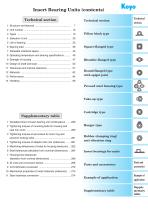
Technical section Pillow block type Square-flanged type Rhombic-flanged type Round-flanged type with spigot joint Pressed steel housing type Take-up type Cartridge type Hanger type Rubber clamping ring/ anti vibration ring 5 Machining dimensions of holes for housing dowel pins ... 262 6 Shaft tolerances (deviation from nominal dimensions) ... 264 Insert bearings for units Supplementary table Supplementary table

 Open the catalog to page 2

INSERT BEARING UNITS-3

INSERT BEARING UNITS

 Open the catalog to page 3
INSERT BEARING UNITS-5

Publication of New Insert Bearing Units Catalog In recent years, needs in industrial world for machineries and equipment highly developed in all aspects have been increased more than ever. Therefore, high technology covering from superior technical advantages including longer service life and maintenance free to higher reliability even under extraordinary conditions such as high and low temperatures and rotation at a high speed is required for insert bearing units. This catalog completely includes results of technical examinations and abundant research and development. In the first half of this...

 Open the catalog to page 5
INSERT BEARING UNITS-6

Insert Bearing Units 13.3 Dustproof and waterproof performance ... 65 7 Allowable rotational speed

 Open the catalog to page 6
INSERT BEARING UNITS-9

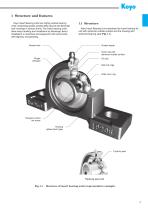
1 Structure and features Koyo Insert Bearing Units are highly precise bearing units comprising grease sealed deep groove ball bearings and housings in various forms. The insert bearing units allow easy handling and installation by followings: direct installation to machines and equipment with some bolts, self-aligning, and greasing. Grease hole 1.1 Structure Koyo Insert Bearing Unit comprises the insert bearing for unit with spherical outside surface and the housing with spherical bearing seat (Fig. 1.1). Grease nipple Outer ring with spherical outside surface Flinger (Slinger) Oil seal Ball...

 Open the catalog to page 9
INSERT BEARING UNITS-10

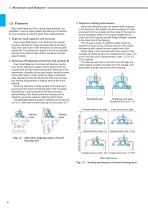
1.2 Features Koyo Insert Bearing Units, having many features, are available in various types. Select the bearing unit optimal for your purpose among the types with unique features. 1 Supreme load capacity and accuracy Koyo Insert Bearings for unit, featuring the internal structure identical to single row deep groove ball bearings, bear axial load in both directions, as well as great radial load. The tolerance is equal to that of an standard bearing. They feature high rotation accuracy and high speed rotation. 2 Rational self aligning mechanism and optimal fit Koyo Insert Bearing Units have self...

 Open the catalog to page 10
INSERT BEARING UNITS-11

4 Simple greasing Because of the grease nipple on the housing of Koyo Insert Bearing Unit, fresh grease can be easily supplied to the bearing being operated. If the bearing is used in severe environments that are exposed to many dusts or high humidity or that is high temperture, supply fresh grease at a regular interval. Then, the lubrication status of the bearing is kept to the best, and the service life of the bearing can be extended. When greasing to the bearing unit with the centralized lubricating system, use the socket for lubricating installed to the grease nipple tapped hole on the housing....

 Open the catalog to page 11
INSERT BEARING UNITS-12

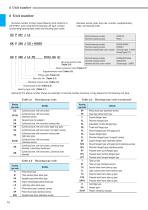
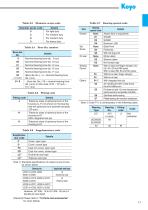
2 Unit number Nominal number of Koyo Insert Bearing Unit conform to JIS B1557, and comprise the bearing unit type number (comprising bearing type code and housing type code), diameter series code, bore dia. number, supplementary code, and special code. Nominal bearing number Nominal housing number Nominal bearing number UK209+H309X Nominal housing number P209JE1 Nominal pressed steel cover number (Through type) C-9x40 (Closed type) D-9 Nominal bearing number Nominal housing number Nominal cast iron cover number Housing special code (Table 2.8) Bearing special code (Table 2.7) Supplementaly code...

 Open the catalog to page 12
INSERT BEARING UNITS-13

Diameter series code For light duty For medium duty For medium duty For heavy duty Diameter series code Details Nominal bearing bore dia. 8 mm Nominal bearing bore dia. 10 mm Nominal bearing bore dia. 12 mm Nominal bearing bore dia. 15 mm Nominal bearing bore dia. 17 mm (Bore dia. No.) × 5 = Nominal bearing bore dia. (mm) − (bore dia. No.) /16 = nominal bearing bore dia. (inch) (in this case, 8/16 = 1/2 inch = 12.7 mm) Item Grease Sealing Device Fitting code Fitting code Tolerance class of spherical bore of the housing is J7 (not shown on the bearing that the spherical bore diameter exceeds 120...

 Open the catalog to page 13
INSERT BEARING UNITS-14

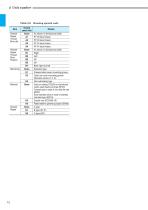
Table 2.8 Item Grease Nipple Thread Bore dia. Grease Nipple Thread Bore Position Grease Nipple Housing special code Details As shown in dimensional table PT1/8 tube thread PF1/8 tube thread PT1/4 tube thread PF1/4 tube thread As shown in dimensional table Right Left 45º 30º Both right and left Standard type Pressed steel cover mounting groove Cast iron cover mounting groove (diameter series 2, X, 3) Non-lubricating type Gray iron casting (FC200) or cold-reduced carbon steel sheets and strips (SPCC) Compact type is made of zinc alloy die-cast (ZDC2) Small stainless series is made of stainless...

 Open the catalog to page 14
INSERT BEARING UNITS-15

3 Types 3.1 Type list Koyo Insert Bearing Units are available in various types. Table 3.1 Type 1 Pillow block type (1) Standard Table 3.1 and Table 3.2 show the types of Koyo Insert Bearing Units and insert bearing for unit. Koyo Insert Bearing Units types Bearing bore dia. Surface (fixing to shaft) Type code Dimension table Cylindrical bore (with set screws) Cylindrical bore (with eccentric locking collar) Tapered bore (with adapter) Cylindrical bore (with set screws) Tapered bore (2) Thick section type (with adapter) Cylindrical bore (with set screws) (4) Higher centerheight type Cylindrical...

 Open the catalog to page 15
INSERT BEARING UNITS-16

Koyo Insert Bearing Units types (continued) Bearing bore dia. Surface (fixing to shaft) Type 6 Take-up type Type code Dimension table Cylindrical bore (with set screws) Tapered bore (with adapter) Cylindrical bore (with set screws) (3) Section steel frame type Cylindrical bore (with set screws) (4) Channel steel frame type Cylindrical bore (with set screws) UCTL UCTU (5) Pressed steel frame type Cylindrical bore (with set screws) Cylindrical bore (with set screws) Tapered bore (with adapter) Cylindrical bore (with set screws) 9 Rubber clamping ring type Cylindrical bore (with set screws) SBNPTH...

 Open the catalog to page 16

All JTEKT catalogs and technical brochures

  1. ONI Flyer

    2  Pages

  2. catb2018e

    272  Pages

*Prices are pre-tax. They exclude delivery charges and customs duties and do not include additional charges for installation or activation options. Prices are indicative only and may vary by country, with changes to the cost of raw materials and exchange rates.