


CERAMIC & EXSEV BEARINGS

CERAMIC & EXSEV BEARINGS
- Ceramic Bearings: Made from materials like silicon nitride, zirconia, and silicon carbide, these bearings are non-magnetic, insulating, and heat-resistant, suitable for high-speed and high-temperature applications.
- Special Steel Bearings: Used with ceramic components to enhance performance in specific environments.
- Includes grease and solid lubricants tailored for EXSEV bearings to ensure optimal performance in extreme conditions.
- Guidelines for selecting bearings based on environmental conditions such as clean, vacuum, high temperature, and corrosive environments.
- Details on non-magnetic, insulating, and high-speed bearings designed for specific applications.
- Illustrates the use of these bearings in various environments, including clean rooms, vacuum, high temperature, corrosive, magnetic, and electric fields.
- Includes tables for shaft tolerances, housing bore tolerances, and conversion factors, providing essential data for engineers and designers.
- Mechanical Properties: Silicon nitride is highlighted for its superior load-carrying capability and service life compared to other ceramic materials.
- Rolling Fatigue Tests: Silicon nitride shows the highest fatigue strength, making it the preferred material for high-performance applications.
- Solid Lubricants: Superior in heat resistance and load carrying capability, suitable for high temperature applications.
- Layer Lattice Materials: Not recommended for clean environments due to high particle emissions.
- Polymeric Materials: Coated on cages or bearing rings, ideal for clean or corrosive environments due to low dependency on ambient conditions.
- Fluorinated Greases: Useful for high temperature and vacuum applications, known for low evaporation pressure and particle emissions.
- Solid Lubricants: Include soft metals and layer lattice materials, with varying particle emissions and applications.
- Service life of bearings is influenced by operating conditions and can be estimated using specific equations provided for different materials.
- Clean Environments: Use stainless steel bearings with low particle emission lubricants.
- Vacuum Environments: Selection depends on cleanliness requirements; fluorinated grease is preferred for non-critical cleanliness.
- High Temperature Environments: Use hybrid ceramic or full ceramic bearings for temperatures above 500°C.
- Special Steels: SUS630 offers better corrosion resistance than SUS440C.
- Ceramic Materials: Silicon nitride is standard but may corrode in highly corrosive conditions; alternatives include zirconia or silicon carbide.
- Dynamic Equivalent Load: Pr = XFr + YFa, where X and Y are coefficients.
- Static Equivalent Load: P0r = 0.6Fr + 0.5Fa, with conditions for when P0r is smaller than Fr.
- Permissible Radial Load and Limiting Speed: Detailed for each bearing type, with specific values provided in tables.
- Basic Load Ratings: Provided in kN with factors Cr, C0r, and f0.
- Ceramic Bearings: Suitable for ultrahigh temperature environments, often used in kilns and furnaces.
- Hybrid Ceramic Bearings: Used in semiconductor and chemical processing systems, featuring corrosion resistance and water compatibility.
- Stainless Steel Bearings: Lubricated with KHD grease, suitable for slightly corrosive environments like chemical and conveyor systems.
- Temperature Range: Varies by bearing type, with some suitable for -100 to 500°C.
- Pressure Conditions: Bearings are designed for atmospheric to ultrahigh vacuum environments.
- Material Composition: Includes silicon nitride ceramic, stainless steel, and fluoropolymer lubricants.
- Bearings are available from stock or with specified lead times.
- Color coding in tables indicates delivery periods.
- Service life and performance are influenced by environmental conditions and material wear.
1. Track Rail Installation:
Position the mounting reference plane of the track rail correctly to the bed's reference plane. Temporarily fasten the track to the bed using a small vice or suitable tool to ensure close contact. Securely tighten the bolts one by one to fasten the drive side track rail to the bed. The driven side track rail should remain temporarily fastened.
Position the slide units on the table, align them with the drive side slide units, and fasten them together. One driven side slide unit should be fixed, while the other remains loosely tightened.
Before securing the driven side track rail, ensure smooth motion by moving the table. Tighten the fastening bolt step-by-step as the slide unit passes over it. Securely fasten the slide unit to the table.
The document provides detailed dimensions and specifications for various linear motion bearing units, including the LWHS and LWES series. It includes measurements for assembly, slide units, track rails, and static bending moment ratings.
These units consist of two raceway bases with V-shaped rolling surfaces and cylindrical rollers. They enable smooth and accurate linear motion. The document outlines the materials used, such as martensitic and austenitic stainless steel, and coatings like KDL grease and molybdenum disulfide.
Ensure components are free from oil stains and contamination. Clean the mounting surfaces and remove any irregularities. Temporarily fasten the raceway bases, adjust preload using the preload adjustment screws, and ensure even torque application. The document provides a table for screw tightening torque values.
Maintain cleanliness and avoid mixing components from different sets. Adjust preload screws to eliminate clearance and ensure even preload distribution. Follow specified torque values for different screw sizes.
The document provides detailed instructions for adjusting preload screws in a cross roller way bearing unit. It emphasizes the importance of applying torque close to the specified value and checking the smooth movement of the table without noise. Running accuracy is verified using a dial gauge.
The document includes extensive tables detailing the specifications of various CRW series bearings, including dimensions, mass, and load ratings. It provides information on the boundary dimensions and mounting dimensions for different models, highlighting the importance of precise measurements for optimal performance.
These bearings are optimized for high-speed performance in machine tool spindles. They offer reduced temperature increases and higher speed limits compared to conventional products. The document suggests referring to specific JTEKT catalogues for detailed specifications.
Ceramic balls, made from silicon nitride, offer excellent resistance to wear, heat, and corrosion. They are lightweight and non-magnetic, making them suitable for various applications, including high-grade bicycle parts and automotive components.
The document outlines the tolerance and internal clearance specifications for ceramic bearings, providing detailed tables for inner and outer ring dimensions and radial internal clearances. It emphasizes the importance of precise measurements to ensure optimal bearing performance.
Catalog excerpts

CERAMIC BEARINGS BEARINGS EXTREME SPECIAL ENVIRONMENTS TM This catalog has been printed on paper of recyceled paper pulp using environmentally friendly soy ink. CERAMIC BEARINGS AND EXSEV BEARINGS FOR EXTREME SPECIAL ENVIRONMENTS FOR CERAMIC BEARINGS AND BEARINGS AND CAT. NO. B2004E Printed in Japan '08.12-2CDS ('05.06) FOR EXTREME SPECIAL ENVIRONMENTS CAT. NO. B2004E
Open the catalog to page 1
û JTEKT CORPORATION does not export its products and engineering know-how unless in compliance with the Foreign Exchange and Foreign Trade Control Act and other applicable trade-related regulations, if they are so covered by such act and regulations. Accordingly, please contact our branch office or sales office if you intend to export any product described in this catalogue. CERAMIC BEARINGS AND EXSEK BEARINGS FOR EXTREME SPECIAL ENVIRONMENTS it The contents of this catalogue are subject to change without prior notice. We took special care in preparing the contents of this catalogue. JTEKT does...
Open the catalog to page 2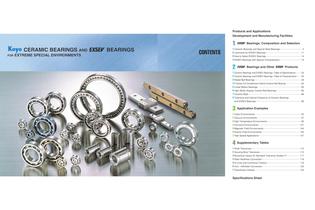
Koyo CERAMIC BEARINGS AND EXSEV BEARINGS FOR EXTREME SPECIAL ENVIRONMENTS Development and Manufacturing Facilities EXSEV Bearings: Composition and Selection 2 EXSEV Bearings and Other EXSEV Products 8 Tolerance and Internal Clearance of Ceramic Bearings Specifications Sheet
Open the catalog to page 3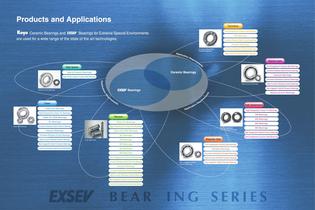
Products and Applications Corrosive Ceramic Bearings and Full Complement Ceramic Ball Bearings Bearings for Extreme Special Environments SK Bearings are used for a wide range of the state of the art technologies. Corrosion Resistant Hybrid Ceramic Bearings Ceramic Bearings Corrosion Resistant Ceramic Bearings Corrosion Resistant Ceramic Bearing App li c a High Corrosion Resistant Ceramic Bearings ti o nR e High Speed qu ir e m en ts Electric field Full Complement Ceramic Ball Bearings Corrosion Resistant Hybrid Ceramic Bearings Ceramic Bearings Hybrid Ceramic Bearings Ceramic Bearings High Ability...
Open the catalog to page 4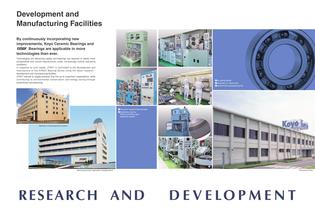
Manufacturing Facilities improvements, Koyo Ceramic Bearings and EXSEV Bearings are applicable in more technologies than ever. Technologies are advancing rapidly and bearings are required to satisfy more complicated and varied requirements under increasingly hostile operating In response to such needs, JTEKT is committed to the development and manufacture of the EXSEV Bearing Series using the latest research / development and manufacturing facilities. JTEKT intends to supply products that live up to customers' expectations, while contributing to environmental conservation and energy saving through...
Open the catalog to page 5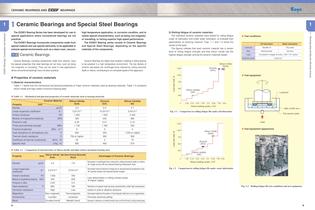
CERAMIC BEARINGS AND EXSEV BEARINGS 1 Ceramic Bearings and Special Steel Bearings The EXSEV Bearing Series has been developed for use in special applications where conventional bearings are not The EXSEV Bearings incorporate components made from special material and use special lubricants, to be applicable in extreme special environments such as a clean room, vacuum, Ceramic Bearings Ceramic Bearings, including components made from ceramic, have the special properties that steel bearings do not have, such as being non-magnetic or insulating. They can be used in new applications where conventional...
Open the catalog to page 7
CERAMIC BEARINGS AND BXSEV BEARINGS 3) Ceramic materials suitable for rolling bearings Table 1 -3 shows the results of evaluating the ceramic materials in terms of their characteristics and the rolling fatigue strength. Among the ceramic materials tested, silicon nitride is the most suitable as rolling bearing material. JTEKT uses the silicon nitride produced by the hot isostatic pressing (HIP) method as the standard ceramic material for 4) Composition of ceramic bearings Koyo ceramic bearings are divided into Full Ceramic Bearings (with all components, namely, the outer ring, inner ring and...
Open the catalog to page 8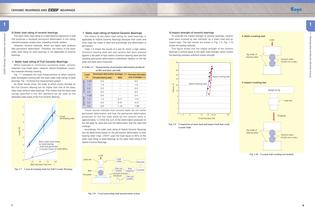
CERAMIC BEARINGS AND BXSEV BEARINGS 2) Static load rating of ceramic bearings The basic static load rating of a steel bearing represents a load that produces a localized permanent deformation in the rolling element/raceway contact area, impeding smooth rotation. However, ceramic materials, which are highly rigid, produce little permanent deformation. Therefore, the theory of the basic static load rating for steel bearings is not applicable to ceramic • Static load rating of Full Ceramic Bearings When exposed to continuous excessive loads, ceramic materials may break down; however, before breakdown...
Open the catalog to page 9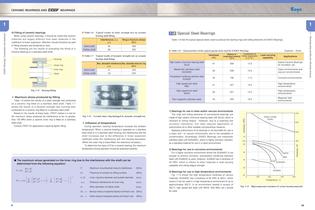
CERAMIC BEARINGS AND EXSEV BEARINGS 4) Fitting of ceramic bearings When using ceramic bearings, it should be noted that ceramic materials are largely different from steel materials in the coefficient of linear expansion. Attention should therefore be paid to fitting stresses and temperature rises. The following are the results of evaluating the fitting of a Ceramic Bearing on a stainless steel shaft. Outer ring Inner ring • Maximum stress produced by fitting Table 1-6 shows the results of a static strength test conducted on a ceramic ring fitted on a stainless steel shaft. Table 1-7 shows the...
Open the catalog to page 10
CERAMIC BEARINGS AND EXSEV BEARINGS 2 Lubricants for EXSEV Bearings Bearing performance depends on lubrication; it is no exaggeration to say that lubrication determines the service life of bearings. Grease or a solid lubricant is properly used to lubricate the EXSEV bearings. Compared with solid lubricants, grease is superior for the high speed performance, load carrying capability, and service life of bearings. Therefore, it is recommended to use grease as much as possible. Grease cannot be used for some application in an ultrahigh vacuum, high temperature, or clean environment. In an application...
Open the catalog to page 11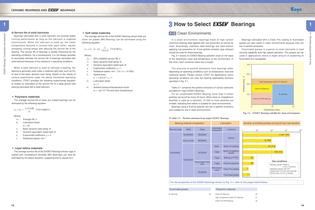
CERAMIC BEARINGS AND EXSEV BEARINGS 4) Service life of solid lubricants Bearings lubricated with a solid lubricant can provide stable running performance as long as the lubricant is supplied continuously. When the lubricant is used up, the metal components become in contact with each other, rapidly increasing running torque and reducing the service life of the bearing. The service life of bearings is greatly influenced by the operating conditions. As a consequence, it is not always possible to accurately estimate the service life of bearings lubricated with solid lubricant because of the variations...
Open the catalog to page 12All JTEKT catalogs and technical brochures
 ONI Flyer
2 Pages
 EasyFit NC-Ball Bearing Units
16 Pages
 Ball Bearing Units
2 Pages
 Ball & Roller Bearings
397 Pages
 INSERT BEARING UNITS
194 Pages
 Spherical Roller Bearings
8 Pages
 Ceramic bearings
17 Pages
 B1011E Traction Drive Unit
4 Pages
 B1005E EXSEV Product Guidebook
13 Pages
 Agriculture and Construction
6 Pages
 catb2018e
272 Pages
 DRIVE SHAFTS for INDUSTRY
25 Pages
 Ball & Roller Bearings
80 Pages
 Ceramic&Exsev bearing
87 Pages
 OIL SEALS & O-RINGS
129 Pages
 TAPERED ROLLER BEARINGS
83 Pages
 LARGE SIZE BALL & ROLLER BEARINGS
245 Pages


Archived catalogs
 Needle Roller Bearings
274 Pages
 NEEDLE ROLLER BEARINGS_2010
158 Pages
 Ball Bearing Units
194 Pages
 Ball & Roller Bearings
200 Pages
 High Performance Bearings
6 Pages
 Miniature Bearings
71 Pages
 Miniature One Way Clutch
6 Pages
 Roll Neck Bearings
8 Pages
 Sprag Clutches
19 Pages
 Exsev Bearings
19 Pages
 Ceramic Bearings
6 Pages
 Oil Seals & O-Rings
119 Pages

