


B2021E Drive shafts for steel production industrial equipment

B2021E Drive shafts for steel production industrial equipment
Drive shafts are essential for transmitting power from motors to machines, particularly in steel production and industrial equipment. They are designed to fit in confined spaces and utilize universal joints for axis alignment, ensuring smooth torque transmission. Key components include cross & bearings, spline sleeves, and flange yokes.
Configurations and Features
The document describes various drive shaft series such as D, U, T, KF, and EZ, each with unique characteristics like swing diameter and torque capacity. Structural features like bearing cups, thrust washers, and spline shafts enhance performance.
Improving Service Life and Strength
To enhance durability and strength, techniques such as using different diameter rollers for cross bearings, ball burnishing on cross shafts, and applying tungsten carbide thermal spray on bearing cups are discussed. These methods improve corrosion resistance and fatigue strength.
Maintenance and Inspection
Regular maintenance is vital for drive shaft longevity. Recommendations include periodic greasing, bolt inspections, and annual overhauls. Guidelines for inspecting cross & bearings, bearing set bolts, and yokes for wear or damage are provided.
Failure Cases
Common failures include insufficient greasing leading to raceway surface flaking and improper bolt tightening causing breakage. Periodic maintenance and proper torque application are suggested to prevent these issues.
Technical Data
The technical section covers universal joint characteristics, including rotational angles and torque ratios. It emphasizes selecting drive shafts based on strength, service life, and operating conditions, with a recommended safety factor of 1.5.
Specifications and Product Introduction
Detailed specifications for various drive shaft series are provided, along with products like drive shafts with roll phase adjustment devices. Tables for recommended tightening torques and parallel key dimensions are included.
Conclusion
The document is a comprehensive guide for selecting, maintaining, and optimizing drive shafts in steel production and industrial applications, ensuring efficient and reliable operation.
The document outlines selection and evaluation criteria for drive shafts, especially in low-speed machines like rolling mills. It stresses considering machine type, peripheral equipment, and operating conditions when selecting a drive shaft. A rough guide for selection is provided, with a recommendation to consult JTEKT for detailed specifications.
Technical Data and Calculations
Key calculations include average calculated bearing life, material factor, rated torque, mean torque, speed factor, angle factor, and rotational speed. It advises against selecting a drive shaft based solely on maximum torque to avoid oversized and uneconomical choices, suggesting adjusting expected service life based on application severity.
Drive Shaft Selection Criteria
JTEKT's selection criteria are based on machine type and usage conditions. For hot strip mills, fatigue strength is emphasized due to severe conditions, while in papermaking machines, lubrication is crucial due to high rotational speeds and continuous operation.
Evaluation and Analysis
The document discusses torque calculation from motor output and the use of FEM analysis for drive shaft selection. Reference safety factors and bearing life for various rolling mills and industrial equipment are provided.
Balance Quality and Correction
Balance quality is expressed through specific equations, and JTEKT corrects drive shaft unbalance using optimal balance systems. Recommended balance quality grades for various machines are listed.
Design and Model Specifications
Details on drive shaft number composition, including series codes, swing diameter numbers, and design serial numbers, are provided. Specifications for different series (D, U, T) and their applications, such as telescoping types and those with propeller tubes, are included.
Recommendations and Best Practices
A dynamic safety factor greater than 1.5 for normal conditions and a static safety factor greater than 1.5 for emergency conditions are recommended. The document also advises on the appropriate use of torque wrenches and other tools for bolt tightening.
Catalog excerpts

Products for Steel Production Equipment Drive shafts for steel production/ industrial equipment JTEKT JTEKT JTEKT CORPORATION
Open the catalog to page 1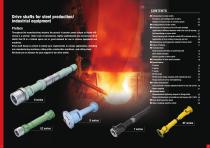
Drive shafts for steel production/ industrial equipment Preface Throughout the manufacturing industry the pursuit of greater power output at higher efficiency is a priority. Under such circumstances, highly sophisticated and economical drive shafts that fit in a limited space are in great demand for use in various equipment and machines. Drive shaft lineup is certain to satisfy your requirements in various applications, including iron manufacturing machines, rolling mills, construction machines, and rolling stock. We thank you in advance for your support of our drive shafts. ■ Introduction to...
Open the catalog to page 2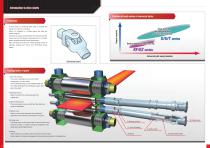
Introduction to drive shafts Position of each series of universal joints Functions A drive shaft is a revolving shaft used to transmit the Torque capacity power of a motor to a machine. Since it is installed in a limited space, the axes are seldom aligned. However, by using a universal joint, the input axis and the space, enabling smooth torque transmission. Each universal joint has four rolling bearings (cross & bearing), realizing low friction and minimizing torque losses. Plate mills Hot/cold strip mills Rod/wire rod mills, etc. D/U/T series General industrial machines, etc. KF/EZ series Universal...
Open the catalog to page 3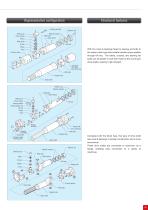
Structural features Retainer ring Retainer washers Weld yoke Spline sleeve Bearing cup Thrust washer Rollers Roller guide Oil seal Felt seal Slinger Cross Oval bore yoke Cylindrical bore yoke Cross & bearing Weld yoke Propeller tube Spline shaft Retainer ring Retainer washers Weld yoke Spline sleeve Bearing cup Thrust washer Bearing holders Rollers (double row) Oil seal Slinger Cross Felt seal Flange yoke Cross & bearing Hexagon head bolts Flange keys Hexagon socket head cap bolts Weld yoke Propeller tube Spline shaft Retainer cap Retainer washers Bearing cups Weld yoke Spline sleeve Felt seal...
Open the catalog to page 5
Because the cross is an elastic cantilever beam and the bearing has some radial clearance, the load on the cross generally becomes heavier toward to the end of the cross. In order to improve this phenomenon, load on the roller is made uniform by designing the roller to have a minutely smaller diameter at the very close end, which would improve flaking life, (figure on the right). It is required that the detailed investigation takes into account multitude of JTEKT records and the technology of theoretical analysis by FEM, when this would be applied. Unequal loads Load distribution Equal loads...
Open the catalog to page 6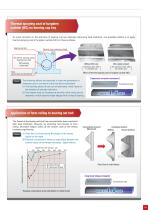
Thermal spraying coat of tungsten carbide (WC) on bearing cup key To avoid corrosion on the side face of bearing cup key applying carburizing heat treatment, one possible method is to apply thermal spraying coat of tungsten carbide (WC) on these surfaces. The following effects are expected in case the generation of clearance due to corrosion at the key area is restrained. (1) The bending stress of bolt can be alleviated, which leads to the restraint of strength reduction. (2) The heavier load on raceways at the end of the cross can be restrained, which expects longer fatigue life for cross &...
Open the catalog to page 7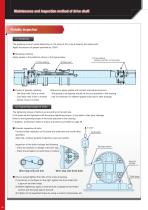
Periodic inspection The greasing amount varies depending on the sizes of the cross & bearing and spline part. Apply the amount of grease specified by JTEKT. ®Cross bearing (bearing cup part or cross body) ■ Greasing positions Apply grease in the positions shown in the figure below. ■ Cycles of periodic greasing * Be sure to apply grease with correct intervals and amount. - Hot strip mills: Once a month The grease to be applied should be the one specified in the drawing. - Cold strip mills: Every 3 months Use of insufficient or different grease may lead to early damage. - Others: Every 3 months...
Open the catalog to page 8
Overhaul ■ As a rule, conduct overhaul of the major parts every year after the start of operation. ■ Cross & bearing nicks, or rusting, etc. of the cross and bearing cup. Thrust washer Checks Rollers Roller guide Slinger Bearing set bolts ■ Bearing set bolt - Check for bending, looseness, cracks, or rusting of the bolt. Yoke Check - Check for cracks, nicks, or rusting, etc. of each part. attaching part for signs of the above. ■ Others Checks Check * *The next page shows some examples of failures of each part. Inspection/repair ■ Long-term use leads to failure of the product,...
Open the catalog to page 9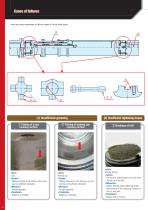
(2) Insufficient tightening torque © Flaking of cross raceway surface ® Flaking of bearing cup raceway surface <Part> Cross <Cause> - Flaking occurred at the bottom of the cross due to insufficient lubrication <Measure> - Periodic greasing <Treatment> - Repair by re-grinding <Part> Bearing cup <Cause> - Flaking occurred on the bearing cup inlet side due to insufficient lubrication <Measure> - Periodic greasing <Treatment> - Repair by re-grinding <Part> Bearing set bolt <Cause> - Flat fracture shape because the axial force did not act on the bolt <Measures> - Tighten with the proper tightening...
Open the catalog to page 10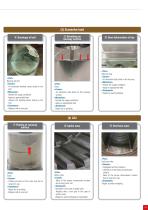
h\ r\ © Brinelling on raceway surface <Measures> - Review the usage conditions - Apply an appropriate load - Reduce the bending stress acting on the bolt <Treatment> - Replace with a new part <Part> Cross <Cause> - An excessive load acted on the raceway surface <Measures> - Review the usage conditions - Apply an appropriate load <Treatment> - Repair by re-grinding <Part> Yoke key way <Cause> - An excessive load acted on the key way <Measures> - Review the usage conditions - Apply an appropriate load <Treatment> - Repair by weld overlaying 7 Flaking of raceway surface r\ © Oval bore wear <Part>...
Open the catalog to page 11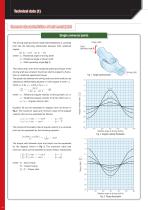
The driving shaft and driven shaft intermediated by a universal joint has the following relationship between their rotational angles: 02 = cos# ■ tan --(I) Rotational angle of driving shaft : Rotational angle of driven shaft : Shaft operating angle (Fig. 1) Driven shaft \ Shaft \ operating angle© \ This means that, even if the rotational speed and torque of the driving shaft are constant, the driven shaft is subject to fluctuation in rotational speed and torque. The speed ratio between the driving shaft and driven shaft can be obtained by differentiating equation (1) with respect to time...
Open the catalog to page 12All JTEKT catalogs and technical brochures
 ONI Flyer
2 Pages
 EasyFit NC-Ball Bearing Units
16 Pages
 Ball Bearing Units
2 Pages
 Ball & Roller Bearings
397 Pages
 INSERT BEARING UNITS
194 Pages
 Spherical Roller Bearings
8 Pages
 Ceramic bearings
17 Pages
 B1011E Traction Drive Unit
4 Pages
 B1005E EXSEV Product Guidebook
13 Pages
 Agriculture and Construction
6 Pages
 catb2018e
272 Pages
 DRIVE SHAFTS for INDUSTRY
25 Pages
 Ball & Roller Bearings
80 Pages
 Ceramic&Exsev bearing
87 Pages
 OIL SEALS & O-RINGS
129 Pages
 TAPERED ROLLER BEARINGS
83 Pages
 LARGE SIZE BALL & ROLLER BEARINGS
245 Pages


Archived catalogs
 Needle Roller Bearings
274 Pages
 NEEDLE ROLLER BEARINGS_2010
158 Pages
 CERAMIC & EXSEV BEARINGS
70 Pages
 Ball Bearing Units
194 Pages
 Ball & Roller Bearings
200 Pages
 High Performance Bearings
6 Pages
 Miniature Bearings
71 Pages
 Miniature One Way Clutch
6 Pages
 Roll Neck Bearings
8 Pages
 Sprag Clutches
19 Pages
 Exsev Bearings
19 Pages
 Ceramic Bearings
6 Pages
 Oil Seals & O-Rings
119 Pages

