
- Catalogs
- JSW The Japan Steel Works, Ltd.
- Waste paper recycle by extrusion technology

Waste paper recycle by extrusion technology

Waste paper recycle by extrusion technology
The document from Japan Steel Works, Ltd. focuses on the recycling of waste paper using advanced mixing and extrusion technology. This process involves combining paper with polymers to create new products, offering an alternative to traditional paper recycling methods.
The technology utilizes a specialized screw tip and die plate design to ensure smooth polymer flow, even with the low fluidity of paper-polymer mixtures. A hot cutting unit is employed to prevent moisture adhesion post-pelletization.
- Stabilize Throughput Rate: Achieved through an enhanced feed rate using a specialized hopper.
- Disperse Paper: High shear rates are applied without reducing the melt index.
- Low Temperature Extrusion: Utilizes a lowered screw RPM with a high torque gear reducer and deep groove screw for mixing at low temperatures and high viscosity.
- Devolatilization: Multiple vacuum vents are used to remove moisture from the paper.
This technology provides a method to recycle waste paper into various products such as containers, wrapping materials, or fuel. The mixed paper and plastic products are environmentally efficient at the disposal stage. Challenges include managing the low bulk density, varied forms, and fiber characteristics of waste paper, which complicate throughput stabilization and dispersion. Additionally, extrusion temperatures must be kept low to prevent paper combustion.
Catalog excerpts
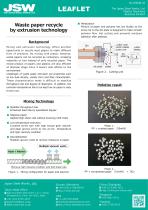
LEAFLET Waste paper recycle by extrusion technology The Japan Steel Works, Ltd. Plastics Machinery Business Division Mixture of paper and polymer has low fluidity so the screw tip to the die plate is designed to make smooth polymer flow. Hot cutting unit prevents moisture adhesion after pelletize. Background Mixing and extrusion technology offers another opportunity to recycle wast papers to make different form of products. By mixing with plastic material, waste papers can be recycled as containers, wrapping materials or fuel instead of only recycled paper. The mixed product of papers and plastics are also efficient at disposal stage since it lowers side effects to the environment. Challenges of waste paper extrusion are properties such as low bulk density, variety form and fiber characteristic. These characteristics make it difficult to stabilize throughput rate and degree of dispersion. In addition, the extrusion temperature has to be kept low as paper is easy to burn out. cutter case cutter blades cutter unit cutter blades Figure 2. Cutting unit Pelletize result Mixing Technology ■ Stabilize throughput rate Enhanced feed rate by specialized hopper Applied high shear rate without lowering melt index Lowered screw rpm with high torque gear reducer and deep groove screw to mix at low temperature and high viscosity condition Photo 1. PP + crushed paper (50wt%) Multiple vacuum vents to remove moistures in paper Multiple vacuum vents Mixing at high viscosity condition with high shear rate Figure 1. Mixing configuration for paper and polymer Japan Steel Works, Ltd. Tokyo Head Office Gate City Osaki West Tower 1-11-1, Osaki, Shinagawa-ku, Tokyo 141-0032, Japan Photo 2. PP + compressed paper (51wt%) + TiO2 Europe (Germany) China (Shanghai)
Open the catalog to page 1All JSW The Japan Steel Works, Ltd. catalogs and technical brochures
 Delta Crown
1 Page
 Compact UWC unit "SDC"
1 Page
 TWIST KEADING DISC "TKD"
1 Page
 JSW Hiroshima Guide
8 Pages
 JSW corporate
14 Pages


- Analysis software solution
- Process software
- Windows software
- Industrial software
- Simulation software solution
- Screw extruder
- Twin screw extruder
- High-performance software
- Flow software
- Single screw extruder
- Production software
- Laboratory software
- Compounding extruder
- Compact extruder
- Laboratory extruder
- Off-line software
- Pelletizing extruder
- R&D software
- Masterbatch extruder
- Chemical software