
- Catalogs
- JPT Opto-electronics
- The Deep Carving Efficiency of 60W Fiber Lasers on Metal


The Deep Carving Efficiency of 60W Fiber Lasers on Metal

The Deep Carving Efficiency of 60W Fiber Lasers on Metal
- Deep carving was performed on 10×10mm cells of aluminum and carbon steel.
- The relationship between carving depth and time was analyzed.
- The ability to carve deeply is enhanced with a larger pulse width.
- Aluminum, due to its lower hardness, is easier to carve deeply compared to carbon steel.
- The depth of carving increases linearly with time.
- Graphs indicate depth progression over time for different pulse widths (350ns, 250ns, 200ns, 100ns) on both aluminum and carbon steel.
- The roughness of shading is influenced by pulse width and time.
- Larger pulse widths result in rougher shading initially, which then decreases over time.
- Using a 100ns pulse width maintains flat shading.
- A recommended approach is to start with a 350ns pulse width for efficiency and then switch to 100ns to refine the shading.
- Graphs show the relationship between shading roughness and time for different pulse widths, highlighting the arithmetical mean deviation of the profile (Ra).
Catalog excerpts
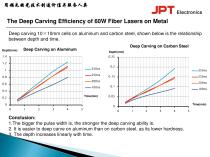
The Deep Carving Efficiency of 60W Fiber Lasers on Metal Deep carving 10×10mm cells on aluminum and carbon steel, shown below is the relationship between depth and time. Depth(mm) Deep Carving on Carbon Steel Deep Carving on Aluminum Conclusion: 1.The bigger the pulse width is, the stronger the deep carving ability is. 2. It is easier to deep carve on aluminum than on carbon steel, as its lower hardness. 3. The depth in
Open the catalog to page 1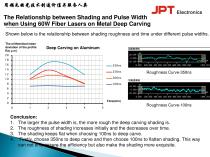
The Relationship between Shading and Pulse Width when Using 60W Fiber Lasers on Metal Deep Carving Shown below is the relationship between shading roughness and time under different pulse widths. The arithmetical mean deviation of the profile Ra( μ m) Deep Carving on Aluminum Conclusion: 1. The larger the pulse width is, the more rough the deep carving shading is. 2. The roughness of shading increases initially and the decreases over time. 3. The shading keeps flat when choosing 100ns to deep carve. 4. Firstly, choose 350ns to deep carve and then choose 100ns to flatten shading. This way can...
Open the catalog to page 2Archived catalogs
 Exhibition Coming Soon
1 Page
 Fiber laser
1 Page
 2017 JPT Laser Event
1 Page
 YDFLP-M6+ MOPA Fiber Laser
2 Pages
 YDFLP-LM1 MOPA Fiber Laser
3 Pages
 JPT Presentation
24 Pages
 YDFLP-M1+ MOPA Fiber Laser
3 Pages
 YDFLP-LP MOPA Fiber Laser
3 Pages
 JPT Applications
18 Pages
 Laser Marking QR Code
1 Page
 MOPA Fiber Laser M6+
1 Page
 MOPA Pulsed Fiber Laser
1 Page


- Welding system
- Rectangular housing
- Automatic welding machine
- Test stand
- Plastic housing
- Automated test bench
- Indoor enclosure
- Industrial cable
- Optical cable
- Metal welding machine
- ABS plastic enclosure
- Compact housing
- Outdoor housing
- Laser sealer
- Precision welding machine
- Optical data cable
- Inspection machine
- Pulsed laser
- Industrial test bench
- Solid-state laser