Cleaning Manual for PUR Hot Melt Adhesives

Cleaning Manual for PUR Hot Melt Adhesives
- PUR hot melt adhesives require protection from moisture due to their chemical crosslinking reaction when exposed to humidity.
- Benefits include high water and heat resistance, a broad adhesion spectrum, and low processing temperatures.
- Minimizing cleaning cycles can reduce thermal stress and avoid standstills.
- Flushing agents and cleaners are essential for maintaining melters and applicator units. Flushing agents inhibit chemical reactions and remove adhesive remnants, while cleaners dissolve solidified adhesives.
- The viscosity of the flushing agent should be higher than that of the adhesive for effective cleaning.
- Tank Melters: Use inert gas to prevent moisture contact and flush with Jowat® flushing agent.
- Bag Melters: Require periodic flushing and cleaning to maintain performance.
- Drum/Hobbock Melters: Follow a similar cleaning process to bag melters, emphasizing the use of flushing agents.
- Cartridge Melters: For small applications, flush with Jowat® flushing agent during downtimes.
- Adhesive Reservoirs and Glue Pots: Use flushing agents for cleaning, especially for polyester-based PUR hot melts.
- Regular cleaning prevents adhesive crosslinking and ensures smooth operation.
- Follow safety measures and manufacturer instructions during cleaning.
- Regularly replace filters and check for clogs to maintain system efficiency.
- Applicator Rollers: Remove adhesive remnants, soak with a flushing agent, and store in inert gas for longer standstills.
- Roller Applicators: Empty the unit, use Jowat® 930.2x cleaner, and ensure the roller is dry.
- Cold Cleaners: Jowat® 40x.xx and Jowat® 402.32 are effective organic solvents.
- Cleaning Agents: Jowat® 930.xx series offers various forms with different soaking times and temperatures.
- Test cleaning products for compatibility with equipment materials.
- Use protective gear during cleaning processes.
- Ensure all cleaning agents are removed before resuming operations.
Catalog excerpts
Jowat Manual Tips an d tricks f or effectiv e cleanin g Cleaning Manual for PUR Hot Melt Adhesives Powerful product solutions for effective flushing and cleaning For many melters / applicator units For many industrial applications Flushing agents / Solid and liquid cleaners / Cold cleaners
Open the catalog to page 1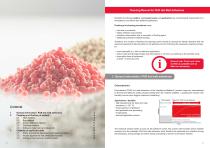
Cleaning Manual for PUR Hot Melt Adhesives Smoothly functioning melters, conveying hoses and applicators are a fundamental requirement for a homogenous and failure-free adhesive application. Flushing and cleaning procedures mean: • lost time in production • higher adhesive consumption • possible contamination due to remnants of flushing agent • additional potential for flawed bonding Therefore, the number of flushing and cleaning cycles should be reduced by taking measures that are aimed at lowering the thermal stress on the adhesive and at minimising the necessary cleaning processes: • avoid...
Open the catalog to page 2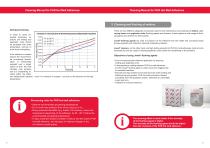
Cleaning Manual for PUR Hot Melt Adhesives Cleaning Manual for PUR Hot Melt Adhesives 2. Cleaning and flushing of melters During processing In order to avoid unwanted secondary reactions, the melting and applicator units should be equipped with exact temperature controls to avoid local overheating. If the adhesive is heated beyond the recommended processing temperature, or thermonally exposed over a longer period of time, the melt viscosity may increase due to a crosslinking reaction within the adhesive (allophanate reaction) - even if no moisture is present - just due to the influence of the...
Open the catalog to page 3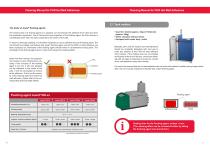
Cleaning Manual for PUR Hot Melt Adhesives Cleaning Manual for PUR Hot Melt Adhesives 2.1 Tank melters The tasks of Jowat flushing agents ® The primary task of a flushing agent is to squeeze out and extrude the adhesive from tubes and from the application equipment. Due to the laminar flow properties of the flushing agent, the flow velocity is considerably lower near the walls compared to the centre of the tube. To ensure a thorough cleaning, it is therefore necessary to use a sufficient amount of flushing agent. The unit should be emptied and flushed with Jowat® flushing agent until all the...
Open the catalog to page 4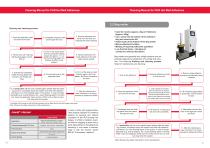
Cleaning Manual for PUR Hot Melt Adhesives Cleaning Manual for PUR Hot Melt Adhesives 2.2 Bag melter Flushing and cleaning process: 1. Close the applicator head and remove the hose 2. Completely empty the tank unit through the hose 3. Remove adhesive remnants from the tank unit mechanically with a spatula 4. Fill the tank unit* half way with flushing agent Jowat® 930.x4 5. Turn on the pump several times during the melting phase (for approx. 1 h, so that the flushing agent can produce its effect in the system) 6. Remove adhesive remnants adhering to the tank walls using a spatula 7. Extrude the...
Open the catalog to page 5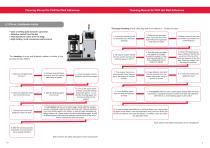
Cleaning Manual for PUR Hot Melt Adhesives Cleaning Manual for PUR Hot Melt Adhesives 2.3 Drum / Hobbock melter Thorough cleaning of tank units, bag and drum melters (1 - 2 times per year) • Uses a melting plate (smooth / grooved) • Adhesive melted from the top • Fold aluminium inliner over the edge • High melting / melt conveyance performance 4. Close the applicator head and remove the hose 7. Connect the hose to the applicator head and flush 3. Attach a sieve to the hose end to filter out particles and contaminations 4. Fill cleaner Jowat 930.60 into the system and heat all machine areas to...
Open the catalog to page 6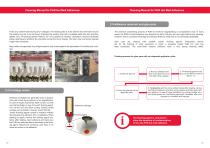
Cleaning Manual for PUR Hot Melt Adhesives Cleaning Manual for PUR Hot Melt Adhesives 2.5 Adhesive reservoir and glue pots Avoid any contamination during drum changes. The heating plate is to be cleaned and remnants around the sealing ring are to be removed. Greasing the sealing rings with a suitable water-free and acid-free grease (e.g. roll bearing grease Petamo GY 193 supplied by Klueber Lubrication, Munich) facilitates easier cleaning and shortens the downtime during the drum change. The drum may not remain opened longer than necessary. Bag melters are generally very airtight systems and...
Open the catalog to page 7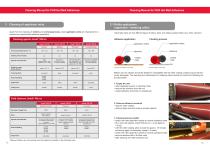
Cleaning Manual for PUR Hot Melt Adhesives Cleaning Manual for PUR Hot Melt Adhesives Jowat Produkt Information Normalbetrieb (Gleichlauf) Cleaning of applicator units Reinigungsmodus (Gegenlauf) 3.1 Roller applicators (applicator / metering roller) Jowat Produkt Information 2. Walzenauftragssysteme there are two different types of rollers: steel- and rubber-coated rollers (e.g. Viton, silicone). Apart from the cleaning of melters and conveying hoses, clean applicator units are imperative for a Generally, smooth and reproducible adhesive application. Normalbetrieb (Gleichlauf) Cleaning agents...
Open the catalog to page 8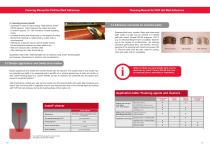
Cleaning Manual for PUR Hot Melt Adhesives 4 dem Abkühlen – aber im noch warmen 4. Cleaning process (liquid) geeigneter Handschuhe mit einem • Optionally in case of heavy soiling: Heat cleaner Jowat ch (ggf. leicht 1mit between the rollers and allow 930.60 (approx. litre) Reiniger Jowat® to soak for approx. dig entfernen. 30 - 180 minutes in normal operating Bei verunreinigten mode. • Increase soaking time -Reiniger the degree of soiling. kann der Jowat® depending on a cotton 930.60 Mechanical cleaning by rubbing with cloth is recommended. zter PUR-Schmelzklebstoff lässt sich ® • Afterwards,...
Open the catalog to page 9
Cleaning Manual for PUR Hot Melt Adhesives
Open the catalog to page 10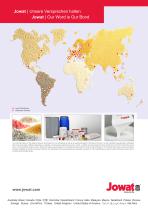
Jowat | Unsere Versprechen halten Jowat | Our Word is Our Bond Jowat Subsidiaries Distribution Partners The information given in this leaflet is based on test results from our laboratories as well as on experience gained in the field, and does in no way constitute any guarantee of properties. Due to the wide range of different applications, substrates, and processing methods beyond our control, no liability may be derived from these indications nor from the information provided by our free technical advisory service. Before processing, please request the corresponding data sheet and observe the...
Open the catalog to page 11All Jowat SE catalogs and technical brochures
 Jowat Primer 407.09
2 Pages
 Jowatherm-Reaktant® MR
2 Pages
 Jowatherm-Reaktant 609.00
2 Pages