
- Catalogs
- Johnson Electric
- Saia-Motors

Saia-Motors

1 / 218 PagesView full catalog
Saia-Motors
Product catalog summary
Overview: The document is a technical catalog from Johnson Electric Group, detailing their range of motors and related products. It includes contact information for various global offices, a table of contents, and detailed descriptions of motor applications across different industries.
Specifications and Product Range: The catalog outlines various motor types, including synchronous and stepper motors, and their applications. It highlights the adaptability of these motors for specific operational needs, emphasizing the importance of consulting with Johnson Electric for tailored solutions. The document also mentions the availability of gearboxes and cam programmers, which can be customized for specific applications.
Applications: The document provides extensive examples of motor applications in various sectors, including:
- Medical and Pharmaceutical: Motors are used in equipment like IV fluid meters, surgical lasers, and blood analyzers, offering features like easy control, high reliability, and long life.
- Security and Automation: Motors serve as locking mechanisms in security applications and are used in office automation and consumer products.
- Appliance Industry: Motors are utilized in both domestic and commercial appliances, such as refrigerators, ovens, and vending machines.
- Industrial and Food Automation: Motors aid in automation processes in industries like food production, packaging, and manufacturing.
Technical Notes: The document includes important notes on motor design, such as the impact of duty cycles and ambient temperatures on motor performance. It also discusses the mechanical and electrical connections available for customization.
Tables and Data: The catalog contains tables mapping motor types to applications, illustrating the versatility and customization options available for different industry needs.
Conclusion: Johnson Electric offers a comprehensive range of motor solutions, emphasizing customization and application-specific design. The catalog serves as a guide for selecting the appropriate motor type for various industrial, medical, and consumer applications.
Specifications:
The document outlines the specifications for gearboxes and motors, emphasizing that gearboxes should not be driven by the output shaft to avoid damage. The direction of rotation depends on the number of stages and is specified by the gearbox output shaft. Torque, force, and power specifications are subject to manufacturing tolerances.
Procedures:
Stepper motors are specified for a duty cycle of 100% and an ambient temperature of 23 ±5°C. The document advises on using chopper driver circuits for higher performance. Synchronous motors have similar specifications but emphasize synchronous torque.
Norms and Standards:
Saia motors, except UR types, meet basic insulation requirements of EN 60335-1: 2004. Customer applications must fulfill protection class I, II, or III according to EN 60355-1: 2004.
Recommendations:
For stepper motors, if the duty cycle or ambient temperature is lower, motors can be designed for higher performance using different winding. The document suggests using chopper driver circuits for better performance and stability.
Gearbox Efficiency and Torque:
Efficiency is determined by the number of gearbox stages, decreasing with higher ratios. Permissible torque is defined by the load on the final stage and housing stability. Lifetime graphs show the relationship between ratio and torque over time.
Clutches:
Gearbox types UGA, UGB, and UGD can be fitted with freewheels or slipping clutches to protect against torque overloads. Freewheels transmit maximum torque in one direction, while slipping clutches allow limited torque in both directions.
Technical Terms:
The document explains terms related to synchronous and stepper motors, including synchronous speed, torque, detent torque, and load inertia. It also covers driver types, such as unipolar and bipolar drivers, and their impact on motor performance.
Cam Programmers:
Each channel in a cam programmer has a change-over microswitch with multiple on/off operations. The document provides guidelines for program duration and the number of channels, considering torque consumption.
The document outlines the specifications for gearboxes and motors, emphasizing that gearboxes should not be driven by the output shaft to avoid damage. The direction of rotation depends on the number of stages and is specified by the gearbox output shaft. Torque, force, and power specifications are subject to manufacturing tolerances.
Procedures:
Stepper motors are specified for a duty cycle of 100% and an ambient temperature of 23 ±5°C. The document advises on using chopper driver circuits for higher performance. Synchronous motors have similar specifications but emphasize synchronous torque.
Norms and Standards:
Saia motors, except UR types, meet basic insulation requirements of EN 60335-1: 2004. Customer applications must fulfill protection class I, II, or III according to EN 60355-1: 2004.
Recommendations:
For stepper motors, if the duty cycle or ambient temperature is lower, motors can be designed for higher performance using different winding. The document suggests using chopper driver circuits for better performance and stability.
Gearbox Efficiency and Torque:
Efficiency is determined by the number of gearbox stages, decreasing with higher ratios. Permissible torque is defined by the load on the final stage and housing stability. Lifetime graphs show the relationship between ratio and torque over time.
Clutches:
Gearbox types UGA, UGB, and UGD can be fitted with freewheels or slipping clutches to protect against torque overloads. Freewheels transmit maximum torque in one direction, while slipping clutches allow limited torque in both directions.
Technical Terms:
The document explains terms related to synchronous and stepper motors, including synchronous speed, torque, detent torque, and load inertia. It also covers driver types, such as unipolar and bipolar drivers, and their impact on motor performance.
Cam Programmers:
Each channel in a cam programmer has a change-over microswitch with multiple on/off operations. The document provides guidelines for program duration and the number of channels, considering torque consumption.
General Overview
The document discusses the functionalities and specifications of Saia cam programmers, which are automation components designed to repeat preset programs. These devices utilize a synchronous motor with a reduction gear to rotate an axis with programmed cams, activating microswitches to control various devices.
Technology and Functions
The cam programmers, including models KKC, KKD, KKP, and KKH, offer different functionalities. The KKC, KKD, and KKP can execute programs continuously or once, while the KKH functions as a timer with a rotary knob for setting time intervals. The basic drive unit consists of a Saia UDS synchronous motor and UGD reduction gear, with options for higher torque or different durations using other motor combinations.
Program Duration and Channels
The combination of Saia motors and reduction gears allows for program durations ranging from a fraction of a second to 120 hours. The number of cams varies by model, with the KKC having up to 2 cams, the KKP up to 4, and the KKD up to 30. The KKH timer can have 1 to 3 cams.
Tolerances and Precision
The document highlights the importance of considering tolerances in cam deviations and microswitch operations, which can affect the precision of switching points. It suggests placing interdependent channels side-by-side and using adjustable levers or faster motors for delicate sequences.
Mounting and Adjustability
The KKD is designed for DIN rail mounting but also allows for screw mounting. The KKP housing can be fixed with screws, and adjustable cams are available for customization. Microswitches are equipped with XGC or XGG models, with options for more powerful switches if needed.
Standards and Approvals
All devices meet European standards and have certificates of conformity. Versions with UL and CSA approval are available.
Lifetime and Temperature
Motors are designed for a minimum of 20,000 hours of operation. The mechanical lifetime of microswitches ranges from 2 million to 50 million operations, depending on the model. The operating temperature range is -5°C to +50°C, with options for extended ranges.
Main Advantages
The Saia cam programmers offer direct control of loads up to 16A 250VAC, modularity for customization, and high reliability due to the quality of components. They are easy to mount, fasten, and wire, making them accessible for service and maintenance.
The document discusses the functionalities and specifications of Saia cam programmers, which are automation components designed to repeat preset programs. These devices utilize a synchronous motor with a reduction gear to rotate an axis with programmed cams, activating microswitches to control various devices.
Technology and Functions
The cam programmers, including models KKC, KKD, KKP, and KKH, offer different functionalities. The KKC, KKD, and KKP can execute programs continuously or once, while the KKH functions as a timer with a rotary knob for setting time intervals. The basic drive unit consists of a Saia UDS synchronous motor and UGD reduction gear, with options for higher torque or different durations using other motor combinations.
Program Duration and Channels
The combination of Saia motors and reduction gears allows for program durations ranging from a fraction of a second to 120 hours. The number of cams varies by model, with the KKC having up to 2 cams, the KKP up to 4, and the KKD up to 30. The KKH timer can have 1 to 3 cams.
Tolerances and Precision
The document highlights the importance of considering tolerances in cam deviations and microswitch operations, which can affect the precision of switching points. It suggests placing interdependent channels side-by-side and using adjustable levers or faster motors for delicate sequences.
Mounting and Adjustability
The KKD is designed for DIN rail mounting but also allows for screw mounting. The KKP housing can be fixed with screws, and adjustable cams are available for customization. Microswitches are equipped with XGC or XGG models, with options for more powerful switches if needed.
Standards and Approvals
All devices meet European standards and have certificates of conformity. Versions with UL and CSA approval are available.
Lifetime and Temperature
Motors are designed for a minimum of 20,000 hours of operation. The mechanical lifetime of microswitches ranges from 2 million to 50 million operations, depending on the model. The operating temperature range is -5°C to +50°C, with options for extended ranges.
Main Advantages
The Saia cam programmers offer direct control of loads up to 16A 250VAC, modularity for customization, and high reliability due to the quality of components. They are easy to mount, fasten, and wire, making them accessible for service and maintenance.
Overview: This document provides technical specifications and data for various synchronous motors produced by Saia Motors. It includes details on dimensions, voltage, speed, torque, power output, and other operational parameters.
Specifications:
- Dimensions: Various models with dimensions ranging from ∅28 x 24 mm to ∅50 x 28 mm.
- Voltage: Operates on a range from 6V to 230V.
- Speed: Speeds vary between 250 rpm to 600 rpm depending on the model and frequency (50 Hz or 60 Hz).
- Torque: Running torque values range from 0.8 cNm to 7.5 cNm.
- Power Output: Power output varies from 0.24 W to 2.83 W.
Procedures and Standards:
- Climatic Class: Wide-spread according to DIN IEC 60721-2-1.
- Thermal Class: Class A or B according to DIN EN 60085.
- Protection: IP 30 or IP 40 according to DIN EN 60529.
- Mounting: Motors can be mounted in any position.
- Electrical Connection: Options include connector types D or N, and cable connections.
Operational Data:
- Ambient Temperature: Operational range from -15°C to +60°C, storage range from -20°C to +100°C.
- Thermal Resistance: Rtherm values range from 27 K/W to 29 K/W.
- Rotor Stalling: Motors can be stopped when voltage is applied without overheating.
- Bearings: Sintered bronze, self-lubricating.
Reversibility and Circuit Diagrams:
- Motors are reversible, with circuit diagrams provided for parallel and series circuits.
- Capacitors and resistors are specified for different voltage levels.
Additional Notes:
- Standard data includes duty cycle at 100% and voltage tolerance of +10%/-10%.
- Weight varies by model, ranging from 54 g to 195 g.
Technical Specifications
- UFB Motors: Available in bipolar (UFB1/3) and unipolar (UFB2/4) configurations with rated voltages of 6, 12, and 24 V. Resistance per winding varies across models, with holding torque ranging from 4.3 to 7.6 cNm and detent torque from 0.46 to 0.8 cNm. The rotor inertia is specified for each model.
- UHD Motors: Bipolar and unipolar configurations with rated voltages of 6, 12, 24, and 48 V. Resistance per winding and holding torque are detailed for each model. The motors have a step angle of 7.5° and a duty cycle of 100%.
- UP Motors: Bipolar motors with a rated voltage of 4.5 V, featuring a step angle of 7.5° or 18.25°. Holding torque ranges from 30 to 45 cNm, with a detent torque of 2 to 7 cNm.
Performance Charts
- Charts illustrate the pull-in and pull-out ranges for various motor models, showing the relationship between frequency (fS/Hz) and torque (M/cNm) or power (P/W).
Standard Data
- Motors are designed to operate in ambient temperatures ranging from -15°C to +55°C, with storage temperatures from -20°C to +100°C. They feature thermal resistance and are classified under thermal class A or B.
- Protection is rated at IP 30, and motors can be mounted in any position. Electrical connections are made via cable.
Gearboxes
- UGA Gearboxes: Dimensions are 55 x 62 mm, with a maximum torque of 32 cNm. Various ratios are available, and the gearboxes can be mounted in any position.
- UGD Gearboxes: Offer a wide range of ratios and are equipped with slipping clutches/free wheels for single-way or two-way operation.
Technical Specifications:
1. Climatic Class: According to DIN IEC 60721-2-1.
2. Ambient Temperature: Operation: -5°C to +60°C; Storage: -20°C to +100°C.
3. Thermal Resistance: 29 K/W at f=0.
4. Thermal Class: B according to DIN EN 60085.
5. Protection: IP 40 according to DIN EN 60529.
6. Mounting: Any position.
7. Electrical Connection: Connector type C, D.
8. Weight: 67 g.
9. Bearings: Ball bearing.
Motor Types and Performance:
1. Bipolar Motors:
- Operating Frequency: 100 Hz, 200 Hz.
- Max Push/Pull Force: 35 N at 30% ED, 30 N at 100% ED.
- Rated Voltage: 6 V, 12 V, 24 V.
- Resistance per Winding: 24 Ω, 90 Ω, 380 Ω.
2. Unipolar Motors:
- Operating Frequency: 100 Hz, 200 Hz.
- Max Push/Pull Force: 25 N at 30% ED, 15 N at 100% ED.
- Rated Voltage: 6 V, 12 V, 24 V.
- Resistance per Winding: 28 Ω, 120 Ω, 500 Ω.
Mechanical Specifications:
1. Linear Travel: Max 10/13 mm.
2. Axial Play: < 0.25 mm at ±20 N force.
3. Step Angle: 7.5°.
4. Travel per Step: 0.036 mm, 0.047 mm, 0.063 mm.
Driver Boards:
1. Samotronic101:
- Supply Voltage: 10-24 VDC.
- Phase Current: 350 mA.
- Step Mode: Full/Half Step.
2. Samotronic102:
- Supply Voltage: 10-42 VDC.
- Phase Current: 70-500 mA.
- Chopper Frequency: 20 kHz.
Applications:
Used in healthcare, personal care, building automation, home appliances, industrial equipment, and more.
Notes:
- Radial forces on the shaft reduce lifetime and performance.
- Drive against end stops only permissible after clarification and approval by Saia-Burgess.
1. Climatic Class: According to DIN IEC 60721-2-1.
2. Ambient Temperature: Operation: -5°C to +60°C; Storage: -20°C to +100°C.
3. Thermal Resistance: 29 K/W at f=0.
4. Thermal Class: B according to DIN EN 60085.
5. Protection: IP 40 according to DIN EN 60529.
6. Mounting: Any position.
7. Electrical Connection: Connector type C, D.
8. Weight: 67 g.
9. Bearings: Ball bearing.
Motor Types and Performance:
1. Bipolar Motors:
- Operating Frequency: 100 Hz, 200 Hz.
- Max Push/Pull Force: 35 N at 30% ED, 30 N at 100% ED.
- Rated Voltage: 6 V, 12 V, 24 V.
- Resistance per Winding: 24 Ω, 90 Ω, 380 Ω.
2. Unipolar Motors:
- Operating Frequency: 100 Hz, 200 Hz.
- Max Push/Pull Force: 25 N at 30% ED, 15 N at 100% ED.
- Rated Voltage: 6 V, 12 V, 24 V.
- Resistance per Winding: 28 Ω, 120 Ω, 500 Ω.
Mechanical Specifications:
1. Linear Travel: Max 10/13 mm.
2. Axial Play: < 0.25 mm at ±20 N force.
3. Step Angle: 7.5°.
4. Travel per Step: 0.036 mm, 0.047 mm, 0.063 mm.
Driver Boards:
1. Samotronic101:
- Supply Voltage: 10-24 VDC.
- Phase Current: 350 mA.
- Step Mode: Full/Half Step.
2. Samotronic102:
- Supply Voltage: 10-42 VDC.
- Phase Current: 70-500 mA.
- Chopper Frequency: 20 kHz.
Applications:
Used in healthcare, personal care, building automation, home appliances, industrial equipment, and more.
Notes:
- Radial forces on the shaft reduce lifetime and performance.
- Drive against end stops only permissible after clarification and approval by Saia-Burgess.
Specifications:
The document describes a manual timer with a unidirectional synchronous motor, available in 230 V, 50 Hz or 110 V, 60 Hz, with other voltages available upon request. It supports a switching power of 16 A (6 A UL) and has standard EC UL approval. The timer can be set from a minimum of 2 minutes to a maximum of 24 hours and includes a manual 'on' position without timing. It features galvanic separation of the load.
The document describes a manual timer with a unidirectional synchronous motor, available in 230 V, 50 Hz or 110 V, 60 Hz, with other voltages available upon request. It supports a switching power of 16 A (6 A UL) and has standard EC UL approval. The timer can be set from a minimum of 2 minutes to a maximum of 24 hours and includes a manual 'on' position without timing. It features galvanic separation of the load.
Applications:
The timer is suitable for various markets including healthcare, personal care, building automation, home appliances, HVAC, industrial equipment, and business machines. Specific applications include hair dryers, solariums, saunas, swimming pools, fountains, fog horns, bell towers, heating ventilation, pottery ovens, automation, test equipment, food specialties, bottling, newspaper, milk truck cleaning, carwash, battery loading, milking equipment, drying, bookbinding, vending machines, and feeding systems.
The timer is suitable for various markets including healthcare, personal care, building automation, home appliances, HVAC, industrial equipment, and business machines. Specific applications include hair dryers, solariums, saunas, swimming pools, fountains, fog horns, bell towers, heating ventilation, pottery ovens, automation, test equipment, food specialties, bottling, newspaper, milk truck cleaning, carwash, battery loading, milking equipment, drying, bookbinding, vending machines, and feeding systems.
Product Variants:
The document lists several product variants with different configurations for shaft type, fixing method, number of channels, program duration, and supply voltage. Custom configurations are available upon request.
The document lists several product variants with different configurations for shaft type, fixing method, number of channels, program duration, and supply voltage. Custom configurations are available upon request.
Accessories:
Accessories include setting knobs, fixing screws, actuators, cams, and setting keys. These are available for different configurations and customer-specific requirements.
Accessories include setting knobs, fixing screws, actuators, cams, and setting keys. These are available for different configurations and customer-specific requirements.
Contact Information:
The document provides contact details for Johnson Electric's headquarters in Hong Kong and various regional offices across Asia, Europe, and the Americas.
The document provides contact details for Johnson Electric's headquarters in Hong Kong and various regional offices across Asia, Europe, and the Americas.
Additional Notes:
The document emphasizes that the data provided is for guideline purposes only and specific operational characteristics may vary. It is recommended to clarify specific operating conditions with Johnson Electric before application. All data is subject to change without notice.
The document emphasizes that the data provided is for guideline purposes only and specific operational characteristics may vary. It is recommended to clarify specific operating conditions with Johnson Electric before application. All data is subject to change without notice.
See more
All Johnson Electric catalogs and technical brochures
 BTA® Size 6EV
2 Pages
 VersaSortTM Modules
2 Pages
 Ledex® Rotary Solenoids
2 Pages
 TrueDrive™ Motorized Rollers
4 Pages
 Solligence™ Actuators
3 Pages
 Solutions by industry
26 Pages
 Automotive Products Group
10 Pages
 Industry Products Group
11 Pages
 SMART METERING
14 Pages
 Ultimag® Rotary Actuators
3 Pages
 Ledex® Tubular Solenoids
37 Pages
 Soft Shift® Solenoids
3 Pages
 Low Profile Solenoids
3 Pages
 Nanomotion Motion Systems
9 Pages
 Compact Lite Window Lift Drive
12 Pages
 Nanomotion-Motors
8 Pages
 Compact AC Starters
4 Pages
 Shaded Pole Motors
32 Pages
 Saia Motors
157 Pages
 Secure Flex
1 Page
 Prepayment Meter Valves
2 Pages
 Smart Meter Valves
2 Pages
 Diverter Valve
13 Pages
 Drive Electronics
3 Pages
 Standard Rotary Stepper Motors
38 Pages
 Standard Linear Stepper Motors
17 Pages
 Rotary Synchronous Motors
91 Pages
 Universal AC Motors
48 Pages
 vd751(0)-101
2 Pages
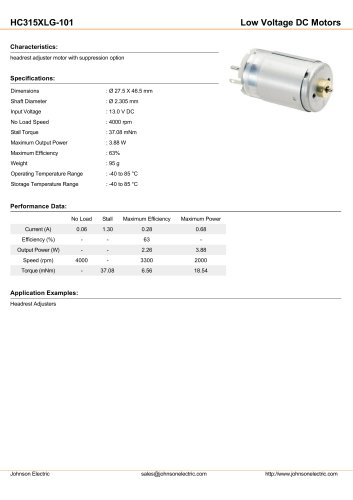 hc315xlg-101
2 Pages
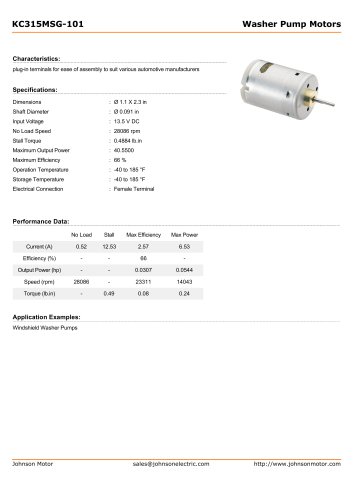 kc315msg-101
2 Pages
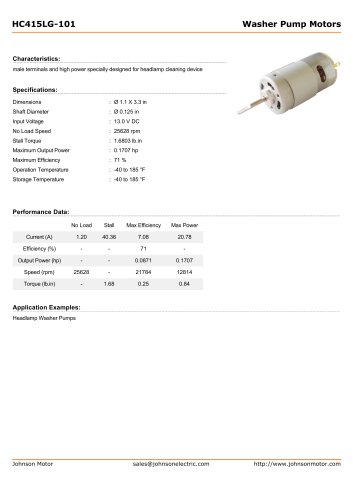 HC415LG-101
2 Pages
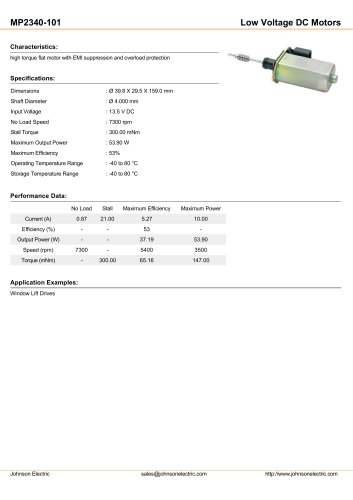 mp2340-101
2 Pages
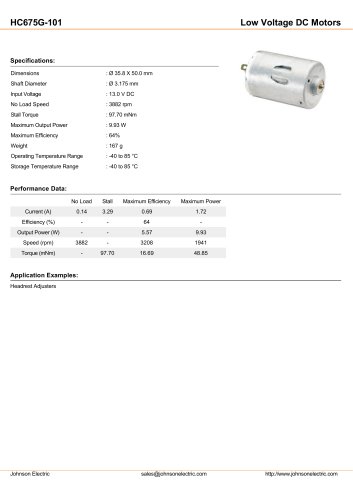 hc675g-101
2 Pages
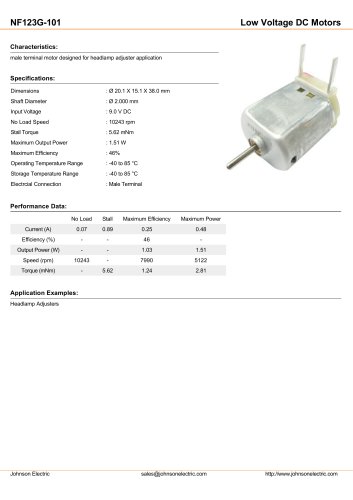 NF123g-101
2 Pages
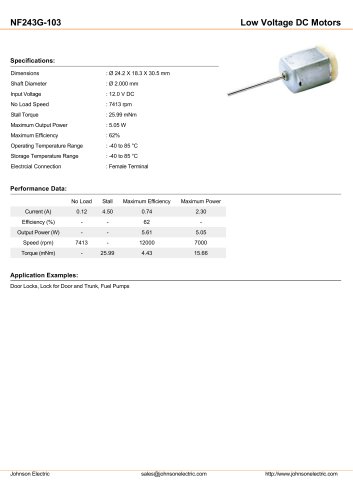 nf243g-103
2 Pages
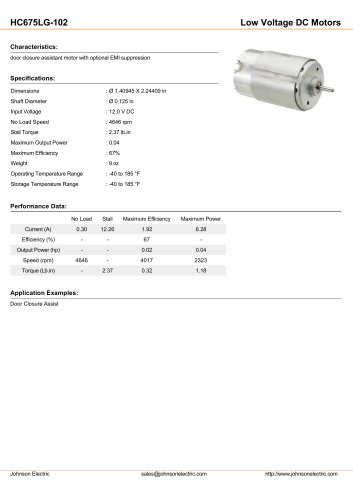 hc675lg-102
2 Pages
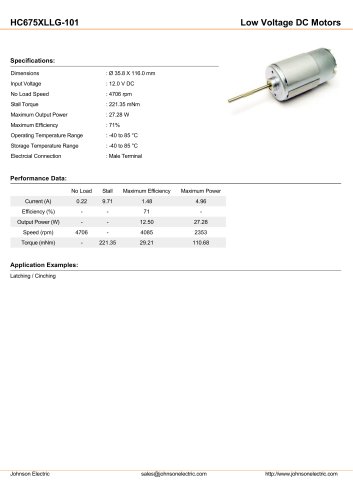 HC675XLLG-101
2 Pages


Archived catalogs
 hc658ulg-101
2 Pages
 mo25wj-101
2 Pages
 hF658ulg-105
2 Pages
 mo25mm-102
2 Pages
 Specialized switching solution
24 Pages
 TH-contact panel mounted push button
112 Pages
 Burgess Switches
80 Pages
 saia microswitches
54 Pages
 Johnsonelectric brochure
22 Pages
 LEDEX DC Solenoids Metric
228 Pages
 LEDEX DC Solenoids Imperial
228 Pages
 Dormeyer AC Solenoids Imperial
52 Pages
 Johnson DC Motors
231 Pages
 Synchronous_Motors
2 Pages

Related Searches
- Pump
- Industrial pump
- Valve
- Pump with electric motor
- Stationary pump
- Johnson Electric electric motor
- Centrifugal pump
- Self-priming pump
- Chemical pump
- Johnson Electric DC motor
- Alternating current motor
- On/off valve
- Electric gearmotor
- Linear actuator
- Planetary gearbox
- Electric actuator
- Positioning table
- Electric valve
*Prices are pre-tax. They exclude delivery charges and customs duties and do not include additional charges for installation or activation options. Prices are indicative only and may vary by country, with changes to the cost of raw materials and exchange rates.
About DirectIndustry
DirectIndustry is a marketplace that offers B2B players a complete experience, from product sourcing to purchase. DirectIndustry is an entity of VirtualExpo Group.
Are you a buyer?
Are you a supplier?