

- Products
- Catalogs
- News & Trends
- Exhibitions
JT.002.10.05
JT.002.10.05
The document discusses the cooling of high-quality, fine-grained bulk goods in the chemicals industry, emphasizing the need for gentle, non-abrasive conveying and high material quality. The cooling process can be direct, using air or gases, or indirect, using heat exchange surfaces. The choice depends on product characteristics and operational costs. Vibratory feeders are highlighted for their gentle conveying, crucial for thermal processing.
Cooling Process:
A combination of direct cooling with conditioned air and indirect cooling via special surfaces is used. This dual approach leverages the fluid bed system's high heat transmission and contact heat transfer's simplicity and cost-effectiveness. The fluid bed area complies with ATEX explosion-proofing standards and includes a co-vibrating waste-air extractor hood.
Design and Construction:
The machine features segmented cooling surfaces, allowing for customizable temperature profiles. Cooling segments are easily exchangeable and made of stainless steel, ensuring cleanliness and durability. The plant comprises two machines with a mass-compensating design to minimize building loads, offering a total cooling capacity of approximately 340 kW.
Benefits:
- Combines fluid bed and contact cooling in one machine.
- Segmented cooling surfaces for tailored temperature control.
- Gentle product transport and easy-to-clean design.
- Low dynamic loads due to patented vibration absorbers.
Catalog excerpts

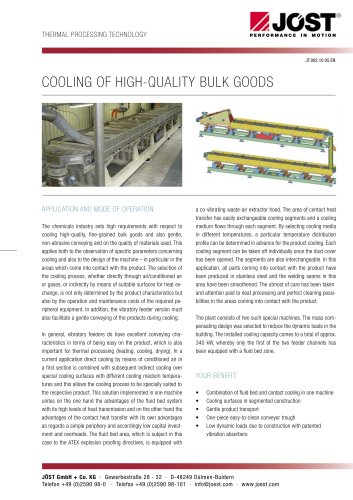
Thermal Processing technology PERFORMANCE in mo t i on JT.002.10.05.EN Cooling of High-Quality Bulk Goods Application and Mode of Operation: The chemicals industry sets high requirements with respect to cooling high-quality, fine-grained bulk goods and also gentle, non-abrasive conveying and on the quality of materials used. This applies both to the observation of specific parameters concerning cooling and also to the design of the machine – in particular in the areas which come into contact with the product. The selection of the cooling process, whether directly through air/conditioned air or gases, or indirectly by means of suitable surfaces for heat exchange, is not only determined by the product characteristics but also by the operation and maintenance costs of the required peripheral equipment. In addition, the vibratory feeder version must also facilitate a gentle conveying of the products during cooling. In general, vibratory feeders do have excellent conveying characteristics in terms of being easy on the product, which is also important for thermal processing (heating, cooling, drying). In a current application direct cooling by means of conditioned air in a first section is combined with subsequent indirect cooling over special cooling surfaces with different cooling medium temperatures and this allows the cooling process to be specially suited to the respective product. This solution implemented in one machine unites on the one hand the advantages of the fluid bed system with its high levels of heat transmission and on the other hand the advantages of the contact heat transfer with its own advantages as regards a simple periphery and accordingly low capital investment and overheads. The fluid bed area, which is subject in this case to the ATEX explosion proofing directives, is equipped with a co-vibrating waste-air extractor hood. The area of contact heat transfer has easily exchangeable cooling segments and a cooling medium flows through each segment. By selecting cooling media in different temperatures, a particular temperature distribution profile can be determined in advance for the product cooling. Each cooling segment can be taken off individually once the dust cover has been opened. The segments are also interchangeable. In this application, all parts coming into contact with the product have been produced in stainless steel and the welding seams in this area have been smoothened. The utmost of care has been taken and attention paid to neat processing and perfect cleaning possibilities in the areas coming into contact with the product. The plant consists of two such special machines. The mass compensating design was selected to reduce the dynamic loads in the building. The installed cooling capacity comes to a total of approx. 340 kW, whereby only the first of the two feeder channels has been equipped with a fluid bed zone. Your benefit: • • • • • Combination of fluid bed and contact cooling in one machine Cooling surfaces in segmented construction Gentle product transport One-piece easy-to-clean conveyor trough Low dynamic loads due to construction with patented vibration absorbers JÖST GmbH + Co. KG · Gewerbestraße 28 - 32 · D-48249 Dülmen-Buldern Telefon +49 (0)2590 98-0 · Telefax +49 (0)2590 98-101 · [email protected] · www.joest.com
Open the catalog to page 1All JÖST catalogs and technical brochures
 BIGGEST VIBRATION AIR
10 Pages
 recycling
6 Pages
 Mining, Minerals, Quarrying
6 Pages
 Foundry Industry
8 Pages
 Lost Foam Process
1 Page
 ZUFS sand attrition unit
1 Page
 FDL Dosing feeder
2 Pages
 charging machine
1 Page
 Air separation Table
2 Pages
 Belt weighting scale
1 Page
 Spiral elevator cooler
1 Page
 FSMG Casting cooler
1 Page
 Granulate dryer
1 Page
 FSM Bridge conveyor
1 Page
 JT.006.10.04
1 Page
 JT.007.12.02
1 Page
 JT.004.10.04
1 Page
 JT.003.01.01
1 Page
 JT.008.11.05
1 Page


Archived catalogs
 casting cooler
4 Pages


- Transport rail conveyor
- Belt conveyor
- Chiller
- Drying system
- Conveying belt
- Solids separator
- Screening unit
- Lifting system
- Bulk material screening machine
- Centrifugal classifier
- Air chiller
- Inclined conveyor
- Work conveyor
- Kilogram weighing scale
- Industrial conveyor belt
- Tube connector
- Continuous drying system
- Modular conveyor