
- Catalogs
- Jinan Saicheng Electronic Technology Co.,LTD
- Why Your Adhesive Peel Tests Fail in Production: Choosing Between 90° and 180°


- Company
- Products
- Catalogs
- News & Trends
- Exhibitions
Why Your Adhesive Peel Tests Fail in Production: Choosing Between 90° and 180°
Why Your Adhesive Peel Tests Fail in Production: Choosing Between 90° and 180°
Production teams often encounter adhesive failures despite laboratory tests indicating strong adhesion. This discrepancy may arise from inappropriate peel test methods that do not reflect actual production conditions. Choosing between 90° and 180° peel tests is crucial for accurate quality control.
Laboratory tests provide static measurements under controlled conditions, which may not match the dynamic and varied conditions in production. Common production issues include label detachment, adhesive residue, and delamination, which may not be predicted by standard tests.
Understanding the root cause of adhesive failure is essential. Potential causes include interfacial adhesion degradation, cohesive failure, substrate surface changes, mechanical stiffness mismatch, process variable drift, and specimen preparation discrepancies.
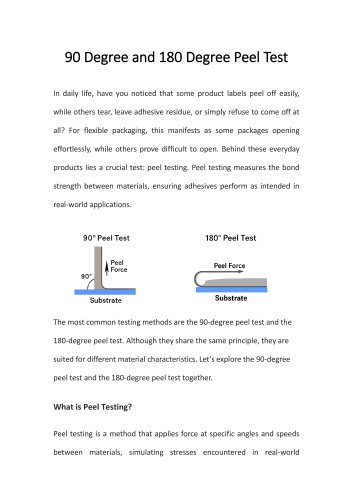
The choice between 90° and 180° peel tests affects the stress distribution during testing. A 90° test focuses stress at the bond interface, while a 180° test involves significant bending stress. These differences mean results from one test cannot substitute for the other.
Comparing peel strength values without considering test conditions can lead to incorrect conclusions. Factors such as test angle, substrate, specimen structure, tensile speed, environmental conditioning, and fixture alignment must be consistent for valid comparisons.
The 180° peel test may not be suitable for hard/thick substrates, materials prone to stretching, mismatched operating conditions, or frequent substrate tearing. These conditions can distort data and fail to reflect true adhesion.
The 90° configuration is better for rigid/semi-rigid substrates, strain-sensitive materials, low-force release testing, and scenarios that replicate real-world conditions like vertical peeling.
When laboratory data does not align with production issues, the focus should be on ensuring test configurations replicate real-world conditions. The choice between 90° and 180° setups is critical for obtaining actionable data for quality control and troubleshooting.
Catalog excerpts
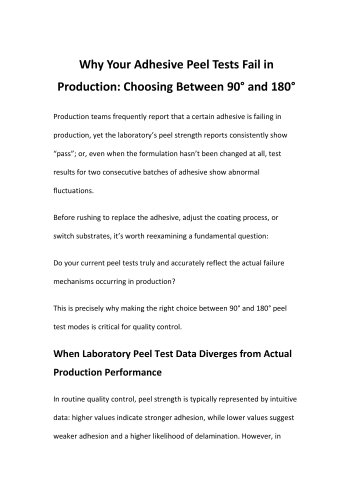
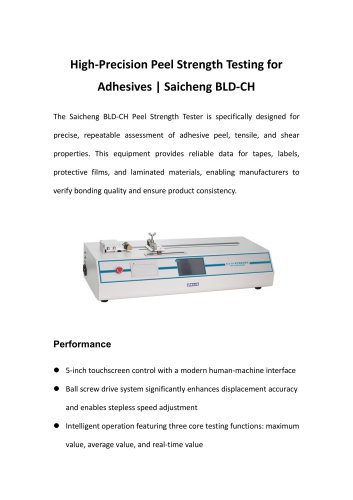
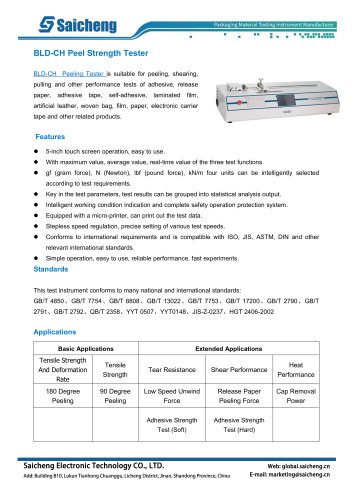
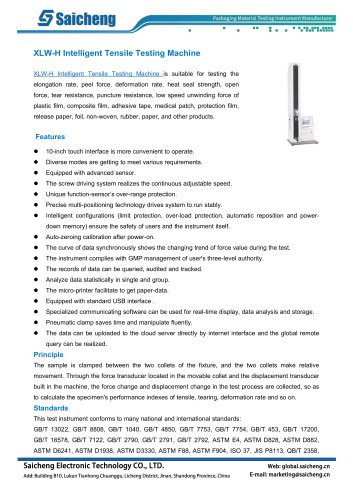
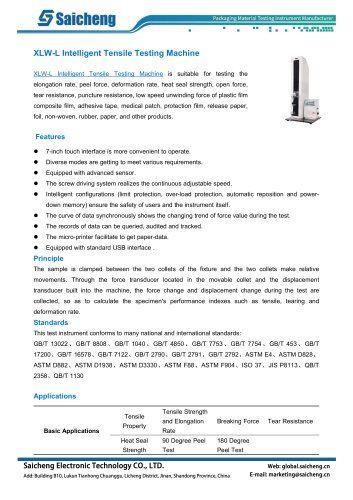
Why Your Adhesive Peel Tests Fail in Production: Choosing Between 90° and 180° Production teams frequently report that a certain adhesive is failing in production, yet the laboratory’s peel strength reports consistently show “pass”; or, even when the formulation hasn’t been changed at all, test results for two consecutive batches of adhesive show abnormal fluctuations. Before rushing to replace the adhesive, adjust the coating process, or switch substrates, it’s worth reexamining a fundamental question: Do your current peel tests truly and accurately reflect the actual failure mechanisms occurring in production? This is precisely why making the right choice between 90° and 180° peel test modes is critical for quality control. When Laboratory Peel Test Data Diverges from Actual Production Performance In routine quality control, peel strength is typically represented by intuitive data: higher values indicate stronger adhesion, while lower values suggest weaker adhesion and a higher likelihood of delamination.
Open the catalog to page 1
actual production scenarios, unexpected failures can still occur even when test data meets specifications. • Automatic labeling and peeling: labels flying off, being flung away, or curling at the edges • Removal of pressure-sensitive tape: adhesive residue, substrate tear, or transfer • Delamination of composite films and laminates: localized bubbles or delamination during processing • Component assembly and package opening: excessive opening force causing package tears, or insufficient opening force leading to seal failure • Material converting and slitting: adhesive overflow or delamination...
Open the catalog to page 2
When production anomalies arise, the effective approach is to investigate the root cause of the failure, rather than adjusting test parameters or angles. Consider a multilayer composite that begins to delaminate during high-speed machining. Although the surface symptom may simply appear to be "poor adhesion," there are many potential causes for this issue: • Interfacial adhesion degradation: Loss of chemical or mechanical bonding between the adhesive and the substrate. • Cohesive failure: Weakened internal strength within the adhesive layer, incomplete curing, or thermal degradation. • Substrate...
Open the catalog to page 3
Given these multiple causes, different investigative methods are required to determine the root cause. Only when the specimen structure, geometry, and test configuration accurately replicate the actual failure modes observed on the production line can peel testing provide actionable engineering insights. Why the Peel Angle Can Change the Meaning of the Result? The difference between 90-degree and 180-degree peel tests goes beyond mere geometry; it alters the kinematics and stress state of the specimen during the peel process. In a 90-degree peel test, the material peels away from the substrate...
Open the catalog to page 4
Suppose you receive materials from a supplier with a stated peel strength of 6 N/25 mm, but your own testing yields a result of 5.2 N/25 mm. It's very likely that you would immediately conclude this batch is non-conforming, but before doing so, you must clarify the following: • Test angle: Did both parties use the exact same 90° or 180° configuration? • Test substrate: Are the material type, surface treatment, and dyne value of the substrate used for testing consistent? • Specimen structure: Have the adhesive layer thickness, substrate thickness, and lamination pressure been exactly replicated?...
Open the catalog to page 5
When Should You Question the 180° Method? In the fields of adhesive and packaging testing, the 180° peel test is often used as the default testing standard due to its simple fixtures and ease of operation. However, “commonly used” does not equate to “appropriate.” When your testing system involves the following materials or operating conditions, applying the 180° test may result in severe data distortion: Hard/thick substrates: Forcibly folding the substrate generates significant bending stress, causing most of the test force to be dissipated in “bending the substrate” rather than “peeling...
Open the catalog to page 6
The 90° configuration effectively isolates bending energy from tensile deformation, concentrating the external force purely on the adhesive interface: • Rigid/semi-rigid substrates: Tapes/labels adhered to metal sheets, glass, hard plastics, or PCBs. • Strain-sensitive materials: Films, flexible packaging laminates, and ductile tapes, to prevent interference from material stretching. • Low-force release force testing: Stable measurement of low-adhesion release liners (paper or film). • Reproduction of real-world conditions: 1:1 simulation of vertical peel scenarios such as label dispensing from...
Open the catalog to page 7
are strictly controlled—does peel strength data become truly actionable for quality control, vendor auditing, line troubleshooting, and adhesive R&D. For a more detailed comparison of 90° vs. 180° peel testing, including method selection, standards, influencing factors, and practical testing considerations, see 90° vs 180° Peel Test: Choose the Right Peel Test Meth
Open the catalog to page 8All Jinan Saicheng Electronic Technology Co.,LTD catalogs and technical brochures
 ASTM F2096
4 Pages
 Saicheng ASTM D3078 Standard
3 Pages
 Why Test Food Texture
3 Pages
 Saicheng Leak Tester MFY-02
2 Pages
 Saicheng Leak Tester MFY-CM
2 Pages




- Test machine
- Gas analyzer
- Concentration analyzer
- Automatic analyser
- Automated testing machine
- Material test machine
- Computer-controlled test machine
- Portable analyzer
- Continuous analyzer
- Digital tester
- Industrial testing machine
- Vertical testing machine
- Automatic tester
- Real-time analyzer
- Industrial tester
- Laboratory analyzer
- Tensile testing machine
- Laboratory testing machine
- Universal testing machine
- Compact analyzer