- Catalogs
- Jinan Saicheng Electronic Technology Co.,LTD
- Why Test Food Texture


- Company
- Products
- Catalogs
- News & Trends
- Exhibitions
Why Test Food Texture
Why Test Food Texture
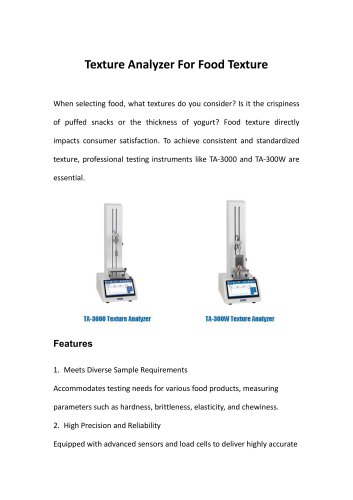
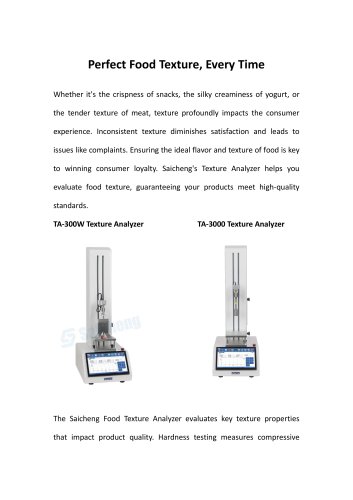
Texture is a crucial factor in consumer acceptance of food products. Descriptions such as "crispy," "chewy," or "smooth" highlight the importance of texture alongside flavor. Manufacturers increasingly market products based on texture, necessitating the use of food texture analyzers for consistent production.
Converting Sensory Perceptions into Measurable Data
Food texture involves mechanical and physical properties like hardness, toughness, and chewiness. Texture analyzers transform subjective sensory experiences into objective, repeatable data.
Production Batch Consistency
Variations in raw materials, moisture content, or processing conditions can lead to texture differences. Texture analysis ensures consistency across production batches.
Product Development
Data-driven monitoring allows for precise flavor adjustments, aiding in product development that aligns with consumer expectations.
Quality Control
Standardized control through texture analysis ensures product quality and minimizes consumer complaints.
Applications
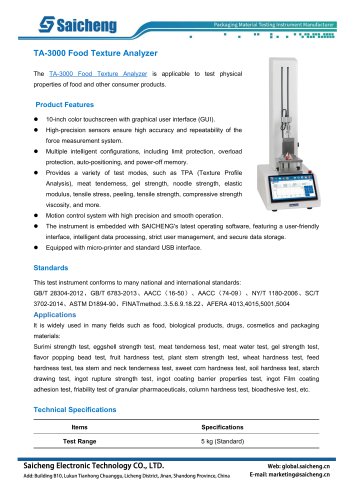
Food texture analyzers are utilized in various industries, including baking, dairy, meat, confectionery, snacks, and processed foods. They measure attributes such as potato chip crispness, meat tenderness, and butter spreadability, supporting both research and development (R&D) and daily production control.
Further Reading
For a comprehensive understanding of food texturometers and their real-world applications, refer to the guide: Food Texture Analyzer for Food Testing: Definition, Principles & Applications.
Catalog excerpts
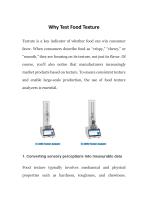
Why Test Food Texture Texture is a key indicator of whether food can win consumer favor. When consumers describe food as “crispy,” “chewy,” or “smooth,” they are focusing on its texture, not just its flavor. Of course, you’ll also notice that manufacturers increasingly market products based on texture. To ensure consistent texture and enable large-scale production, the use of food texture analyzers is essential. 1. Converting sensory perceptions into measurable data Food texture typically involves mechanical and physical properties such as hardness, toughness, and
Open the catalog to page 1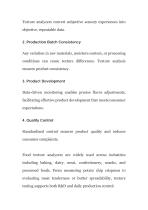
Texture analyzers convert subjective sensory experiences into objective, repeatable data. Any variation in raw materials, moisture content, or processing conditions can cause texture differences. Texture analysis ensures product consistency. Data-driven monitoring enables precise flavor adjustments, facilitating effective product development that meets consumer expectations. Standardized control ensures product quality and reduces consumer complaints. Food texture analyzers are widely used across industries including baking, dairy, meat, confectionery, snacks, and processed foods. From measuring...
Open the catalog to page 2
For readers seeking to understand how food texturometers work and their applications in real-world testing scenarios, this detailed guide provides a comprehensive explanation: Food Texture Analyzer for Food Testing: Definition, Principles & Applications.
Open the catalog to page 3All Jinan Saicheng Electronic Technology Co.,LTD catalogs and technical brochures
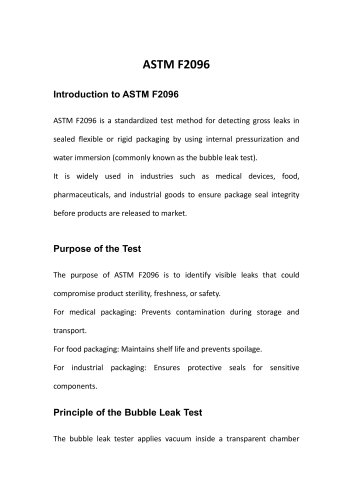 ASTM F2096
4 Pages
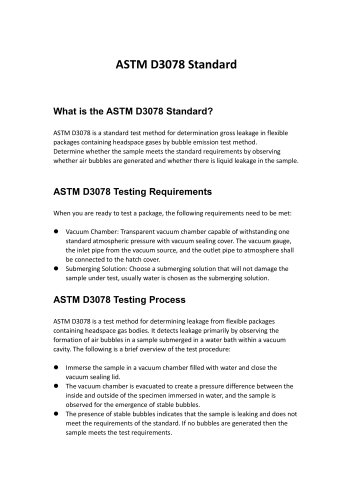 Saicheng ASTM D3078 Standard
3 Pages
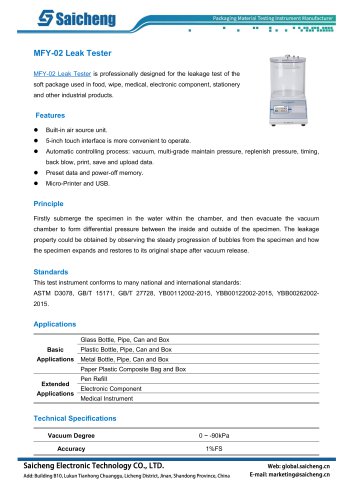 Saicheng Leak Tester MFY-02
2 Pages
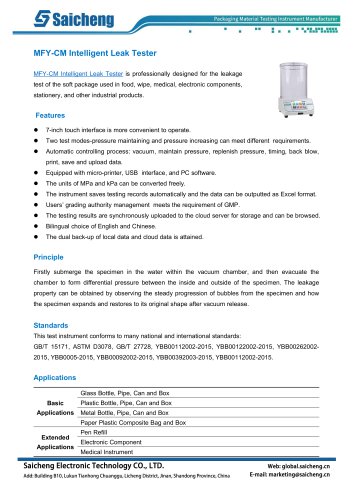 Saicheng Leak Tester MFY-CM
2 Pages