
- Catalogs
- Jinan Saicheng Electronic Technology Co.,LTD
- Why Food Manufacturers Need Objective Gel Strength Testing for Product Consistency


- Company
- Products
- Catalogs
- News & Trends
- Exhibitions
Why Food Manufacturers Need Objective Gel Strength Testing for Product Consistency
Why Food Manufacturers Need Objective Gel Strength Testing for Product Consistency
Introduction
Food manufacturers face challenges in ensuring consistent texture, firmness, and eating experience across different batches of products. Gelling agents, used in products like gummy candies and yogurt, are sensitive to variations in raw materials and processing conditions, which can lead to inconsistent textures.
The Challenge of Maintaining Consistent Gel Texture
Gels such as gelatin, pectin, and agar are crucial for food texture but are affected by external factors like ingredient concentrations and storage conditions. These variations can lead to differences in texture even with the same formula.
Limitations of Subjective Texture Evaluation
- Operator Dependence: Different operators may have varying perceptions of texture, leading to inconsistent evaluations.
- Detection of Minor Changes: Subtle changes in texture are difficult to detect visually but can affect consumer experience.
- Lack of Quantitative Data: Subjective methods do not provide the quantitative data needed for precise adjustments and R&D efficiency.
Benefits of Objective Gel Strength Testing
Objective testing provides scientific, reproducible evaluations of gel properties, such as compressive force and texture consistency. This data helps ensure batch consistency, optimize formulations, and improve quality control efficiency.
Applications in Food Manufacturing
- Gelatin-based Products: Ensures firmness and chewiness in candies and desserts.
- Dairy Products: Optimizes stabilizers and processing for texture stability in yogurt and puddings.
- Jams and Jellies: Evaluates pectin performance for desired firmness.
- Hydrocolloids: Compares ingredient performance for better stability.
Choosing the Right Testing Method
Common methods include compression testing, penetration testing, Bloom strength testing, and texture profile analysis (TPA). For detailed guidance, refer to the "Gel Strength Texture Analyzer: A Complete Guide to Testing Methods, Factors, and Applications."
Conclusion
Transitioning from subjective evaluations to objective testing with professional texture analyzers can transform subjective experience into objective data, improve R&D efficiency, and establish a robust quality control system.
Catalog excerpts
Why Food Manufacturers Need Objective Gel Strength Testing for Product Consistency Food manufacturers need to ensure that products from different batches offer consistent texture, firmness, and eating experience. Consumers are most concerned about a food’s mouthfeel, firmness, and chewiness, but maintaining product consistency is often not that easy. Products such as gummy candies, jelly desserts, and yogurt often incorporate gelling agents into their formulations to maintain stability. However, gelling agents are highly sensitive materials; even when manufacturers follow the same recipe, variations in raw materials, processing conditions, storage time, and environmental factors can cause the product to deviate from expectations, resulting in textures that are too soft or too hard. To achieve consistency across batches and ensure product stability, manufacturers use gel strength testing to precisely analyze food texture, thereby enhancing product quality.
Open the catalog to page 1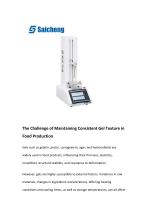
The Challenge of Maintaining Consistent Gel Texture in Food Production Gels such as gelatin, pectin, carrageenan, agar, and hydrocolloids are widely used in food products, influencing their firmness, elasticity, mouthfeel, structural stability, and resistance to deformation. However, gels are highly susceptible to external factors. Variations in raw materials, changes in ingredient concentrations, differing heating conditions and cooling times, as well as storage temperatures, can all affect
Open the catalog to page 2
gel performance, leading to differences in texture characteristics even between two batches of products made from the same formula. Why Subjective Texture Evaluation Is Not Enough? Traditional methods for evaluating food texture rely primarily on visual inspection, touch, or taste. Subjective evaluation has obvious shortcomings: Results Depend on the Operator’s Experience From a subjective standpoint, different operators may have varying perceptions of a product’s firmness or elasticity. One operator might find a product acceptable, while another might consider it too soft or too hard. It is...
Open the catalog to page 3
Subjective inspections struggle to provide quantitative data. When manufacturers need to adjust a formula, the absence of quantitative data makes it difficult to measure changes in the performance of the adjusted formula. This increases the cost of trial and error and reduces R&D efficiency. How Does Objective Gel Strength Testing Improve Food Quality Control? Objective gel strength testing provides a scientific and reproducible method for evaluating the mechanical properties of gel products, such as maximum compressive force, gel hardness, structural strength, resistance to deformation, and...
Open the catalog to page 4
Gelatin-based Products: Gel strength directly affects the firmness and chewiness of soft candies, gelatin desserts, and marshmallows. Gel strength testing evaluates gel quality to ensure products meet expectations. • Dairy Products and Gel-Based Desserts: Products such as yogurt, pudding, and other dairy items rely on a stable gel structure to ensure texture and prevent water separation. Gel strength testing helps manufacturers optimize stabilizers, fermentation conditions, and processing parameters to enhance product stability. • Jams and Jellies: Gel strength testing evaluates the performance...
Open the catalog to page 5
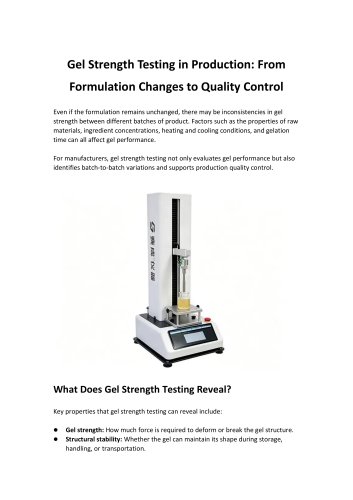
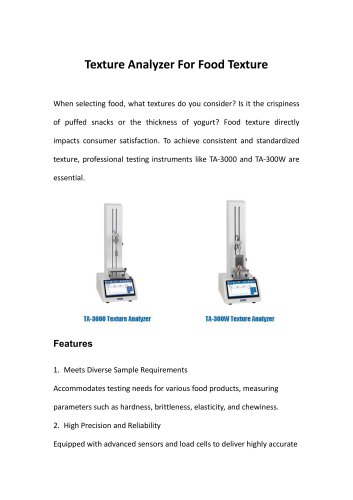
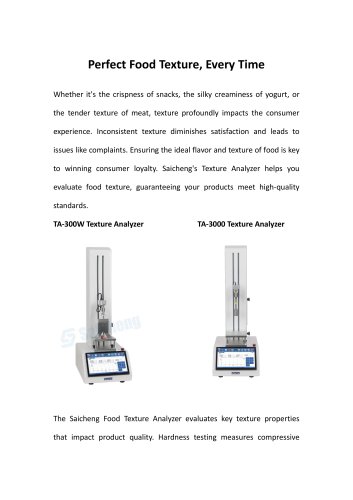
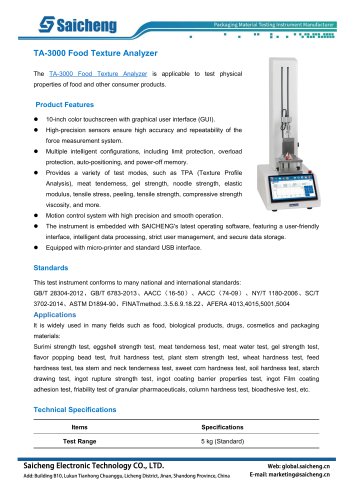
For a detailed explanation of testing methods, equipment selection, and applications, you can learn more from this guide: Gel Strength Texture Analyzer: A Complete Guide to Testing Methods, Factors, and Applications Conclusion By moving away from traditional, subjective, experience-based judgments and adopting professional texture analyzers(Saicheng TA-3000 texture analyzers ) to test the gel properties of food products, you can transform subjective experience into objective data, scientifically evaluate product texture, improve formulation R&D efficiency, and establish a robust quality control...
Open the catalog to page 6All Jinan Saicheng Electronic Technology Co.,LTD catalogs and technical brochures
 ASTM F2096
4 Pages
 Saicheng ASTM D3078 Standard
3 Pages
 Why Test Food Texture
3 Pages
 Saicheng Leak Tester MFY-02
2 Pages
 Saicheng Leak Tester MFY-CM
2 Pages



























- Test machine
- Gas analyzer
- Concentration analyzer
- Automatic analyser
- Automated testing machine
- Material test machine
- Computer-controlled test machine
- Portable analyzer
- Continuous analyzer
- Digital tester
- Industrial testing machine
- Vertical testing machine
- Automatic tester
- Real-time analyzer
- Laboratory analyzer
- Industrial tester
- Tensile testing machine
- Laboratory testing machine
- Universal testing machine
- Compact analyzer