
- Catalogs
- Jinan Saicheng Electronic Technology Co.,LTD
- Why Flexible Packaging Leak Testing Fails


- Company
- Products
- Catalogs
- News & Trends
- Exhibitions
Why Flexible Packaging Leak Testing Fails
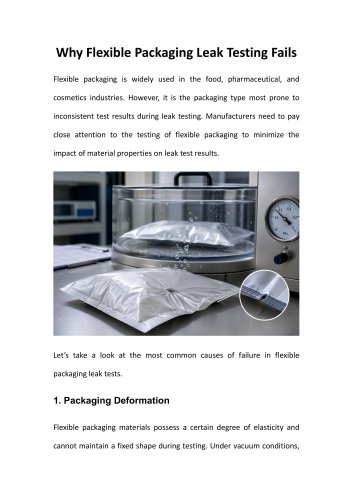
Why Flexible Packaging Leak Testing Fails
Catalog excerpts
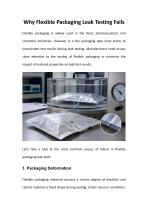
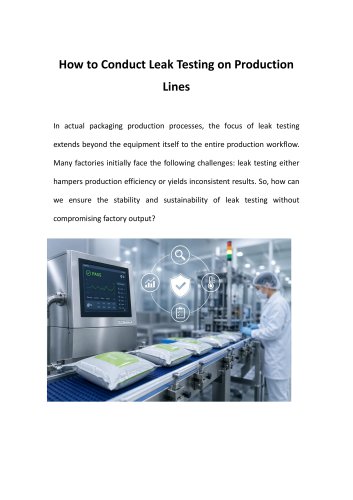
Why Flexible Packaging Leak Testing Fails Flexible packaging is widely used in the food, pharmaceutical, and cosmetics industries. However, it is the packaging type most prone to inconsistent test results during leak testing. Manufacturers need to pay close attention to the testing of flexible packaging to minimize the impact of material properties on leak test results. Let’s take a look at the most common causes of failure in flexible packaging leak tests. 1. Packaging Deformation Flexible packaging materials possess a certain degree of elasticity and cannot maintain a fixed shape during testing. Under vacuum conditions,
Open the catalog to page 1
the material is stretched and deforms, leading to instability in the internal pressure and making it difficult to interpret pressure change signals. When testing flexible packaging, manufacturers can use restraint plates or other fixtures to limit deformation. 2. Seal Quality If the seal quality differs significantly from expectations, accurate test results cannot be obtained even if the correct parameters are set during testing. For example, uneven temperature distribution along the seal or misalignment of the film can affect seal quality. Manufacturers should regularly monitor seal temperature...
Open the catalog to page 2
4. Failure to Adjust Test Parameters Different types of packaging require different test parameters. Without adjusting these parameters, it is impossible to accurately detect the packaging’s actual leakage conditions. Manufacturers need to configure customized parameter settings for flexible packaging and extend the duration of micro-leak testing. Conditions Most leak tests are conducted in controlled environments; however, testing should reflect the conditions packaging encounters in real-world scenarios. Select a testing environment that simulates actual pressure conditions, including the effects...
Open the catalog to page 3All Jinan Saicheng Electronic Technology Co.,LTD catalogs and technical brochures
 ASTM F2096
4 Pages
 Saicheng ASTM D3078 Standard
3 Pages
 Why Test Food Texture
3 Pages
 Saicheng Leak Tester MFY-02
2 Pages
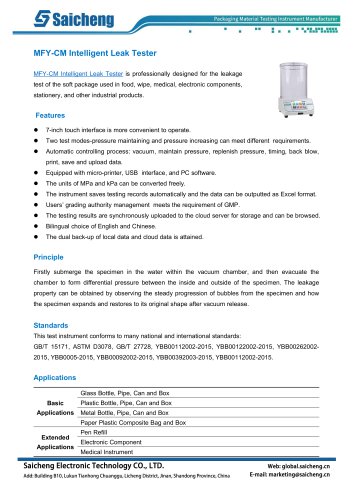 Saicheng Leak Tester MFY-CM
2 Pages


- Test machine
- Gas analyzer
- Concentration analyzer
- Automatic analyser
- Material test machine
- Automated testing machine
- Computer-controlled test machine
- Portable analyzer
- Continuous analyzer
- Digital tester
- Industrial testing machine
- Vertical testing machine
- Automatic tester
- Real-time analyzer
- Laboratory analyzer
- Industrial tester
- Tensile testing machine
- Laboratory testing machine
- Universal testing machine
- Compact analyzer