
- Catalogs
- Jinan Saicheng Electronic Technology Co.,LTD
- When to Use Vacuum Decay Leak Testing


- Company
- Products
- Catalogs
- News & Trends
- Exhibitions
When to Use Vacuum Decay Leak Testing
When to Use Vacuum Decay Leak Testing
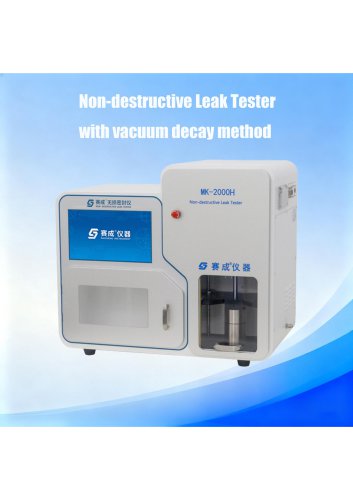
Vacuum decay testing is a prevalent method for leak detection, offering quantitative data and being non-destructive. However, its suitability depends on specific conditions.
Principle of Vacuum Decay Testing
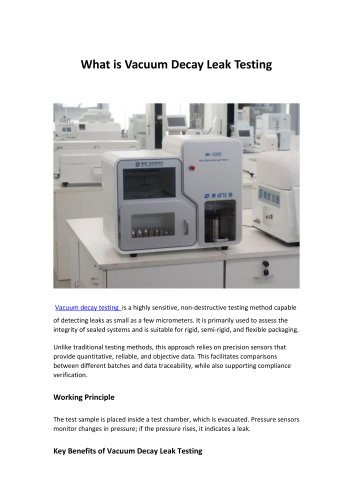
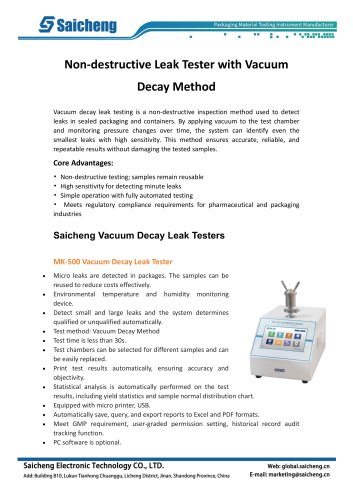
This method involves placing a sample in a test chamber, evacuating it to a preset vacuum level, and monitoring pressure changes. A leak causes gas to escape into the chamber, raising the pressure.
Optimal Conditions for Vacuum Decay Testing
- Detection of Minute Leaks: Essential when regulations demand detection of very small leaks, as traditional methods fall short.
- Non-destructive Testing: Ideal for high-value products or when sample integrity must be preserved.
- Quantitative Leak Detection: Provides precise, repeatable, and consistent results, unlike visual inspections.
- Industry Standards: Recognized by ASTM F2338 and USP 1207, widely used in pharmaceuticals and medical devices.
Applicable Packaging Types
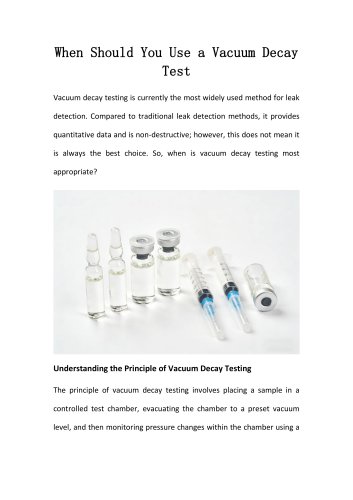
- Pharmaceutical packaging (vials, ampoules, syringes)
- Medical device packaging
- Flexible food packaging with headspace
- Sealed containers requiring barrier integrity
Inapplicable Packaging Types
- Porous materials
- Packaging without headspace
- Very soft packaging that deforms under vacuum
In these cases, alternative testing methods should be considered based on packaging characteristics.
Conclusion
While not suitable for all packaging types, vacuum decay testing is optimal for detecting minute leaks, ensuring sample integrity, and performing quantitative analysis, thereby supporting product safety and quality control.
Catalog excerpts
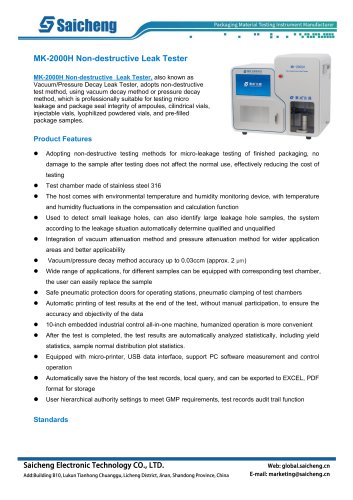
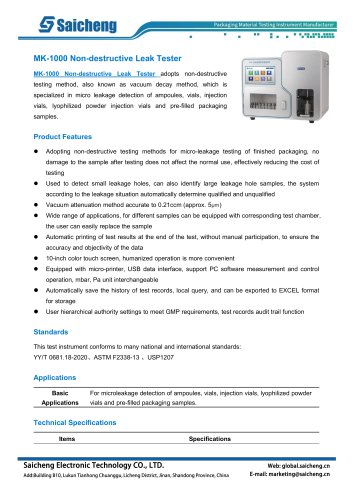
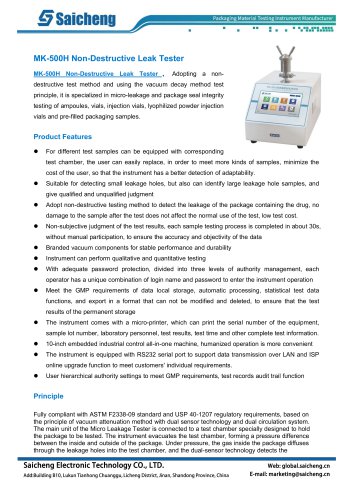
When to Use Vacuum Decay Leak Testing Vacuum decay testing is currently the most widely used method for leak detection. Compared to traditional leak detection methods, it provides quantitative data and is non-destructive; however, this does not mean it is always the best choice. So, when is vacuum decay testing most appropriate? Understanding the Principle of Vacuum Decay Testing The principle of vacuum decay testing involves placing a sample in a controlled test chamber, evacuating the chamber to a preset vacuum level, and then monitoring pressure changes within the chamber using a pressure sensor. If a leak exists, gas from the packaging will escape into the test chamber, causing the pressure to rise. When Is It the Best Choice? Although vacuum decay testing is currently widely used, it is the best choice only when the following requirements are met: 1. Detection of Minute Leaks If industry regulations require the detection of minute leaks, vacuum decay testing must be used. Traditional leak detection methods are unable to detect such minute leaks, making vacuum decay testing
Open the catalog to page 1
necessary to ensure industry compliance. If your product is high-value or requires the integrity of the sample to be maintained, vacuum decay testing is the best choice. Traditional leak detection typically relies on visual inspection and cannot provide quantitative data. Vacuum decay testing uses sensors for precise detection, delivering quantitative, repeatable, and consistent results. Vacuum decay testing is recognized by the ASTM F2338 and USP 1207 standards and is widely used in regulated industries such as pharmaceuticals and medical devices. The most common packaging types for vacuum decay...
Open the catalog to page 2
Inapplicable Packaging Types Vacuum decay testing is not a universal solution and is not universally applicable; it is not suitable in the following situations: Porous materials Packaging without headspace Packaging that is very soft and deforms significantly under vacuum In these cases, vacuum decay testing is not suitable. The appropriate testing method should be selected based on the packaging characteristics. Vacuum decay testing is not suitable for all packaging types. However, when you need to detect minute leaks, ensure sample integrity, or perform quantitative analysis, vacuum decay...
Open the catalog to page 3All Jinan Saicheng Electronic Technology Co.,LTD catalogs and technical brochures
 ASTM F2096
4 Pages
 Saicheng ASTM D3078 Standard
3 Pages
 Why Test Food Texture
3 Pages
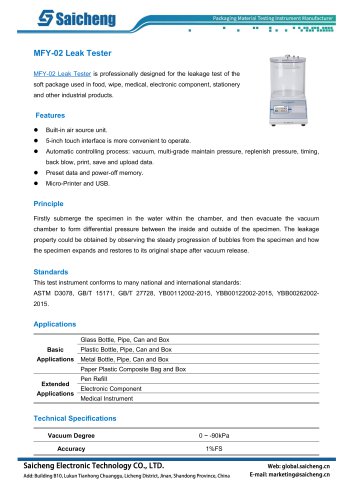 Saicheng Leak Tester MFY-02
2 Pages
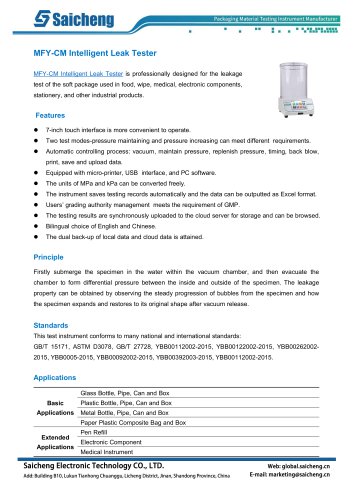 Saicheng Leak Tester MFY-CM
2 Pages


- Test machine
- Gas analyzer
- Concentration analyzer
- Automatic analyser
- Automated testing machine
- Material test machine
- Computer-controlled test machine
- Portable analyzer
- Continuous analyzer
- Digital tester
- Industrial testing machine
- Vertical testing machine
- Automatic tester
- Real-time analyzer
- Laboratory analyzer
- Industrial tester
- Tensile testing machine
- Laboratory testing machine
- Universal testing machine
- Compact analyzer