
- Catalogs
- Jinan Saicheng Electronic Technology Co.,LTD
- What Is The Gel Strength Test


- Company
- Products
- Catalogs
- News & Trends
- Exhibitions
What Is The Gel Strength Test
What Is The Gel Strength Test
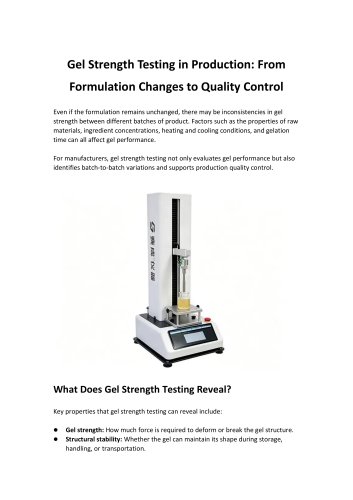
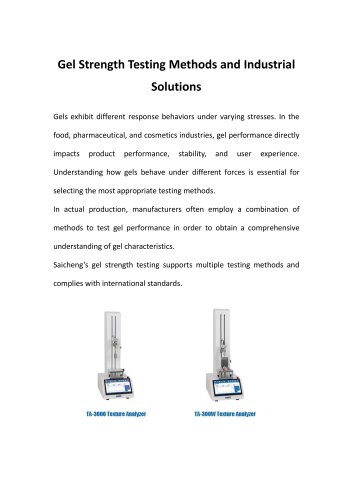
Gel strength testing is a standardized method to evaluate a gel's performance under external forces, focusing on its ability to withstand compressive, shear, and puncture forces before deformation or rupture. This test measures the integrity and stability of the gel's internal network.
Common Methods of Gel Strength Testing
Several methods are used for gel strength testing, chosen based on specific requirements:
- Compression force testing: Assesses overall structural strength under pressure.
- Puncture force testing: Measures localized resistance and surface integrity.
- Bloom standard testing: A standardized method for comparing gelatin strength.
- Shear force testing: Evaluates gelatin strength through standardized methods.
Properties Evaluated by Gel Strength Testing
The test primarily evaluates mechanical properties and stability, focusing on:
- Gel strength
- Deformation resistance
- Rupture resistance
- Stability
- Texture consistency
Importance of Gel Strength Testing
Gel strength testing is crucial in industries like food, pharmaceuticals, and cosmetics due to the sensitivity of gel materials to production changes. It ensures:
- Consistency across production batches
- Evaluation of formulation performance and new product development
- Structural stability of gels
- Compliance with industry standards
Factors Affecting Gel Strength Testing Results
Several factors can influence gel strength results, including:
- Type and concentration of gelling agent
- Temperature conditions
- Setting and cooling times
- Test parameter settings
- Sample preparation consistency
Applications of Gel Strength Testing
Gel strength testing is applied across various industries to ensure product stability and functionality:
- Food Industry: Ensures consistency in texture and firmness in products like desserts and dairy.
- Pharmaceutical Industry: Used in soft capsules and medicinal gels for controlled drug release and protection of active ingredients.
- Cosmetics and Personal Care: Ensures stable gel properties in skincare formulations.
- Biotechnology and Medical Materials: Evaluates mechanical integrity of biomaterials like hydrogels and tissue scaffolds.
- Industrial and Materials Sectors: Assesses mechanical stability of hydrogels and sealants for applications involving water absorption and structural support.
Conclusion
Gel strength testing provides a quantitative approach to ensure batch consistency and maintain product quality and safety. Saicheng’s gel strength testers offer reliable data for quality control and material evaluation.
Catalog excerpts
What Is The Gel Strength Test Introduction Gel strength test is a standardized quantitative method for evaluating a gel’s performance under external forces. It primarily involves applying controlled compressive, shear, and puncture forces to the gel to determine the maximum force it can withstand before its internal structure deforms or ruptures. This measurement reflects the integrity and stability of the internal gel network. The principle of operation involves a probe descending at a uniform speed. Upon contacting the gel surface, the probe and the gel structure begin to interact. As the probe continues to apply pressure, the gel eventually reaches a point where its internal structure can no longer maintain its integrity, leading to deformation or rupture. A real-time curve is generated, with the peak point representing the gel strength. Common Methods of Gel Strength Testing
Open the catalog to page 1
There are various methods for gel strength testing, and the specific method should be selected based on testing requirements. Common testing methods include: • Compression force testing: evaluates overall structural strength under pressure. • Puncture force testing: measures localized resistance and surface integrity. • Bloom standard testing: standardized method for gelatin strength comparison. • Shear force testing: standardized method for gelatin strength comparison. Gel strength testing primarily focuses on the mechanical properties and stability of gel structures, evaluating the following...
Open the catalog to page 2
Texture consistency Gel strength testing is widely used in daily life and is relevant to industries, such as food, pharmaceuticals, and cosmetics. Since gel materials are highly sensitive to minute changes, even slight variations during production can significantly impact gel performance, making gel strength testing essential. Through gel strength testing, the following can be achieved: • Consistency across production batches. • Evaluate formulation performance and assess new product development. • Ensure gel structural stability. • Comply with industry standards. Gel strength can vary significantly...
Open the catalog to page 3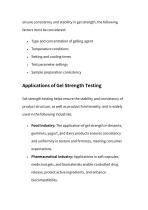
ensure consistency and stability in gel strength, the following factors must be considered: • Type and concentration of gelling agent • Temperature conditions • Setting and cooling times • Test parameter settings • Sample preparation consistency Gel strength testing helps ensure the stability and consistency of product structure, as well as product functionality, and is widely used in the following industries: • Food Industry: The application of gel strength in desserts, gummies, yogurt, and dairy products ensures consistency and uniformity in texture and firmness, meeting consumer expectations....
Open the catalog to page 4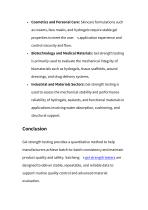
• Cosmetics and Personal Care: Skincare formulations such as creams, face masks, and hydrogels require stable gel properties to meet the user’ s application experience and control viscosity and flow. • Biotechnology and Medical Materials: Gel strength testing is primarily used to evaluate the mechanical integrity of biomaterials such as hydrogels, tissue scaffolds, wound dressings, and drug delivery systems. • Industrial and Materials Sectors: Gel strength testing is used to assess the mechanical stability and performance reliability of hydrogels, sealants, and functional materials in applications...
Open the catalog to page 5All Jinan Saicheng Electronic Technology Co.,LTD catalogs and technical brochures
 ASTM F2096
4 Pages
 Saicheng ASTM D3078 Standard
3 Pages
 Why Test Food Texture
3 Pages
 Saicheng Leak Tester MFY-02
2 Pages
 Saicheng Leak Tester MFY-CM
2 Pages

- Test machine
- Gas analyzer
- Concentration analyzer
- Automatic analyser
- Automated testing machine
- Material test machine
- Computer-controlled test machine
- Portable analyzer
- Continuous analyzer
- Digital tester
- Industrial testing machine
- Vertical testing machine
- Automatic tester
- Real-time analyzer
- Laboratory analyzer
- Industrial tester
- Tensile testing machine
- Laboratory testing machine
- Universal testing machine
- Compact analyzer