
- Catalogs
- Jinan Saicheng Electronic Technology Co.,LTD
- USP 1207 and Container Closure Integrity Testing


- Company
- Products
- Catalogs
- News & Trends
- Exhibitions
USP 1207 and Container Closure Integrity Testing
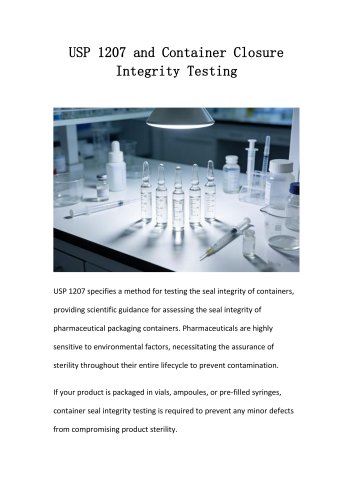
USP 1207 and Container Closure Integrity Testing
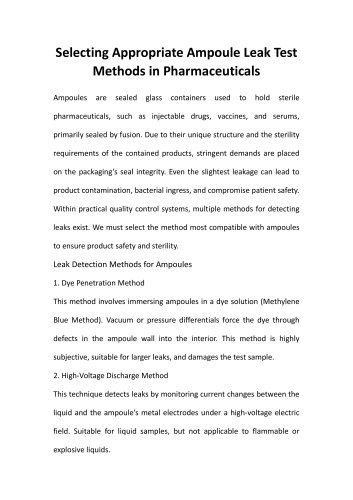
USP 1207 is a chapter in the United States Pharmacopeia that provides scientific guidance for testing the seal integrity of pharmaceutical packaging containers. This is crucial for ensuring the sterility and safety of pharmaceuticals, which are sensitive to environmental factors. The chapter emphasizes the importance of container seal integrity testing for products packaged in vials, ampoules, or pre-filled syringes to prevent contamination.
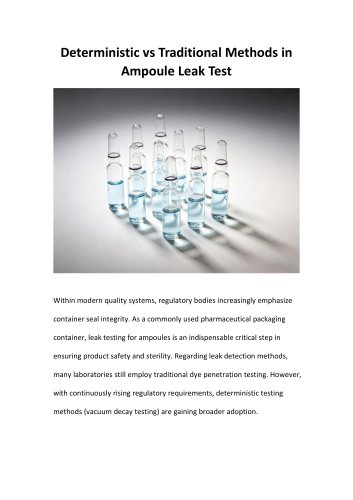
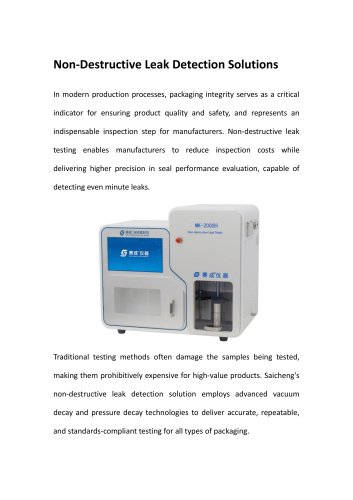
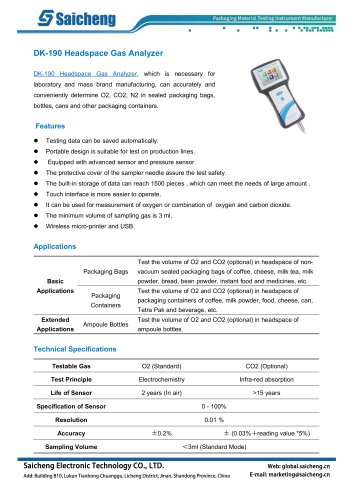
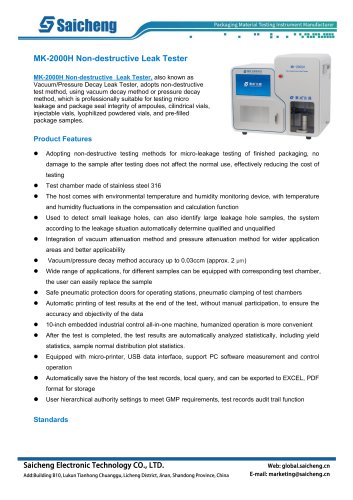
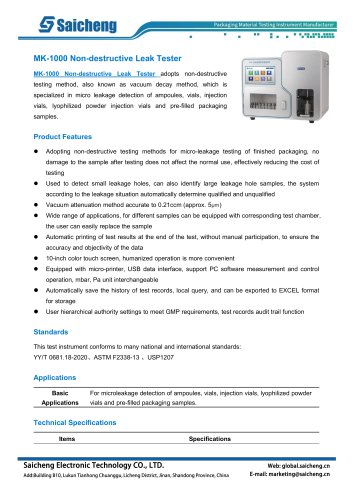
USP 1207 categorizes testing methods into deterministic and probabilistic approaches. Deterministic methods are preferred for their quantitative detection capabilities, providing objective and sensitive results. Examples include vacuum decay testing, pressure decay testing, high voltage leak detection, laser headspace gas analysis, and helium tracer gas leak detection. Probabilistic methods, such as dye penetration testing and bubble escape testing, rely on visual inspection and are less sensitive, often influenced by human factors.
USP 1207 offers a scientific framework for pharmaceutical companies to validate packaging integrity. By adopting reliable container seal integrity testing methods, companies can protect sterile drugs from contamination, detect minute leaks, ensure regulatory compliance, and maintain product stability.
For more detailed information on USP 1207 and container closure integrity testing technologies, refer to USP <1207>: Container Closure Integrity Testing for Pharmaceutical Packaging.
Catalog excerpts
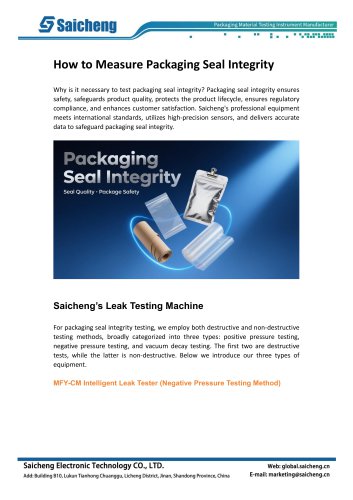
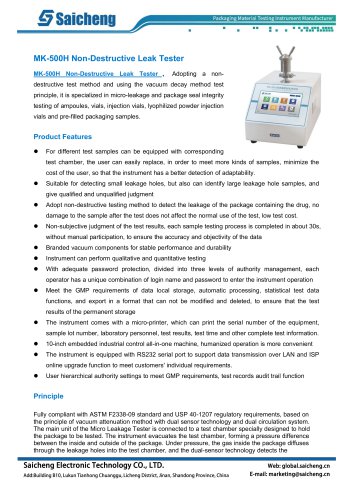
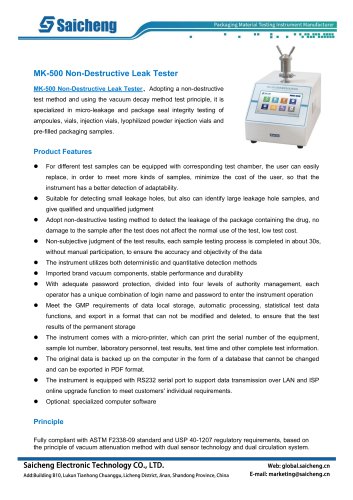
USP 1207 and Container Closure Integrity Testing USP 1207 specifies a method for testing the seal integrity of containers, providing scientific guidance for assessing the seal integrity of pharmaceutical packaging containers. Pharmaceuticals are highly sensitive to environmental factors, necessitating the assurance of sterility throughout their entire lifecycle to prevent contamination. If your product is packaged in vials, ampoules, or pre-filled syringes, container seal integrity testing is required to prevent any minor defects from compromising product sterility.
Open the catalog to page 1
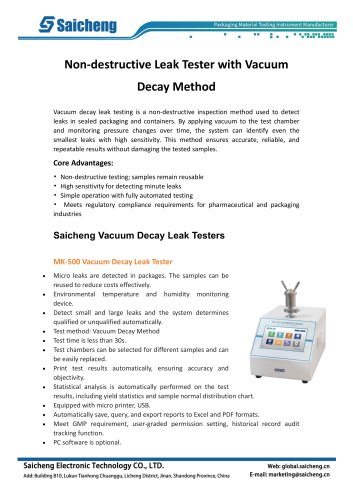
USP 1207 is a chapter of the United States Pharmacopeia that provides scientific guidance for assessing the integrity of pharmaceutical container closure systems. It categorizes testing methods into deterministic and probabilistic approaches, encouraging the use of deterministic methods for leak testing whenever feasible. The testing methods described in this standard are broadly applicable to the following pharmaceutical packaging formats: • Glass vials • Prefilled syringes • Cartridges used in drug delivery devices Deterministic methods enable quantitative detection, providing objective and...
Open the catalog to page 2
Probabilistic methods primarily rely on visual inspection to identify leaks, cannot provide quantitative data, and are significantly influenced by human factors. They include dye penetration testing and bubble escape testing. These methods have low detection sensitivity and cannot identify minute leaks. Therefore, modern pharmaceutical quality systems typically employ deterministic leak detection technologies. Why USP 1207 Matters? USP 1207 provides pharmaceutical companies with a scientific framework for validating packaging integrity. By implementing reliable container seal integrity testing...
Open the catalog to page 3All Jinan Saicheng Electronic Technology Co.,LTD catalogs and technical brochures
 ASTM F2096
4 Pages
 Saicheng ASTM D3078 Standard
3 Pages
 Why Test Food Texture
3 Pages
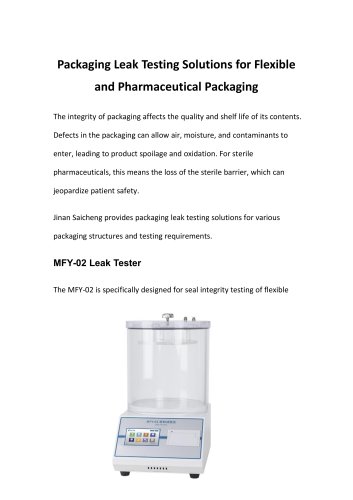
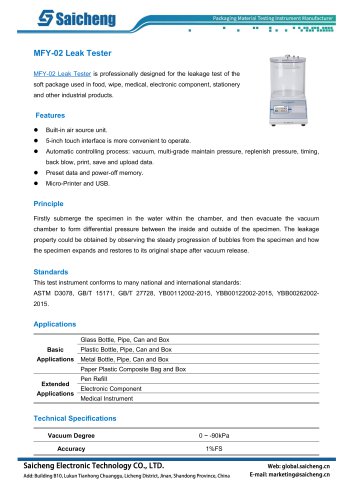 Saicheng Leak Tester MFY-02
2 Pages
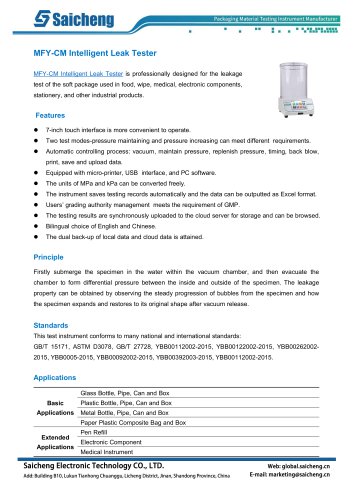 Saicheng Leak Tester MFY-CM
2 Pages

- Test machine
- Gas analyzer
- Concentration analyzer
- Automatic analyser
- Automated testing machine
- Material test machine
- Computer-controlled test machine
- Portable analyzer
- Continuous analyzer
- Digital tester
- Industrial testing machine
- Vertical testing machine
- Automatic tester
- Real-time analyzer
- Industrial tester
- Laboratory analyzer
- Tensile testing machine
- Laboratory testing machine
- Universal testing machine
- Compact analyzer