
- Catalogs
- Jinan Saicheng Electronic Technology Co.,LTD
- Understand ASTM D3078 the Bubble Point Test


- Company
- Products
- Catalogs
- News & Trends
- Exhibitions
Understand ASTM D3078 the Bubble Point Test
Understand ASTM D3078 the Bubble Point Test
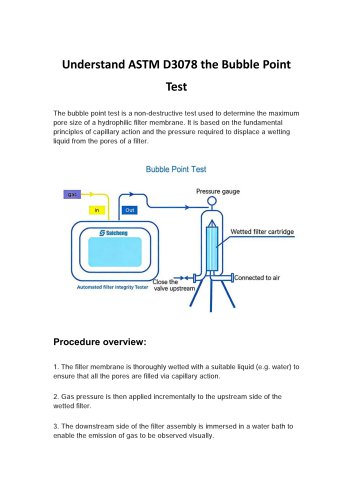
- The filter membrane is wetted with a suitable liquid, such as water, to fill all pores via capillary action.
- Gas pressure is applied incrementally to the upstream side of the wetted filter.
- The downstream side of the filter is immersed in a water bath to visually observe gas emission.
- At low pressures, gas diffuses through the water-filled pores, creating a sparse stream of bubbles downstream.
- Pressure is increased until it surpasses the capillary retention force of the liquid in the largest pore, expelling the liquid and allowing convective gas flow.
- A continuous stream of bubbles from the largest pore is visually detected, marking the bubble point pressure.
Catalog excerpts
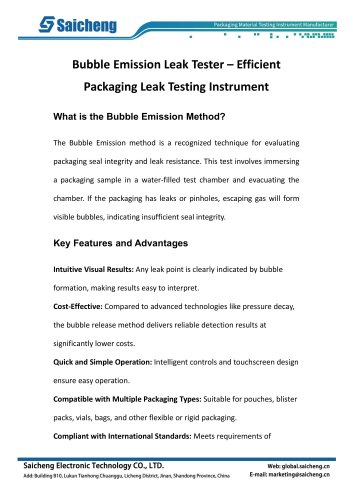
The bubble point test is a non-destructive test used to determine the maximum pore size of a hydrophilic filter membrane. It is based on the fundamental principles of capillary action and the pressure required to displace a wetting liquid from the pores of a filter. Procedure overview: 1. The filter membrane is thoroughly wetted with a suitable liquid (e.g. water) to ensure that all the pores are filled via capillary action. 2. Gas pressure is then applied incrementally to the upstream side of the wetted filter. 3. The downstream side of the filter assembly is immersed in a water bath to enable the emission of gas to be observed visually.
Open the catalog to page 1
4. Initially, at low pressures, gas diffuses through the water-filled pores via dissolution and diffusion, generating a sparse, intermittent stream of bubbles downstream. 5. The pressure is then gradually increased until it exceeds the capillary retention force of the liquid in the largest pore. At this critical pressure, the liquid is forcibly expelled from the pore, enabling convective gas flow in larger quantities. 6. The onset of a continuous, steady stream of bubbles from the largest pore is then visually detected. The gas pressure recorded at this transition point is defined as the bubble...
Open the catalog to page 2All Jinan Saicheng Electronic Technology Co.,LTD catalogs and technical brochures
 ASTM F2096
4 Pages
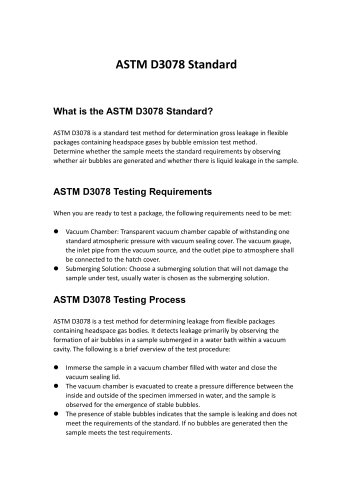 Saicheng ASTM D3078 Standard
3 Pages
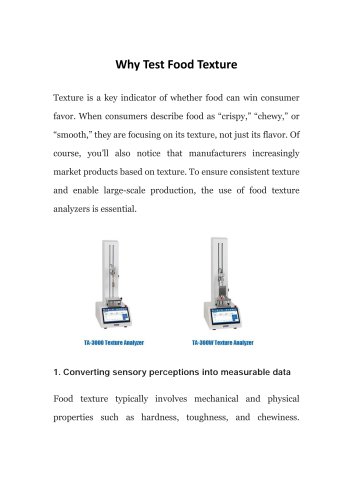 Why Test Food Texture
3 Pages
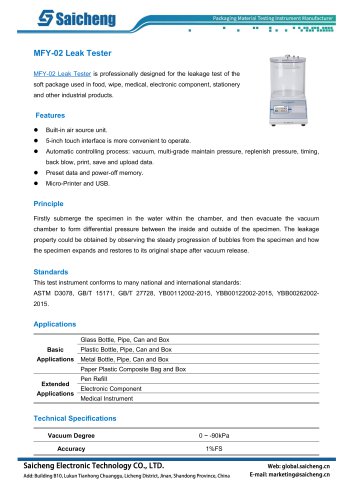 Saicheng Leak Tester MFY-02
2 Pages
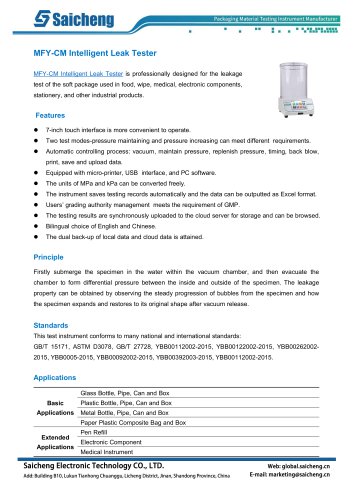 Saicheng Leak Tester MFY-CM
2 Pages




- Test machine
- Gas analyzer
- Concentration analyzer
- Automatic analyser
- Automated testing machine
- Material test machine
- Computer-controlled test machine
- Portable analyzer
- Continuous analyzer
- Digital tester
- Industrial testing machine
- Vertical testing machine
- Automatic tester
- Real-time analyzer
- Laboratory analyzer
- Industrial tester
- Tensile testing machine
- Laboratory testing machine
- Universal testing machine
- Compact analyzer