
- Catalogs
- Jinan Saicheng Electronic Technology Co.,LTD
- Saicheng Advanced Leak Test Methods for Blister Packaging


- Company
- Products
- Catalogs
- News & Trends
- Exhibitions
Saicheng Advanced Leak Test Methods for Blister Packaging
Saicheng Advanced Leak Test Methods for Blister Packaging
Blister packaging is crucial in the pharmaceutical, medical device, and nutraceutical industries for maintaining product efficacy and patient safety. Even microscopic leaks can compromise sterility and degrade active ingredients, necessitating advanced leak testing methods beyond visual inspection to comply with global regulations.
Package failure can lead to product loss, recalls, regulatory actions, and damage to brand reputation. For moisture-sensitive or sterile products, package integrity is essential for safety. Global regulations require validated methods to ensure package integrity, making leak testing a key component of Quality by Design (QbD).
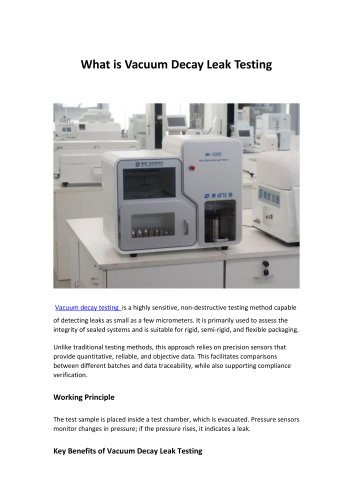
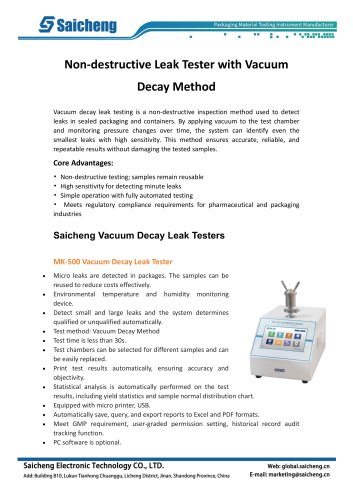
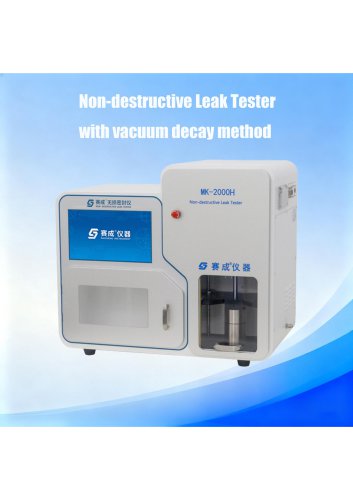
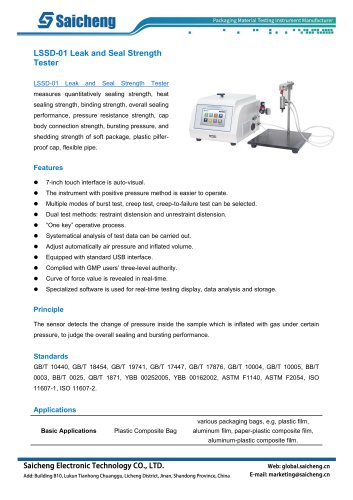
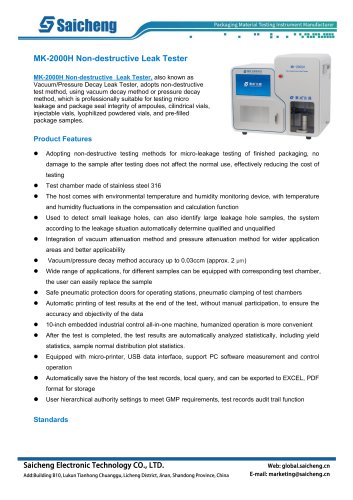
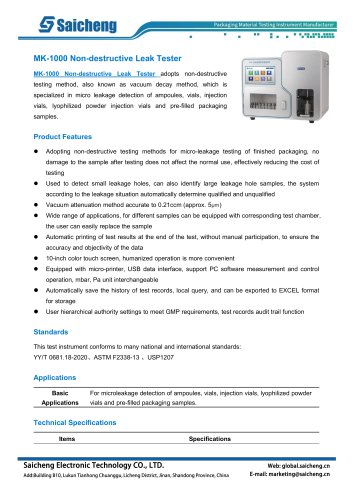
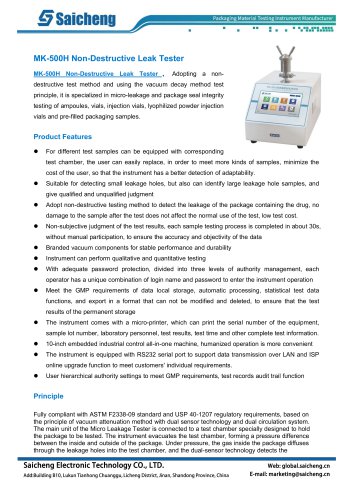
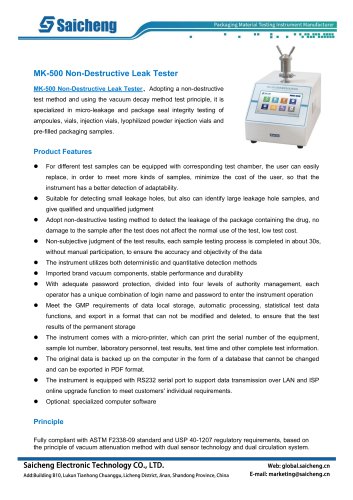
- Vacuum Decay Testing: A non-destructive method that detects leaks by monitoring pressure changes in a vacuum chamber. It is highly sensitive and compliant with standards like ASTM F2338, suitable for high-speed production environments.
- High Voltage Leak Detection (HVLD): Used for conductible liquid products, this method detects leaks through current discharge when high voltage is applied. It is fast and sensitive, ideal for parenteral products in blisters.
- Dye Penetration Testing: A cost-effective, destructive method involving dye immersion to visually confirm leaks. It is useful for failure analysis and method validation.
Selection depends on product format, test objectives, regulatory requirements, and sensitivity needs. Vacuum Decay is optimal for non-destructive, high-sensitivity testing, while Dye Penetration is valuable for cost-effective lab testing and leak location.
A robust program includes method validation, standard operating procedures, and personnel training. Advanced technology adoption is just the beginning; a complete program ensures system suitability and operator understanding.
Leak testers are becoming integrated into Industry 4.0 production lines, enabling real-time data analysis and predictive analytics for continuous quality improvement.
Ensuring blister packaging integrity is essential for patient safety and product quality. Investing in advanced leak testing methods enhances product reliability and corporate integrity. Collaborating with experienced providers like Saicheng helps manufacturers implement compliant and forward-looking testing solutions.
Catalog excerpts
Advanced Leak Test Methods for Blister Packaging In the pharmaceutical, medical device and high-end nutraceutical industries, blister packaging is the main guardian of product efficacy and patient safety. However, even a microscopic leak, invisible to the naked eye, can compromise sterility, allow moisture to enter the packaging and degrade active ingredients, ultimately endangering end users. With stringent global regulations (from FDA cGMP to EU GMP Annex 1) now mandating container-closure integrity, visual inspection alone is insufficient. Advanced leak testing has evolved from a quality check into a critical strategic investment in product lifecycle and brand protection. Why Leak Testing is Non-Negotiable for Blister Packs The risks associated with package failure are severe. As well as resulting in product loss, leaks can lead to costly recalls, regulatory action and irreversible damage to a brand's reputation. For moisture-sensitive or sterile products, package integrity is synonymous with product safety. Global regulatory frameworks now explicitly require validated, objective methods to prove package integrity throughout a product's shelf life, making robust leak testing a cornerstone of Quality by Design (QbD).
Open the catalog to page 1
Advanced Leak Detection Methods: Principles and Applications Today's technologies have moved beyond subjective methods to offer quantitative, reliable and often non-destructive analysis. In this article, we explore the most effective methods and highlight their optimal applications. 1. Vacuum Decay Testing: The Gold Standard for Non-Destructive Quality Control Principle: This method involves placing the blister pack in a sealed test chamber, evacuating the air to a specified vacuum level and monitoring for an increase in pressure caused by gas flowing through a leak. It is a direct, deterministic...
Open the catalog to page 2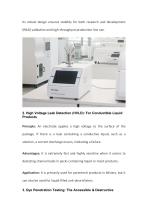
Its robust design ensures stability for both research and development (R&D) validation and high-throughput production line use. 2. High Voltage Leak Detection (HVLD): For Conductible Liquid Products Principle: An electrode applies a high voltage to the surface of the package. If there is a leak containing a conductive liquid, such as a solution, a current discharge occurs, indicating a failure. Advantages: It is extremely fast and highly sensitive when it comes to detecting channel leaks in packs containing liquid or moist products. Application: It is primarily used for parenteral products in...
Open the catalog to page 3
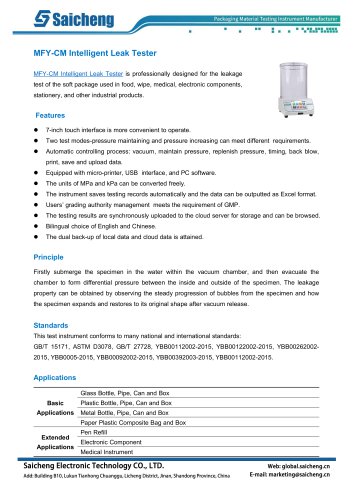
Principle: This is a proven, intuitive method involving the immersion of blister packs in a vacuum chamber filled with coloured dye solution. A vacuum is then applied and any leaks are revealed by the ingress of dye. The packs are visually inspected afterwards. Advantages: It is cost-effective and excellent for identifying leaks. It is also valuable for failure analysis and method validation. Application Spotlight: When definitive visual confirmation of the location of a leak is required for root cause analysis or sample audits, the Saicheng MFY-CM Leak Tester is a reliable solution. With precise...
Open the catalog to page 4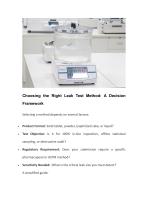
Selecting a method depends on several factors: • Product Format: Solid tablet, powder, lyophilized cake, or liquid? • Test Objective: Is it for 100% in-line inspection, offline statistical sampling, or destructive audit? • Regulatory Requirement: Does your submission require a specific pharmacopeial or ASTM method? • Sensitivity Needed: ;What is the critical leak size you must detect?
Open the catalog to page 5
• For non-destructive, high-sensitivity, in-line/at-line testing of finished products: Vacuum Decay (e.g., Saicheng MK-500H) is often the optimal choice. • For destructive audit, leak location, and cost-effective lab testing: Dye Penetration (e.g., Saicheng MFY-CM) remains highly valuable. Adopting advanced technology is only the first step. A complete program requires: • Method Validation: Performing Installation/Operational/Performance Qualification (IQ/OQ/PQ) to prove the system is suitable for its intended use. • Standard Operating Procedures (SOPs): Defining test parameters, acceptance criteria,...
Open the catalog to page 6
only to identify defective products, but also to prevent defects altogether. Conclusion In the mission to ensure patient safety and product quality, maintaining the integrity of blister packaging is non-negotiable. Investing in advanced, validated leak testing methodologies such as vacuum decay and dye penetration directly improves product reliability and corporate integrity. By partnering with experienced equipment providers such as Saicheng, manufacturers can implement bespoke, compliant and forward-looking testing solutions that protect their products and their reputation.
Open the catalog to page 7All Jinan Saicheng Electronic Technology Co.,LTD catalogs and technical brochures
 ASTM F2096
4 Pages
 Saicheng ASTM D3078 Standard
3 Pages
 Why Test Food Texture
3 Pages
 Saicheng Leak Tester MFY-02
2 Pages
 Saicheng Leak Tester MFY-CM
2 Pages

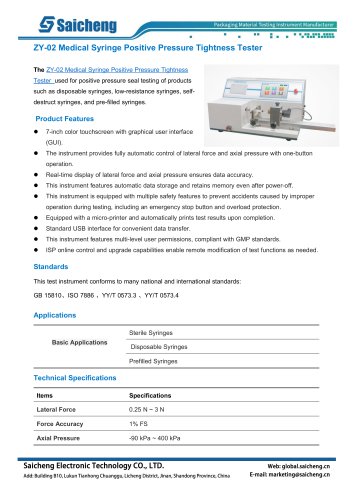
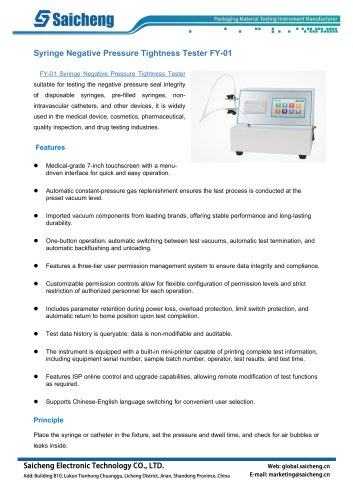
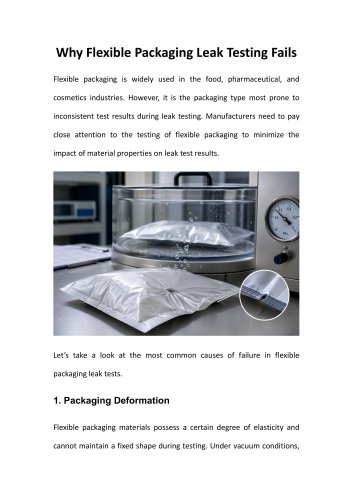
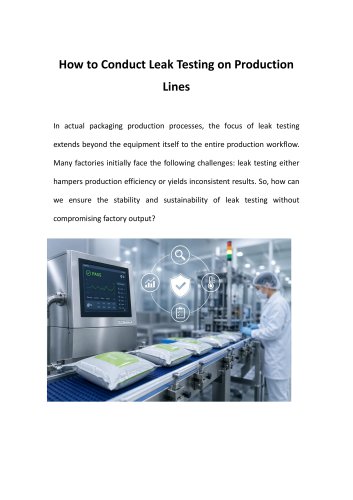


- Test machine
- Gas analyzer
- Concentration analyzer
- Automatic analyser
- Automated testing machine
- Material test machine
- Computer-controlled test machine
- Portable analyzer
- Continuous analyzer
- Digital tester
- Industrial testing machine
- Vertical testing machine
- Automatic tester
- Real-time analyzer
- Industrial tester
- Laboratory analyzer
- Tensile testing machine
- Laboratory testing machine
- Universal testing machine
- Compact analyzer