
- Catalogs
- Jinan Saicheng Electronic Technology Co.,LTD
- Saicheng 90 Degree and 180 Degree Peel Test


- Company
- Products
- Catalogs
- News & Trends
- Exhibitions
Saicheng 90 Degree and 180 Degree Peel Test
Saicheng 90 Degree and 180 Degree Peel Test
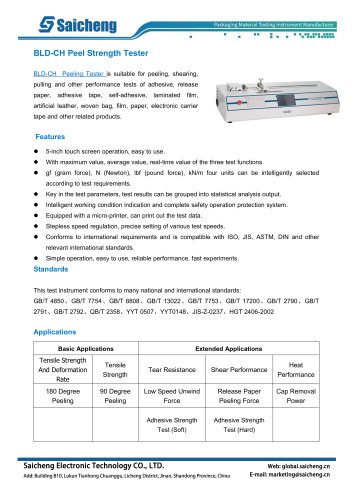
Peel testing is essential for assessing the bond strength between materials, particularly in packaging, food, medical, and electronics industries. It ensures adhesives perform as intended, affecting how easily labels and packaging can be removed or opened.
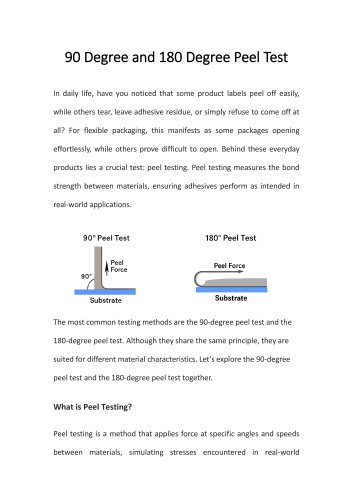
- 90-Degree Peel Test: Suitable for semi-rigid or rigid substrates, this test reflects real-world conditions by concentrating stress at the adhesive interface. It is commonly used for pressure-sensitive labels and tapes on rigid substrates.
- 180-Degree Peel Test: Ideal for flexible materials, this test simulates consumer interactions with packaging. It provides uniform stress distribution, making it suitable for flexible packaging, composite films, and heat-sealed pouches.
- Peel Angles: The 90-degree test separates materials at a 90-degree angle, while the 180-degree test uses a 180-degree angle.
- Test Materials: The 90-degree test is for semi-rigid or rigid materials, whereas the 180-degree test is for flexible materials.
- Stress Distribution: The 90-degree test concentrates stress, while the 180-degree test distributes stress uniformly.
Peel testing accurately assesses adhesive performance, identifies failure modes, and ensures compliance with industry standards. It is crucial for restructuring materials and guaranteeing product quality.
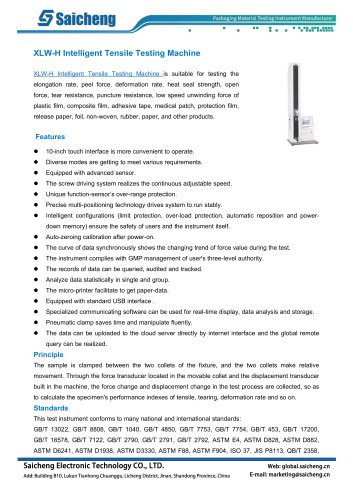
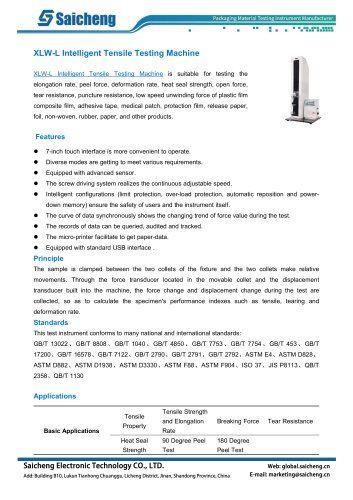
Saicheng provides the XLW series universal tensile testing machine and the BLD series specialized peel testing machine, both capable of performing 90-degree and 180-degree peel tests according to industry standards.
Conducting peel tests is vital for determining material bond strength, enhancing user experience, and ensuring product quality. For more detailed information on these methods, including procedures and standards, refer to the complete guide.
Catalog excerpts
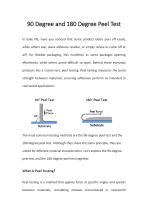
90 Degree and 180 Degree Peel Test In daily life, have you noticed that some product labels peel off easily, while others tear, leave adhesive residue, or simply refuse to come off at all? For flexible packaging, this manifests as some packages opening effortlessly, while others prove difficult to open. Behind these everyday products lies a crucial test: peel testing. Peel testing measures the bond strength between materials, ensuring adhesives perform as intended in real-world applications. The most common testing methods are the 90-degree peel test and the 180-degree peel test. Although they share the same principle, they are suited for different material characteristics. Let’s explore the 90-degree peel test and the 180-degree peel test together. What is Peel Testing? Peel testing is a method that applies force at specific angles and speeds between materials, simulating stresses encountered in real-world
Open the catalog to page 1
environments. It measures the adhesive strength of films, labels, pressure-sensitive adhesives, and tapes, finding widespread use in packaging, food, medical, and electronics industries. 90-Degree Peel Test The 90-degree peel test is more suitable for semi-rigid or rigid substrates. Since these materials cannot bend, this test better reflects real-world conditions. This test concentrates stress at the adhesive interface, enabling precise detection of localized defects. It is commonly used to evaluate the adhesion performance of pressure-sensitive labels and tapes on rigid substrates. 180-Degree...
Open the catalog to page 2
rigid substrates at a 90-degree angle, while the 180-degree peel test separates flexible materials at a 180-degree angle. 2. Different Test Materials The 90° peel test is more suitable for semi-rigid or rigid materials, while the 180° peel test is more suitable for flexible materials. 3. Different Stress Distribution The 90° peel test mainly concentrates on stress distribution, whereas the 180° peel test has a more uniform stress distribution. Why the Peel Test Matters? Conducting the appropriate peel test accurately assesses a material’s adhesive performance under varying conditions, identifies...
Open the catalog to page 3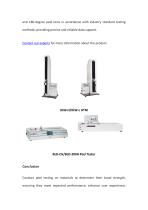
and 180-degree peel tests in accordance with industry standard testing methods, providing precise and reliable data support. Contact our experts for more information about the product. Conclusion Conduct peel testing on materials to determine their bond strength, ensuring they meet expected performance, enhance user experience,
Open the catalog to page 4
and guarantee product quality. For detailed information on these two peel testing methods — including test procedures, standards, and applicable equipment — read the complete guide here: 90° vs 180° Peel Test for Adhesive Streng
Open the catalog to page 5All Jinan Saicheng Electronic Technology Co.,LTD catalogs and technical brochures
 ASTM F2096
4 Pages
 Saicheng ASTM D3078 Standard
3 Pages
 Why Test Food Texture
3 Pages
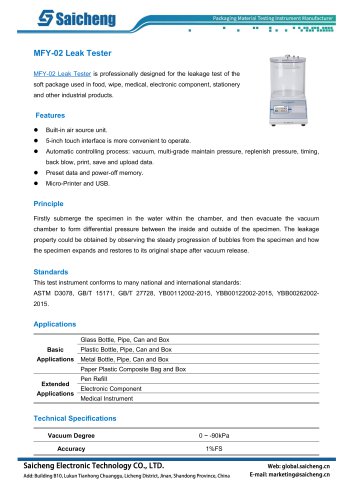 Saicheng Leak Tester MFY-02
2 Pages
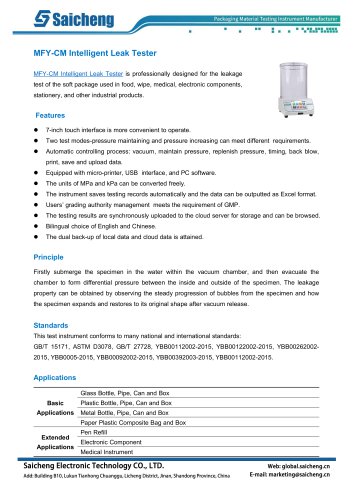 Saicheng Leak Tester MFY-CM
2 Pages
- Gas analyzer
- Concentration analyzer
- Automatic analyser
- Automated testing machine
- Material test machine
- Computer-controlled test machine
- Portable analyzer
- Continuous analyzer
- Digital tester
- Industrial testing machine
- Vertical testing machine
- Automatic tester
- Real-time analyzer
- Industrial tester
- Laboratory analyzer
- Tensile testing machine
- Laboratory testing machine
- Universal testing machine
- Compact analyzer