
- Catalogs
- Jinan Saicheng Electronic Technology Co.,LTD
- The Method of Measuring Coefficient of Friction


- Company
- Products
- Catalogs
- News & Trends
- Exhibitions
The Method of Measuring Coefficient of Friction
The Method of Measuring Coefficient of Friction
The coefficient of friction (COF) is a crucial concept in physics and engineering, describing the resistance encountered when two surfaces slide against each other. It is important in various fields such as mechanical engineering, materials science, automotive design, and packaging.
What is the Coefficient of Friction?
The COF is a dimensionless value quantifying the frictional resistance between two surfaces. It helps determine how easily one material moves over another. Friction arises from microscopic surface roughness, opposing relative motion. There are two main types of friction: static friction (preventing motion) and kinetic friction (resisting motion).
Coefficient of Friction Formula
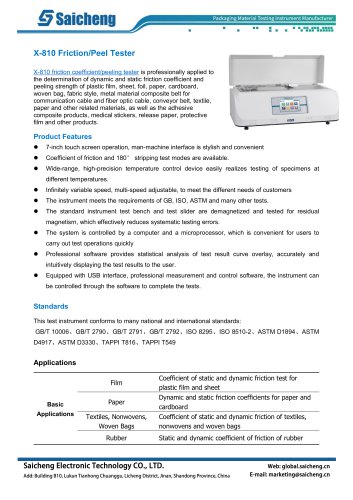
The COF is calculated using the formula: μ = Ff / Fn, where μ is the coefficient of friction, Ff is the frictional force, and Fn is the normal force. This formula applies to both static and kinetic friction.
Units of Coefficient of Friction
The COF is dimensionless, being a ratio of two forces measured in Newtons (N) or pounds-force (lbf). Consistent units are essential for accurate calculations.
Coefficient of Friction Test Methods
Several methods exist to measure COF, including:
- Inclined Plane Method: Involves increasing the angle of inclination until an object slides, calculating static friction.
- Horizontal Pull Test: Measures the force required to drag a material across a surface.
- Tribometer Test: Uses a specialized instrument to measure friction under controlled conditions.
- Pin-on-Disk Test: Measures friction as a pin slides over a rotating disk.
ASTM D1894: Standard Test Method for COF
This standardized method is used for determining COF, especially for plastic films and sheeting. It involves dragging a sled across a surface to measure static and kinetic COF.
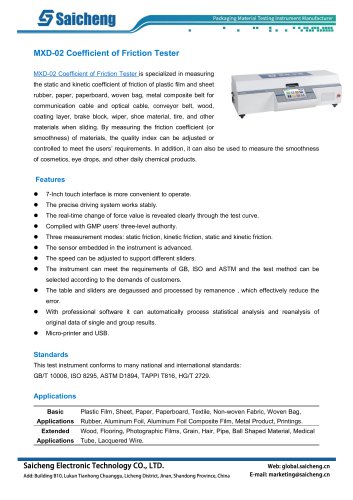
How to Measure Coefficient of Friction
Steps include sample preparation, testing with a sled, and calculating static and kinetic COF based on the forces required to initiate and maintain motion.
Applications of COF Measurements
COF measurements are vital in industries such as automotive engineering, aerospace, manufacturing, and consumer goods, influencing design and material selection.
Conclusion
The COF is essential for understanding material interactions in motion. Accurate measurement and application of COF optimize material performance and safety across various industries.
Catalog excerpts
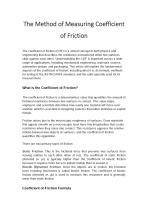
The Method of Measuring Coefficient of Friction The coefficient of friction (COF) is a critical concept in both physics and engineering that describes the resistance encountered when two surfaces slide against each other. Understanding the COF is important across a wide range of applications, including mechanical engineering, materials science, automotive design, and packaging. This article will explore the fundamental aspects of the coefficient of friction, including what it is, its formula, methods for testing it, the ASTM D1894 standard, and the units typically used for its measurement. What is the Coefficient of Friction? The coefficient of friction is a dimensionless value that quantifies the amount of frictional resistance between two surfaces in contact. This value helps engineers and scientists determine how easily one material will move over another, which is essential in designing systems that either minimize or exploit friction. Friction arises due to the microscopic roughness of surfaces. Even materials that appear smooth on a macroscopic level have tiny irregularities that create resistance when they come into contact. This resistance opposes the relative motion between two objects or surfaces, and the coefficient of friction quantifies this opposition. There are two primary types of friction: . Static Friction: This is the frictional force that prevents two surfaces from moving relative to each other when at rest. The coefficient of static friction (denoted as μs) is typically higher than the coefficient of kinetic friction because it requires more force to initiate motion than to sustain it. Kinetic (Dynamic) Friction: Once the objects are in motion, the frictional force resisting movement is called kinetic friction. The coefficient of kinetic friction (denoted as μk) is used to measure this resistance and is generally lower than static friction. Coefficient of Friction Formula
Open the catalog to page 1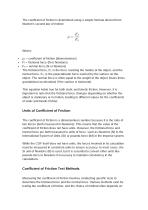
The coefficient of friction is determined using a simple formula derived from Newton's second law of motion: μs = coefficient of friction (dimensionless) Ff = frictional force (N or Newtons) Fn = normal force (N or Newtons) The frictional force, Ff, is the force resisting the motion of the object, and the normal force, Fn, is the perpendicular force exerted by the surface on the object. The normal force is often equal to the weight of the object (mass times gravitational acceleration) if the surface is horizontal. This equation holds true for both static and kinetic friction. However, it is important...
Open the catalog to page 2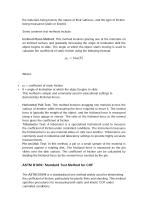
the materials being tested, the nature of their surfaces, and the type of friction being measured (static or kinetic). Some common test methods include: . Inclined Plane Method: This method involves placing one of the materials on an inclined surface and gradually increasing the angle of inclination until the object begins to slide. The angle at which the object starts moving is used to calculate the coefficient of static friction using the following formula: μs = coefficient of static friction θ = angle of inclination at which the object begins to slide This method is simple and commonly used...
Open the catalog to page 3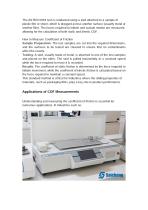
The ASTM D1894 test is conducted using a sled attached to a sample of plastic film or sheet, which is dragged across another surface (usually metal or another film). The forces required to initiate and sustain motion are measured, allowing for the calculation of both static and kinetic COF. How to Measure Coefficient of Friction Sample Preparation: The test samples are cut into the required dimensions, and the surfaces to be tested are cleaned to ensure that no contaminants affect the results. Testing: A sled, usually made of metal, is attached to one of the test samples and placed on the other....
Open the catalog to page 4
• Automotive Engineering: COF plays a role in tire design, braking systems, and material selection for gears and bearings. • Aerospace: Aircraft component designs rely on precise friction calculations for optimal performance. • Manufacturing: Lubricants are designed to reduce COF, improving machinery efficiency and longevity. • Consumer Goods: Packaging materials are tested for COF to ensure that products slide or stack correctly during transportation. The coefficient of friction is a vital parameter for understanding the interaction between materials in motion. By using simple equations and...
Open the catalog to page 5All Jinan Saicheng Electronic Technology Co.,LTD catalogs and technical brochures
 ASTM F2096
4 Pages
 Saicheng ASTM D3078 Standard
3 Pages
 Why Test Food Texture
3 Pages
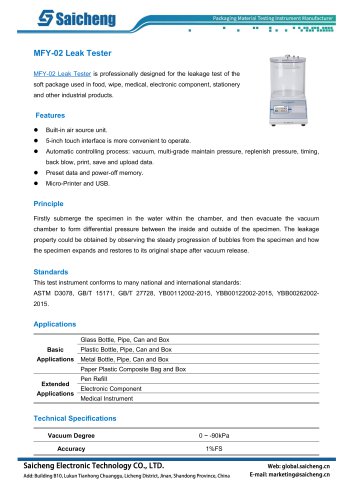 Saicheng Leak Tester MFY-02
2 Pages
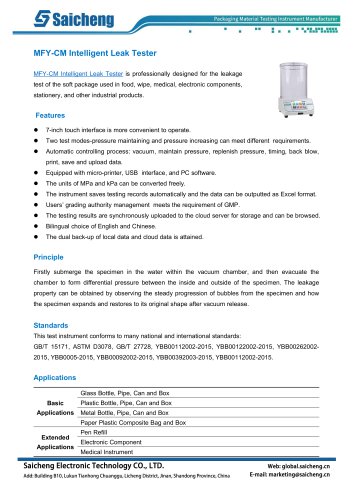 Saicheng Leak Tester MFY-CM
2 Pages
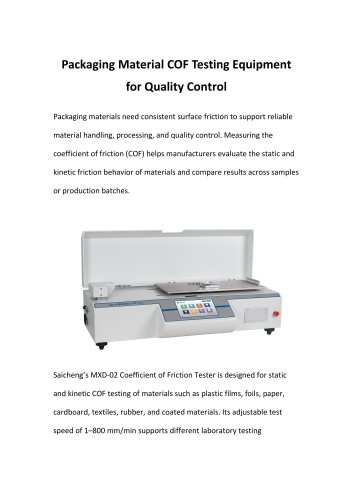
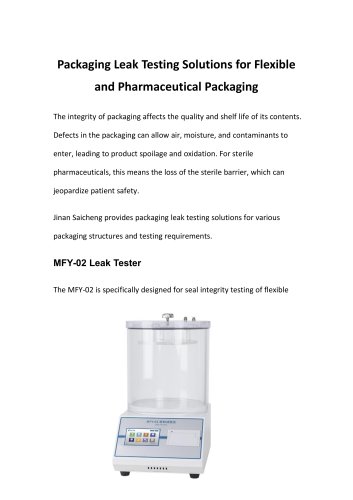























































- Test machine
- Gas analyzer
- Concentration analyzer
- Automatic analyser
- Automated testing machine
- Material test machine
- Computer-controlled test machine
- Portable analyzer
- Continuous analyzer
- Digital tester
- Industrial testing machine
- Vertical testing machine
- Automatic tester
- Real-time analyzer
- Laboratory analyzer
- Industrial tester
- Tensile testing machine
- Laboratory testing machine
- Universal testing machine
- Compact analyzer