
- Catalogs
- Jinan Saicheng Electronic Technology Co.,LTD
- How to Prevent Micro-Leaks & Costly Product Recalls


- Company
- Products
- Catalogs
- News & Trends
- Exhibitions
How to Prevent Micro-Leaks & Costly Product Recalls
How to Prevent Micro-Leaks & Costly Product Recalls
Micro-leaks in packaging can lead to product spoilage, reduced shelf life, and costly recalls. This document discusses the causes of micro-leaks, the limitations of traditional detection methods, and advanced solutions to prevent them.
- Weak or Inconsistent Sealing Processes: Variations in sealing temperature, time, or pressure can create weak points prone to failure.
- Material Defects or Packaging Damage: Defects like uneven film thickness or impurities can lead to seal failure. Pinholes or tears during processing also compromise seal integrity.
- Transportation and Environmental Stresses: Changes in pressure and temperature during transport can exacerbate defects, causing leaks.
- Traditional methods rely on visible bubble formation, which requires a significant leak volume.
- Manual observation can be influenced by operator experience and conditions, leading to inaccurate assessments.
- Qualitative methods cannot quantify leak rates.
- Adopting methods like vacuum decay and pressure decay testing can detect minute leaks and provide quantitative data.
- Testing during development helps identify defects early, optimize materials, and reduce recall risks.
- Reduces product recalls and material waste.
- Enhances customer trust and protects brand reputation.
- Ensures compliance with regulatory requirements and maintains product quality.
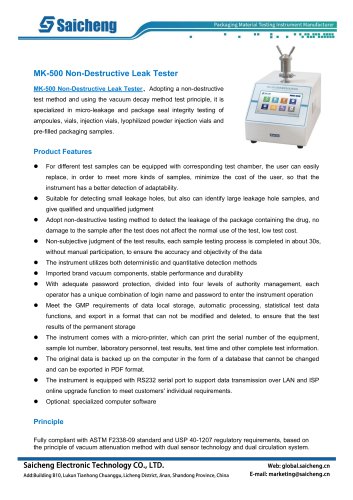
Advanced leak detection equipment, such as those designed by Saicheng, ensures reliable and accurate testing across industries, complying with ASTM F2338 and USP 1207 standards.
Catalog excerpts
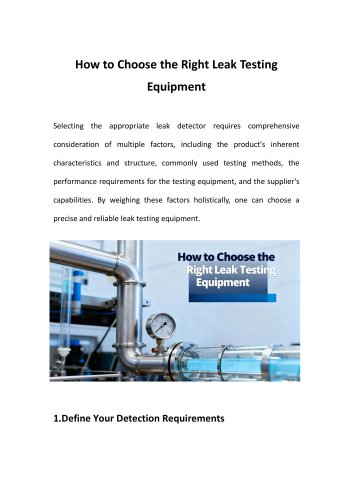
How to Prevent Micro-Leaks & Costly Product Recalls Even the slightest gaps, areas of weak adhesion, or minor defects caused during transportation in packaging seals can allow oxygen, moisture, bacteria, and other contaminants to penetrate the packaging. This compromises product quality and the integrity of the seal, leading to product spoilage and a shorter shelf life. Why are manufacturers concerned about seal failures once packaging enters the market? This is because if packaging with seal failures reaches the market, manufacturers face costly recalls and damage to their brand reputation. High-risk and high-value products, such as pharmaceuticals and medical devices, have strict requirements regarding leakage rates; even the slightest leak can compromise the product’s sterile barrier, leading to contamination and jeopardizing patient safety. Why Do Micro-Leaks Occur? Micro-leaks can occur at any stage of a product’s lifecycle. Understanding the causes of leaks at different stages helps improve packaging reliability
Open the catalog to page 1
Weak or Inconsistent Sealing Processes If there are variations in sealing temperature, time, or pressure during processing, weak points may form within the seal structure. These points are prone to seal failure when subjected to compression or pressure during storage or transportation. Material Defects or Packaging Damage Inherent defects in the material—such as uneven film thickness or impurity particles in the raw materials—can easily lead to seal failure during subsequent processing or transportation. Additionally, pinholes in flexible packaging, or tears and punctures in the film caused during...
Open the catalog to page 2
These methods rely on the formation of bubbles; however, a continuous stream of bubbles visible to the naked eye typically requires a certain volume of leakage to occur. Therefore, the absence of visible bubbles does not guarantee a completely airtight seal. These methods rely on manual observation, and factors such as the operator’s experience and viewing angle can influence the assessment. Additionally, factors like operator distraction or eye strain can affect the interpretation of test results. Qualitative testing methods determine pass/fail status and identify leak locations based on bubble...
Open the catalog to page 3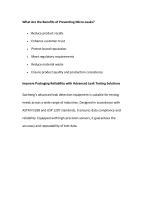
• Reduce product recalls • Enhance customer trust • Protect brand reputation • Meet regulatory requirements • Reduce material waste • Ensure product quality and production consistency Saicheng's advanced leak detection equipment is suitable for testing needs across a wide range of industries. Designed in accordance with ASTM F2338 and USP 1207 standards, it ensures data compliance and reliability. Equipped with high-precision sensors, it guarantees the accuracy and repeatability of test data.
Open the catalog to page 4All Jinan Saicheng Electronic Technology Co.,LTD catalogs and technical brochures
 ASTM F2096
4 Pages
 Saicheng ASTM D3078 Standard
3 Pages
 Why Test Food Texture
3 Pages
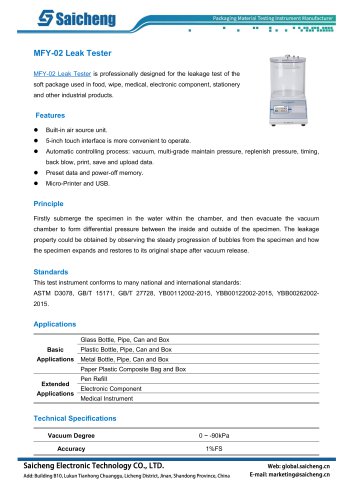 Saicheng Leak Tester MFY-02
2 Pages
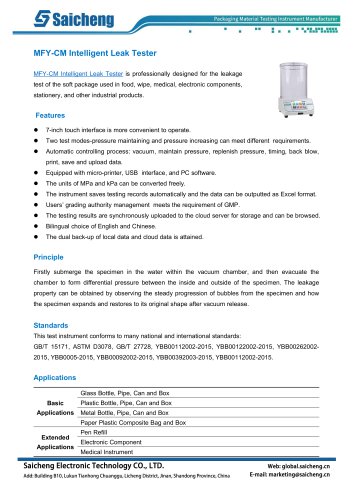 Saicheng Leak Tester MFY-CM
2 Pages







- Test machine
- Gas analyzer
- Concentration analyzer
- Automatic analyser
- Automated testing machine
- Material test machine
- Computer-controlled test machine
- Portable analyzer
- Continuous analyzer
- Digital tester
- Industrial testing machine
- Vertical testing machine
- Automatic tester
- Real-time analyzer
- Industrial tester
- Laboratory analyzer
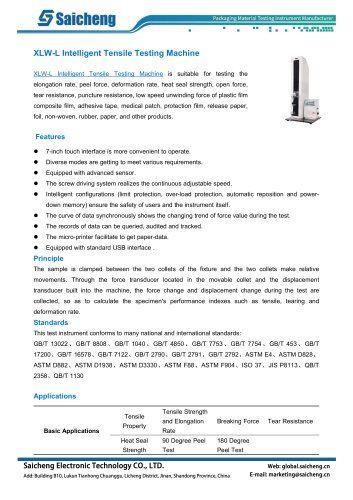
- Tensile testing machine
- Laboratory testing machine
- Universal testing machine
- Compact analyzer