
- Catalogs
- Jinan Saicheng Electronic Technology Co.,LTD
- Heat Seal Strength Test Method


- Company
- Products
- Catalogs
- News & Trends
- Exhibitions
Heat Seal Strength Test Method
Heat Seal Strength Test Method
The heat seal strength test method is a crucial quality inspection technique used to assess the performance and reliability of heat seal materials. This method evaluates the strength of seals within flexible barrier materials, determining consistency and the opening force of package systems. Key parameters influencing heat seal strength include sealing temperature, pressure, and dwell time.
Importance of Sealing Parameters
Appropriate sealing parameters are vital for package performance and quality. Insufficient parameters may lead to weak seals, causing breakage or leakage, while excessive parameters can cause shrinkage and breakage at the root. Manufacturers must carefully select sealing parameters to ensure optimal seal strength.
Testing Equipment
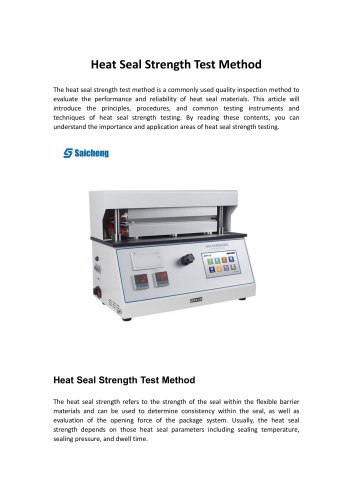
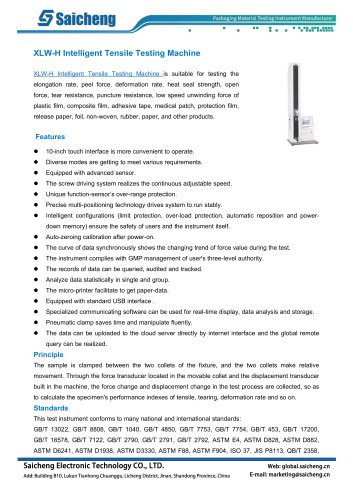
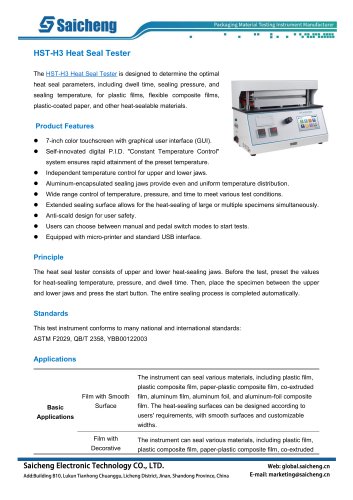
The article outlines a method for determining heat sealing parameters using Saicheng’s HST-H3 Heat Seal Tester and XLW-H Tensile Testing Machine.
Test Environment
Samples should be conditioned at 23°C±2°C and 50%±5% relative humidity for over 4 hours before testing.
Specimen Preparation
Using the HST-H3 Heat Seal Tester, set the sealing pressure, dwell time, and temperature. Stack two specimens together and insert them between the sealing jaws to initiate heat sealing.
Testing Method - ASTM F88
Open the heat-sealed sample to 180° and clamp it in the XLW-H Tensile Testing Machine. Ensure proper alignment and tightness to prevent slipping or premature breakage. The test speed is 300±30mm/min, and the maximum load at separation or breakage is recorded. Invalid samples are retested.
Conclusion
The test results are the arithmetic average of five samples in both longitudinal and transverse directions. For composite bags, the average of ten samples from different positions is used, expressed in N/15mm.
Catalog excerpts
Heat Seal Strength Test Method The heat seal strength test method is a commonly used quality inspection method to evaluate the performance and reliability of heat seal materials. This article will introduce the principles, procedures, and common testing instruments and techniques of heat seal strength testing. By reading these contents, you can understand the importance and application areas of heat seal strength testing. Heat Seal Strength Test Method The heat seal strength refers to the strength of the seal within the flexible barrier materials and can be used to determine consistency within the seal, as well as evaluation of the opening force of the package system. Usually, the heat seal strength depends on those heat seal parameters including sealing temperature, sealing pressure, and dwell time.
Open the catalog to page 1
The determination of suitable sealing parameters is significant to the performance and quality of the package. To be specific, if the sealing parameters are too low, due to insufficient seal strength, the sealing layer may not be able to combine together tightly and as a result, the sealing edges may break or leak. On the other hand, if the sealing parameters are too high, the sealing area may shrink and as a result, the package may break from the root. Therefore, it is quite important for the manufacturers of flexible plastic medical packaging to control the seal strength by selecting suitable...
Open the catalog to page 2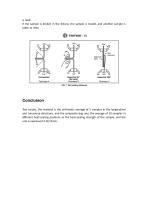
If the sample is broken in the fixture, the sample is invalid, and another sample is taken to redo. FIG. 1 Tail Holding Methods Test results, the material is the arithmetic average of 5 samples in the longitudinal and transverse directions, and the composite bag uses the average of 10 samples in different heat-sealing positions as the heat-sealing strength of the sample, and the unit is expressed in N/15mm.
Open the catalog to page 3All Jinan Saicheng Electronic Technology Co.,LTD catalogs and technical brochures
 ASTM F2096
4 Pages
 Saicheng ASTM D3078 Standard
3 Pages
 Why Test Food Texture
3 Pages
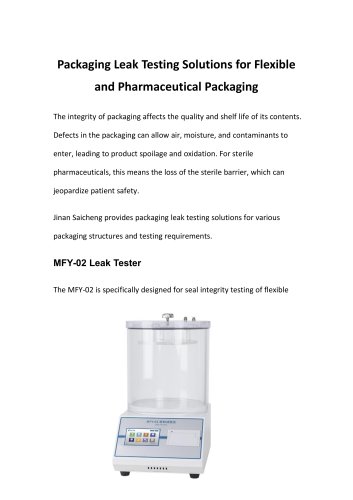
 Saicheng Leak Tester MFY-02
2 Pages
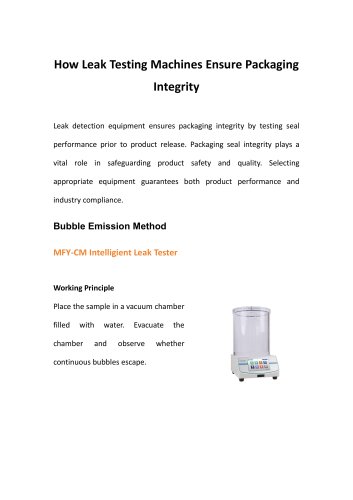
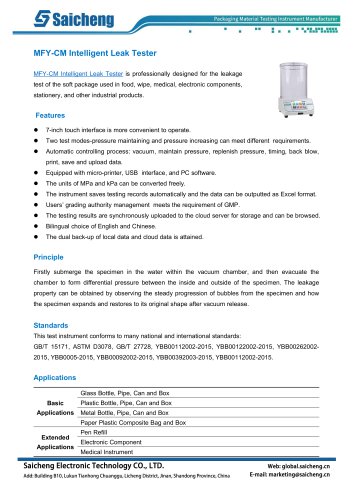 Saicheng Leak Tester MFY-CM
2 Pages




- Gas analyzer
- Concentration analyzer
- Automatic analyser
- Automated testing machine
- Material test machine
- Computer-controlled test machine
- Portable analyzer
- Continuous analyzer
- Digital tester
- Industrial testing machine
- Vertical testing machine
- Automatic tester
- Real-time analyzer
- Laboratory analyzer
- Industrial tester
- Laboratory testing machine
- Universal testing machine
- Compact analyzer