
- Catalogs
- Jinan Saicheng Electronic Technology Co.,LTD
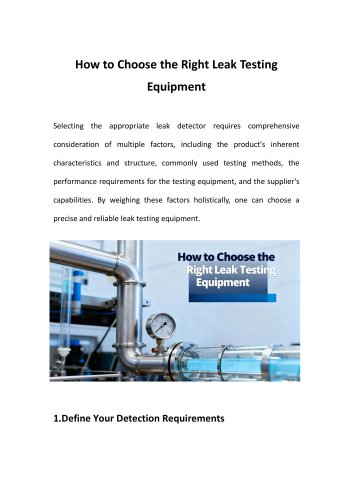
- Choosing the Right Leak Testing Method for Modified Atmosphere Packaging


- Company
- Products
- Catalogs
- News & Trends
- Exhibitions
Choosing the Right Leak Testing Method for Modified Atmosphere Packaging
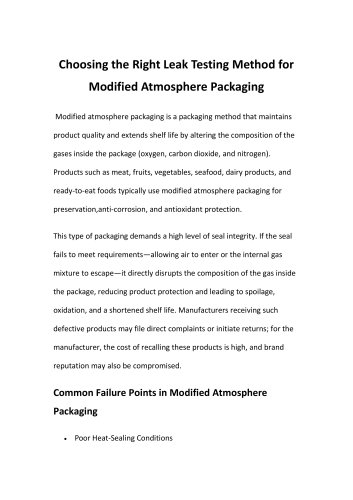
Choosing the Right Leak Testing Method for Modified Atmosphere Packaging
Modified atmosphere packaging is a technique used to preserve product quality and extend shelf life by altering the gas composition inside the package. It is commonly used for products like meat, fruits, vegetables, seafood, dairy, and ready-to-eat foods. The integrity of the seal is crucial to prevent spoilage and maintain the protective atmosphere.
- Poor heat-sealing conditions
- Contaminants in the sealing area
- Damage to packaging materials
- Inappropriate heat-sealing pressure, temperature, or time
- Pinholes or microchannels in the film
- Pressure and temperature fluctuations during transportation
The traditional bubble leak test is commonly used but is destructive. It involves immersing the package in a solution and observing for bubbles, which indicates leaks. This method is subjective and only detects larger leaks.
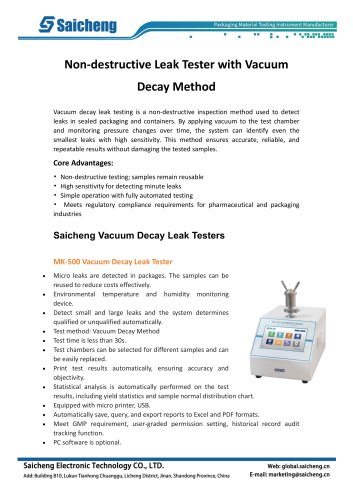
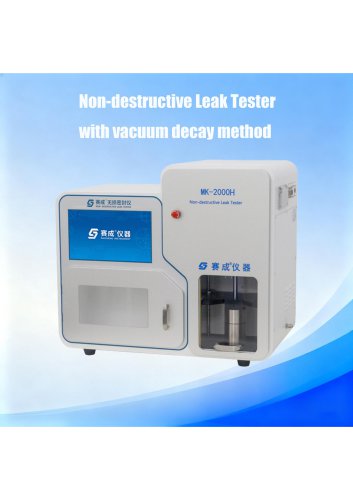
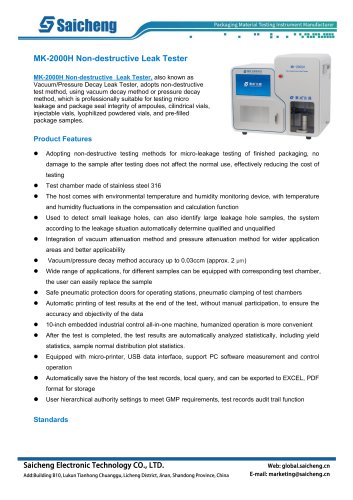
Industries are moving towards non-destructive methods like vacuum decay testing, which is in accordance with ASTM F2338 standards. This method uses a sealed test chamber and sensors to detect pressure changes, allowing for quantitative analysis without damaging the sample. Saicheng’s MK-2000H tester is an example of such advanced technology.
| Metric | Traditional Bubble Test | Advanced Vacuum Decay |
|---|---|---|
| Package Preservation | Destructive | Non-Destructive |
| Test Objectivity | Subjective | Objective |
| Detection Sensitivity | Macro leaks >20–30 μm | Micro-leaks 1–5 μm |
| Industry Standards | ASTM D3078 | ASTM F2338 & USP <1207> |
To enhance MAP seal quality assurance, adopting advanced leak detection methods like Saicheng’s vacuum decay tester is recommended. It offers precise, repeatable, and non-destructive testing, aligning with industry standards. For further information, refer to the comprehensive guide on leak testing or contact the technical team for support.
Catalog excerpts
Choosing the Right Leak Testing Method for Modified Atmosphere Packaging Modified atmosphere packaging is a packaging method that maintains product quality and extends shelf life by altering the composition of the gases inside the package (oxygen, carbon dioxide, and nitrogen). Products such as meat, fruits, vegetables, seafood, dairy products, and ready-to-eat foods typically use modified atmosphere packaging for preservation,anti-corrosion, and antioxidant protection. This type of packaging demands a high level of seal integrity. If the seal fails to meet requirements—allowing air to enter or the internal gas mixture to escape—it directly disrupts the composition of the gas inside the package, reducing product protection and leading to spoilage, oxidation, and a shortened shelf life. Manufacturers receiving such defective products may file direct complaints or initiate returns; for the manufacturer, the cost of recalling these products is high, and brand reputation may also be compromised. Common Failure Points in Modified Atmosphere Packaging Poor Heat-Sealing Conditi
Open the catalog to page 1
• Contaminants in the Sealing Area • Damage to Packaging Materials • Inappropriate Heat-Sealing Pressure, Temperature, or Time • Pinholes or Microchannels in the Film • Pressure and Temperature Fluctuations During Transportation For modified atmosphere packaging, production lines rely on traditional bubble tests to verify the integrity of the seal; however, this method is destructive. Bubble Leak Test: The sample is fully immersed in a detection solution, and the operator visually observes whether continuous bubbles form to determine pass/fail. This method is susceptible to operator eye fatigue...
Open the catalog to page 2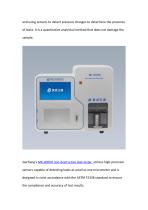
and using sensors to detect pressure changes to determine the presence of leaks. It is a quantitative analytical method that does not damage the sample. Saicheng’s MK-2000H non-destructive leak tester utilizes high-precision sensors capable of detecting leaks as small as one micrometer and is designed in strict accordance with the ASTM F2338 standard to ensure the compliance and accuracy of test results.
Open the catalog to page 3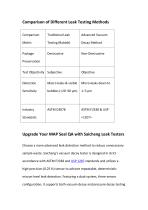
Choose a more advanced leak detection method to reduce unnecessary sample waste. Saicheng's vacuum decay tester is designed in strict accordance with ASTM F2338 and USP 1207 standards and utilizes a high-precision (0.25 fs) sensor to achieve repeatable, deterministic micron-level leak detection. Featuring a dual-system, three-sensor configuration, it supports both vacuum decay and pressure decay testing
Open the catalog to page 4
methods, helping you precisely control product quality and avoid losses caused by non-conforming products. We’ve compiled a comprehensive guide specifically on leak testing. If you’d like to learn more, please read our article: “Leak Testing Equipment: Methods, Applications & How to Choose the Right System for Packaging,” or contact our technical team directly for expert sup
Open the catalog to page 5All Jinan Saicheng Electronic Technology Co.,LTD catalogs and technical brochures
 ASTM F2096
4 Pages
 Saicheng ASTM D3078 Standard
3 Pages
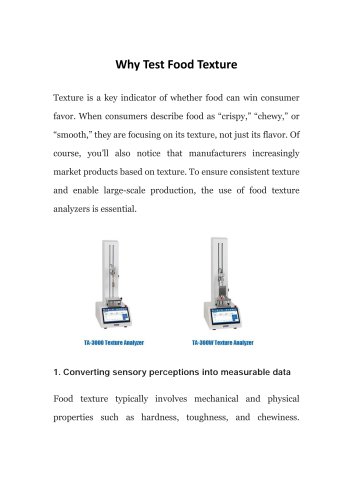 Why Test Food Texture
3 Pages
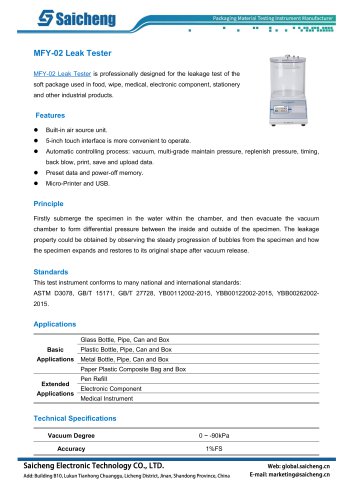 Saicheng Leak Tester MFY-02
2 Pages
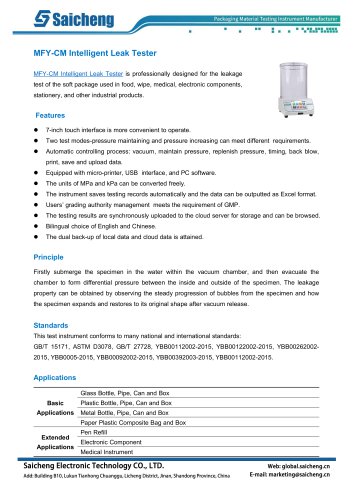 Saicheng Leak Tester MFY-CM
2 Pages
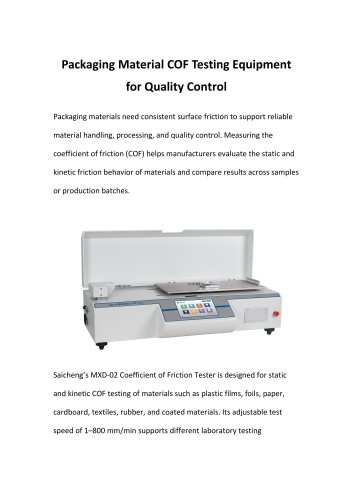
- Test machine
- Gas analyzer
- Concentration analyzer
- Automatic analyser
- Automated testing machine
- Material test machine
- Computer-controlled test machine
- Portable analyzer
- Continuous analyzer
- Digital tester
- Industrial testing machine
- Vertical testing machine
- Automatic tester
- Real-time analyzer
- Laboratory analyzer
- Industrial tester
- Tensile testing machine
- Laboratory testing machine
- Universal testing machine
- Compact analyzer