
- Catalogs
- Jinan Saicheng Electronic Technology Co.,LTD
- Bubble Tests vs. Precision: Upgrading Your Quality Control


- Company
- Products
- Catalogs
- News & Trends
- Exhibitions
Bubble Tests vs. Precision: Upgrading Your Quality Control
Bubble Tests vs. Precision: Upgrading Your Quality Control
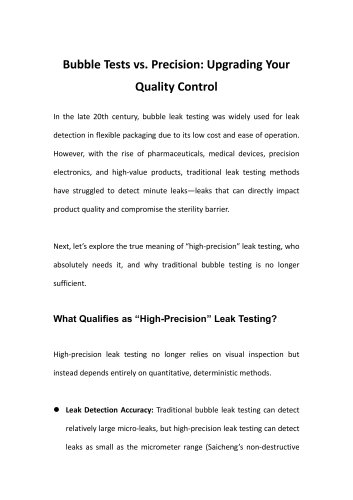
In the late 20th century, bubble leak testing was prevalent for detecting leaks in flexible packaging due to its cost-effectiveness and simplicity. However, with the advent of industries like pharmaceuticals, medical devices, and precision electronics, traditional methods have become inadequate for detecting minute leaks that can affect product quality and sterility.
High-precision leak testing relies on quantitative, deterministic methods rather than visual inspection. Key aspects include:
- Leak Detection Accuracy: Capable of detecting leaks as small as one micrometer, unlike traditional methods.
- Quantitativeness: Utilizes high-precision sensors for real-time pressure monitoring and data reporting.
- Compliance: Adheres to international standards like ASTM F2338 and USP <1207>.
Not all industries need high-precision testing. However, it is crucial for:
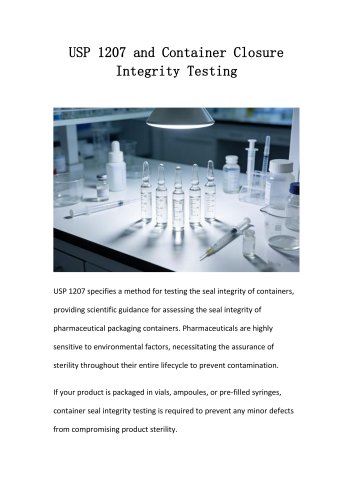
- Pharmaceuticals and Medical Devices: Ensures sterility in products like vials and syringes.
- Electronics and Electric Vehicle Batteries: Prevents moisture-induced damage and safety risks.
- High-value Food Packaging: Protects against spoilage and maintains product stability.
For high-value and high-risk products, bubble leak testing is insufficient due to:
- Subjectivity: Relies on visual inspection, prone to human error.
- Destructive Nature: Samples cannot be reused post-testing.
- Inability to Detect Microscopic Leaks: Effective only for larger leaks.
Manufacturers are transitioning to deterministic methods like vacuum decay testing, which involves:
- Placing the sample in a vacuum chamber and monitoring pressure changes with advanced sensors.
- Providing quantitative, reliable, and repeatable results.
Catalog excerpts
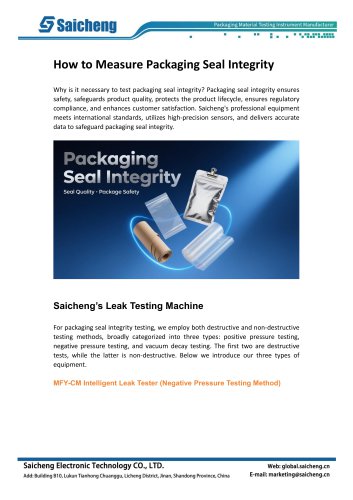
Bubble Tests vs. Precision: Upgrading Your Quality Control In the late 20th century, bubble leak testing was widely used for leak detection in flexible packaging due to its low cost and ease of operation. However, with the rise of pharmaceuticals, medical devices, precision electronics, and high-value products, traditional leak testing methods have struggled to detect minute leaks—leaks that can directly impact product quality and compromise the sterility barrier. Next, let’s explore the true meaning of “high-precision” leak testing, who absolutely needs it, and why traditional bubble testing is no longer sufficient. What Qualifies as “High-Precision” Leak Testing? High-precision leak testing no longer relies on visual inspection but instead depends entirely on quantitative, deterministic methods. Leak Detection Accuracy: Traditional bubble leak testing can detect relatively large micro-leaks, but high-precision leak testing can detect leaks as small as the micrometer range (Saicheng’s no
Open the catalog to page 1
leak tester can detect leaks as small as one micrometer). • Quantitativeness: Using high-precision sensors to monitor pressure changes in real time and generate data reports allows for an accurate understanding of the leak rate. • Compliance: Meets strict international standards, such as ASTM F2338 (vacuum decay) or USP <1207> (sterile drug packaging). Not all industries are required to use high-precision leak testing; for products such as shampoo pouches and moisture-proof shipping bags, standard testing is entirely sufficient. Special attention should be given to the following products: • Pharmaceuticals...
Open the catalog to page 2
performance—and may even lead to safety risks and product recalls. • High-value Food Packaging: These products typically have longer shelf lives and higher quality requirements. Even minor leaks can allow oxygen, water vapor, or microorganisms to enter, causing product spoilage and compromising safety and stability. For some high-value and high-risk products, the traditional bubble emission test is indeed no longer sufficient. However, for applications with a low risk of leakage, less stringent regulatory requirements, lower product value, or where only obvious leaks need to be detected, the...
Open the catalog to page 3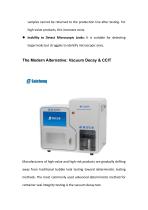
samples cannot be returned to the production line after testing. For high-value products, this increases costs. Inability to Detect Microscopic Leaks: It is suitable for detecting larger leaks but struggles to identify microscopic ones. The Modern Alternative: Vacuum Decay & CCIT Manufacturers of high-value and high-risk products are gradually shifting away from traditional bubble leak testing toward deterministic testing methods. The most commonly used advanced deterministic method for container seal integrity testing is the vacuum decay test.
Open the catalog to page 4
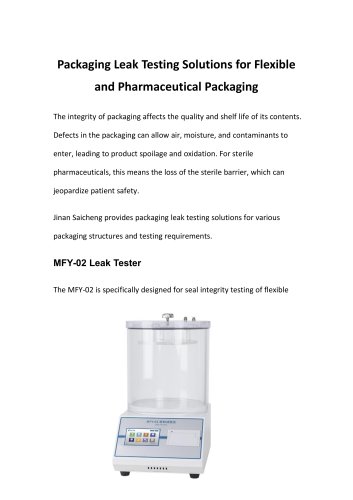
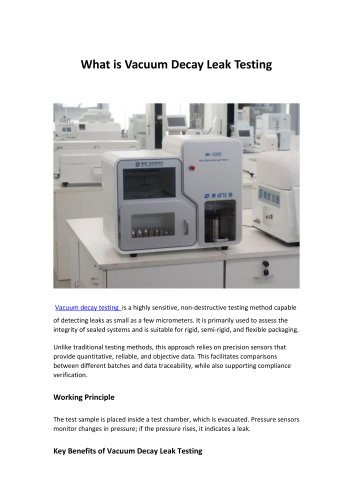
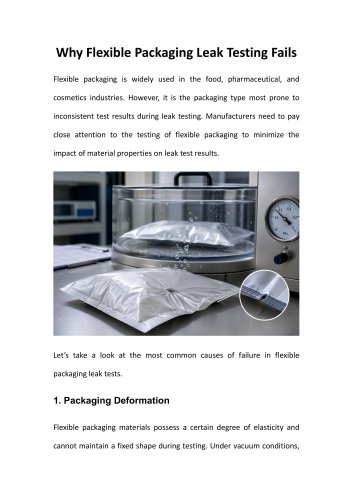
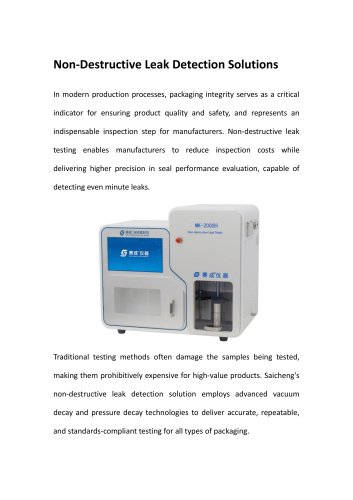
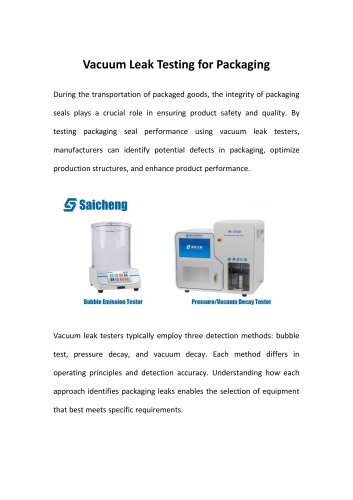
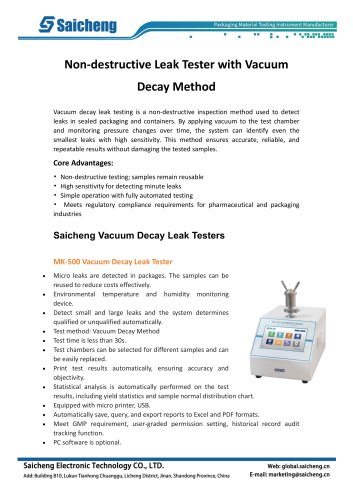
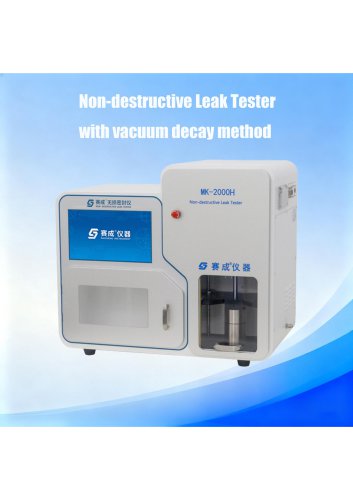
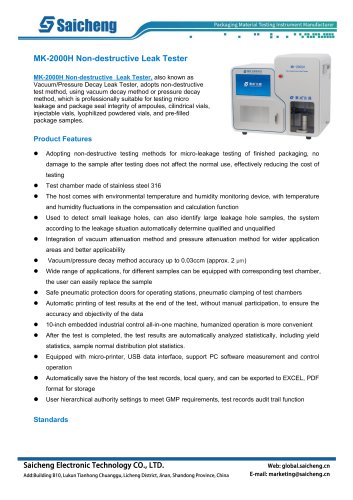
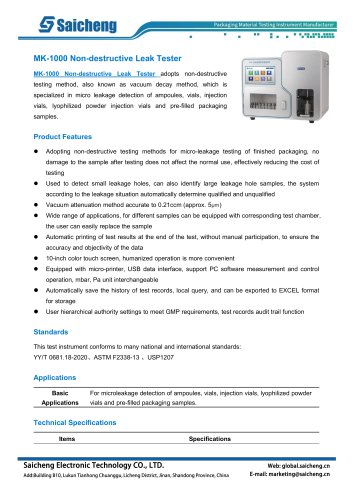
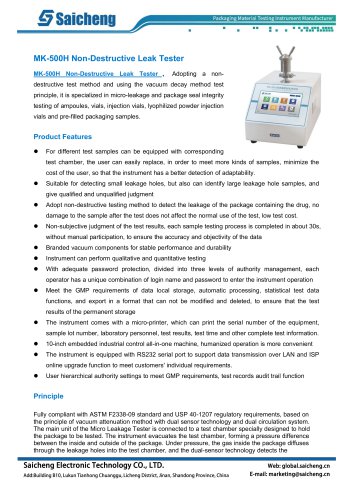
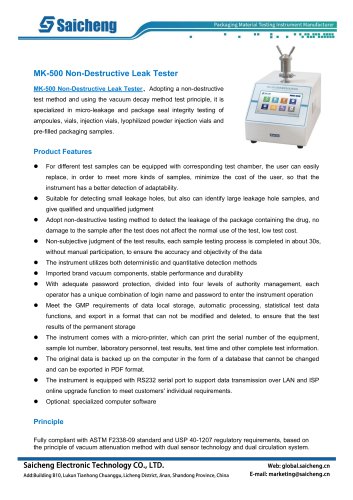
The principle behind this method involves placing the test sample in a test chamber, evacuating the chamber to create a vacuum, and using advanced sensors to monitor pressure changes in real time, providing quantitative data. A drop in vacuum level indicates a leak. Saicheng’s non-destructive leak tester strictly complies with international standards such as ASTM F2338 and USP 1207, providing quantitative, reliable, and repeatable test results. Equipped with advanced sensors, it can detect micro-leaks as small as a few micrometers, ensuring the accuracy of the results. If your team is seeking...
Open the catalog to page 5All Jinan Saicheng Electronic Technology Co.,LTD catalogs and technical brochures
 ASTM F2096
4 Pages
 Saicheng ASTM D3078 Standard
3 Pages
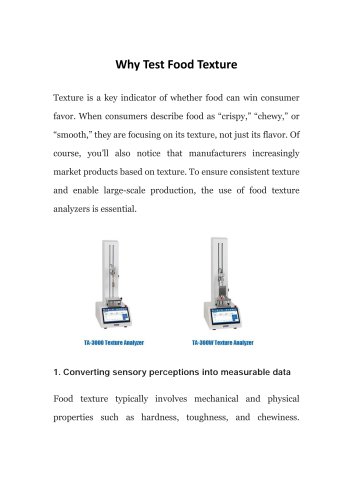 Why Test Food Texture
3 Pages
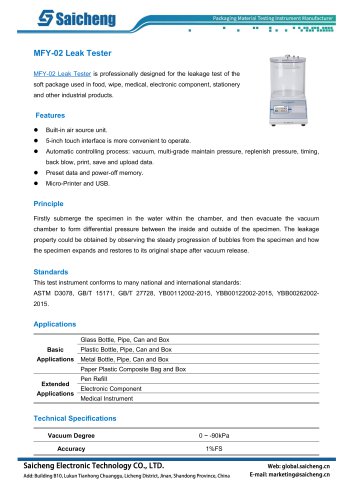 Saicheng Leak Tester MFY-02
2 Pages
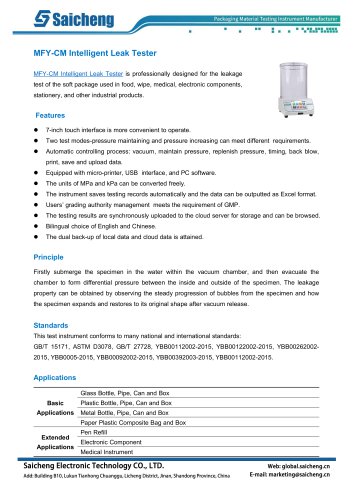 Saicheng Leak Tester MFY-CM
2 Pages
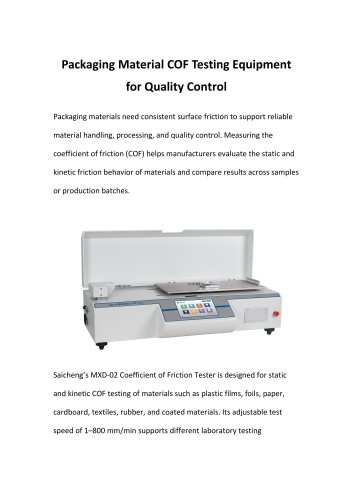



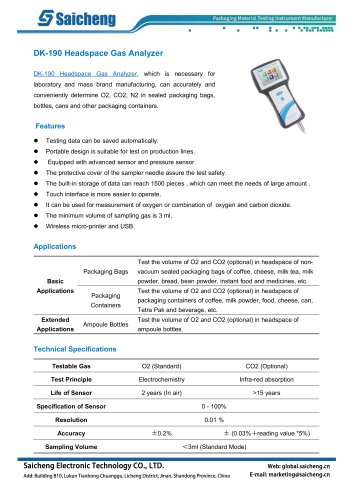
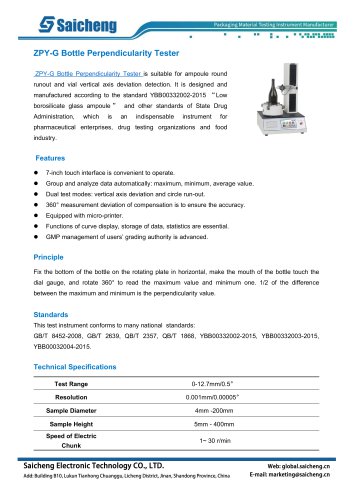
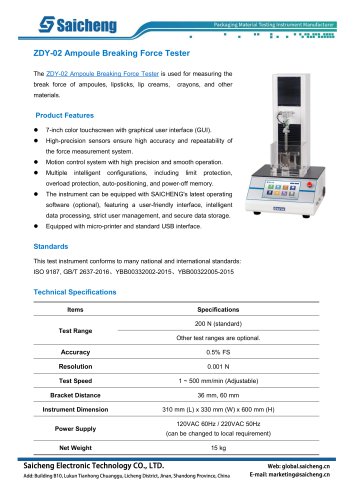
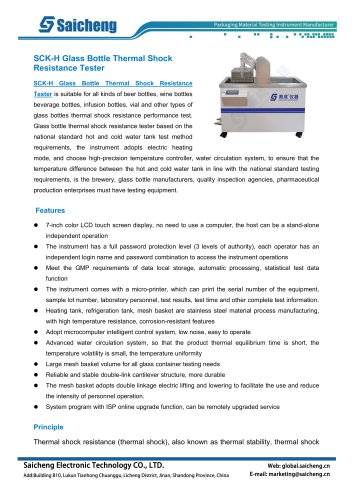
- Test machine
- Gas analyzer
- Concentration analyzer
- Automatic analyser
- Automated testing machine
- Material test machine
- Computer-controlled test machine
- Portable analyzer
- Continuous analyzer
- Digital tester
- Industrial testing machine
- Vertical testing machine
- Automatic tester
- Real-time analyzer
- Laboratory analyzer
- Industrial tester
- Tensile testing machine
- Laboratory testing machine
- Universal testing machine
- Compact analyzer