
- Catalogs
- Jiangsu Xinrongplas Machinery Co., Ltd
- PPR pipe material and advantages


- Company
- Products
- Catalogs
- News & Trends
- Exhibitions
PPR pipe material and advantages
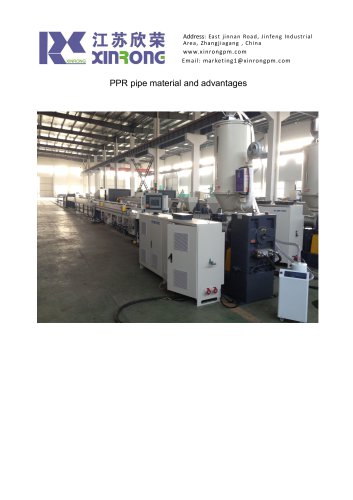
PPR pipe material and advantages
PPR Pipe Material and Advantages
This document provides information about PPR (Polypropylene Random Copolymer) pipe material, highlighting its key benefits and applications. PPR pipes are widely used in plumbing and industrial piping systems due to their durability, chemical resistance, and ease of installation.
Material Specifications
PPR pipes are made from polypropylene random copolymer, which offers excellent thermal stability and resistance to pressure. This material is suitable for both hot and cold water supply systems.
Advantages
- Durability: PPR pipes have a long service life due to their resistance to corrosion and scaling.
- Chemical Resistance: They are resistant to a wide range of chemicals, making them suitable for industrial applications.
- Thermal Resistance: Capable of withstanding high temperatures, ideal for hot water systems.
- Ease of Installation: Lightweight and easy to join using heat fusion techniques, reducing installation time and costs.
- Environmental Benefits: PPR pipes are recyclable and have low environmental impact.
Contact Information
For more details or inquiries, contact via email at [email protected] or visit the website www.xinrongpm.com. The company is located at East Jinnan Road, Jinfeng Industrial Area, Zhangjiagang, China.
Catalog excerpts
Address: East jin n a n Ro a d , Ji nfe n g In d u st r ia l Are a, Zh an g ji agan g , Ch i n a ww w.x inron gpm .com Email : marke ti ng1 @ xin ron gp m.com PPR pipe material and advantages
Open the catalog to page 1All Jiangsu Xinrongplas Machinery Co., Ltd catalogs and technical brochures
 Jiangsu Xinrongplas
1 Page








- Automatic cleaning system
- Water cleaning system
- Extrusion line
- Screw extruder
- Thermoplastic extrusion line
- Pelletizer
- Stainless steel cleaning system
- Process cleaning system
- Compact cleaning system
- Plastic pelletizing system
- Single screw extruder
- Tube extrusion line
- Panel extrusion line
- Multilayer extrusion line
- Waste granulator
- PP extruder
- PVC extrusion line
- PP extrusion line
- PE extrusion line
- PE extruder