

PFP7 and PFP7/C
1 /45Pages

PFP7 and PFP7/C
1 /45Pages
Catalog excerpts
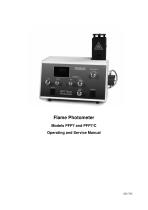
Flame Photometer Models PFP7 and PFP7/C Operating and Service Manual
Open the catalog to page 1
Safety Please read this information carefully prior to installing or using this equipment. 1. The unit described in this manual is designed to be operated only by trained personnel. Any adjustments, maintenance and repair must be carried out as defined in this manual by a person qualified to be aware of the hazards involved. 2. It is essential that both operating and service personnel employ a safe system of work in addition to the detailed instructions provided in the manual. 3. The covers of the unit should only be removed by personnel who have been trained to avoid the risk of shock. At this...
Open the catalog to page 2
Instrument description The PFP7 and PFP7/C are low temperature, single channel emission flame photometers designed for the routine determination of sodium (Na) and potassium (K). Additional filters are available for the determination of lithium (Li), calcium (Ca) and barium (Ba). Both versions are fitted with automatic flame failure detection for user safety, making them ideal for use in clinical, industrial or educational applications. The model PFP7/C is specifically designed for use in clinical applications. The in-built lineariser circuitry enables readings of both Na and K, at normal clinical...
Open the catalog to page 5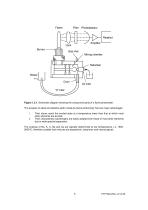
Readout Amplifier Lens Burner Gas inlet Mixing chamber Waste Drain Figure 1.2.1: Schematic diagram showing the component parts of a flame photometer. The analysis of alkali and alkaline earth metals by flame photometry has two major advantages: i. ii. Their atoms reach the excited state at a temperature lower than that at which most other elements are excited. Their characteristic wavelengths are easily isolated from those of most other elements due to wide spectral separation. The analysis of Na, K, Li, Ba and Ca are typically determined at low temperatures, i.e. 15002000° therefore suitable...
Open the catalog to page 6
1% Coefficient of variation (C.V.) for 20 consecutive samples using 10ppm Na set to read 50.0. Readings taken at 20 second intervals. N.B. C.V. is defined as: the sample standard deviation X 100 mean reading And sample standard deviation as: Where x is the reading, x is the mean readings of the series and n is the number of readings. Linearity: Better than 2% when concentration of 3ppm Na and K and 5ppm Li are set to read 100. Interference from Na, K and Li when equal in concentration to the test element will be less than 0.5%. Better than 2% over 5 minutes when continuously aspirating 10ppm,...
Open the catalog to page 7
Services required The fuel and air supplies to the instrument must be clean and dry and supply pressures regulated within the limits specified. Any contamination, moisture or variation in supply pressure will directly affect the performance of the instrument. NOTE: The instrument will only operate with the correct type of air compressor and gas regulator. 2.1.1 Voltage 90 - 125V or 190 - 250V @ 50 or 60Hz. 2.1.2 • • • • Propane or butane regulated to 10-15 inches water gauge (0.36-0.54psi or 0.0252 0.038kg/cm ). Natural gas at mains pressure between 3 and 10 inches water gauge (0.11-0.36psi or...
Open the catalog to page 8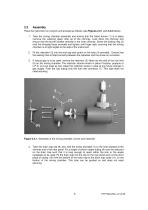
Place the instrument on a bench and proceed as follows (see Figures 2.3.1 and 2.3.2 below). 1. Take the mixing chamber assembly and ensure that the fluted burner (1) is in place (remove the retaining tape); offer up to the chimney. Look down the chimney and ensure that the burner locates centrally in the inner chimney. Screw the locking ring (2) onto the threaded boss provided and tighten until finger tight, ensuring that the mixing chamber is at right angles to the side of the instrument. 2. Fit the nebuliser (3) into the end cap and screw on the tube (4) provided. Ensure that the sealing olive...
Open the catalog to page 9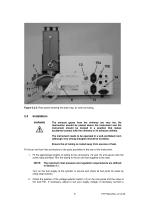
Figure 2.3.2: Rear panel showing the drain trap, air and fuel tubing. Installation WARNING The exhaust gases from the chimney are very hot. No obstruction should be placed above the instrument and the instrument should be located in a position that makes accidental contact with the chimney or its exhaust unlikely. The instrument needs to be operated in a well-ventilated room (although very strong draughts should be avoided). Ensure the air tubing is routed away from sources of heat. Fit the air and fuel inlet connectors to the ports provided on the rear of the instrument. 1. Fit the appropriate...
Open the catalog to page 10
suitable plug to the 3-pin AC supply lead. The colours of the wires conform to the internationally recognised standard such that: BROWN LIVE BLUE NEUTRAL GREEN/YELLOW EARTH IMPORTANT - THE INSTRUMENT MUST BE EARTHED. The green/yellow wire in the AC supply must be connected to a properly grounded If a compressor and/or pen recorder is to be run directly from the instrument then they should be wired to the plugs provided and connected to the POWER OUT sockets (15a Press the power switch on the front panel. The digital readout should be illuminated. 3. Fill the centre tube of the drain trap and...
Open the catalog to page 11
Analysis Preparation A comprehensive range of aqueous calibration standards is available from Jenway in both industrial and clinical levels. These must be diluted to a suitable concentration for aspiration into Clinical Standards (500ml) Part Code Industrial Standards (500ml) Part Code When preparing standards always observe the following: 1. Standards must always contain the constituents that are present in the samples in the same concentration ratios; i.e. if samples are prepared in 0.05M HCI then the standards should also contain 0.05M HCI. 2. Always ensure that the standards encompass the...
Open the catalog to page 12
3.1.1 Sodium Accurately weigh 0.634g of dry “Analar” quality NaCl, dissolve in pure deionised water and wash into a 500ml volumetric flask. Fill to the mark with pure deionised water. To prepare the standard solution for use with the flame photometer, this stock solution should be diluted 1 in 50. Calculation: Atomic weight Na = 23.0 Molecular weight NaCl = 58.46 Therefore, 0.634g NaCl contains Thus in 500ml of solution there is 250mg Na or 50mg Na/100ml. Diluting 1 in 50 gives a standard of 1mg Na/100ml = 10ppm Na. 3.1.2 Potassium Accurately weigh 0.477g of dry “Analar” quality KCl, dissolve...
Open the catalog to page 13All Jenway catalogs and technical brochures
 Virtual Catalog
1 Page
 PFP7
PFP71 Page
 7415 Nano
4 Pages
 Genova Bio
3 Pages
 traycell
1 Page
 74 Series
2 Pages
 Focus on Spectroscopy
4 Pages
 67 Series Spectrophotometers
8 Pages
 73 Series Spectrophotometers
8 Pages
 63 Series Spectrophotometers
4 Pages
 Flame Photometers
2 Pages
 3520 Bench pH Meter
1 Page
 3510 Bench pH/mV Meter
1 Page
 3505 Bench pH Meter
1 Page
 Genova Plus Life Science
4 Pages
 Genova Nano
4 Pages
 fluorimeter filter
1 Page
 6051 colorimeter Pages 6 & 7
2 Pages
 6800 Spectrophotometer
2 Pages
 Fluorimeters
8 Pages
 6850 Spectrophotometer
4 Pages
 Jenway Catalogue 2012
104 Pages
 Lab Electrochemistry
12 Pages
 Portable Electrochemistry
12 Pages
 Electrochemistry Products
2 Pages
 Jenway - Equipment for Analysis
104 Pages


Archived catalogs
 6051 Colorimeter
2 Pages
- SARRALLE measuring instrument
- Spectrophotometer
- Benchtop measuring module
- Visible spectrophotometer
- Benchtop spectrophotometer
- Laboratory measuring instrument
- UV spectrophotometer
- PH meter
- USB spectrophotometer
- UV-Vis spectrophotometer
- Color measurement spectrophotometer
- Conductivity meter
- Absorption spectrophotometer
- Concentricity measuring instrument
- Measuring spectrophotometer
- Industrial use spectrophotometer
- Process pH meter
- Conductivity measuring instrument
- Double-beam spectrophotometer