
- Catalogs
- IXXAT Automation
- CAN and CAN FD solutions


CAN and CAN FD solutions
1 /24Pages

CAN and CAN FD solutions
1 /24Pages
Catalog excerpts

PC interfaces Repeaters, bridges and gateways Analysis tools PLC expansions and more... Connecting Devices
Open the catalog to page 1
Content 2-3 About HMS 4-5 Application areas and industries Ixxat CAN Products 6-7 CAN PC interfaces 8-11 CAN infrastructure 12-14 CAN analysis and diagnosis 15 CANopen extension for SIMATIC PLC systems 16-17 APIs and protocol software Anybus CAN-related Products 18-19 Anybus X-gateways 20-21 Anybus Communicator 22 Accessories 4, 100% product tesma 4 past delwerv from stock / High quality standard
Open the catalog to page 2
HMS Technology Center Ravensburg – Development center for HMS products with focus on the Ixxat brand. Pioneering CAN technology For more than 30 years, HMS has been a leading and reliable provider of solutions for industrial communication under the brands Ixxat, Anybus and Ewon. With the availability of the first CAN chip in 1988, engineers from HMS implemented CAN-based system solutions and developed analysis tools, interfaces, infrastructure components and CAN-based higher protocols. Under the Ixxat brand, cutting-edge system concepts and system solutions have been implemented in numerous customer-specific...
Open the catalog to page 3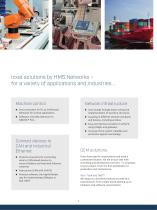
Ixxat solutions by HMS Networks -for a variety of applications and industries... Machine control ■ Easy connection of PCs to CAN-based Networks for control applications ■ CANopen and CAN extension for SIMATIC® PLCs Network infrastructure ■ Cost savings through easier wiring and implementation of star/tree structures ■ Coupling of different network standards and devices, including wireless ■ Easy and risk-free transition to CAN-FD using bridges and gateways ■ Increase of the system reliability and protection against overvoltage Connect devices to CAN and Industrial Ethernet ■ Protocol converters...
Open the catalog to page 4
As a longtime CAN expert, we are a reliable partner when it comes to CAN technology as well as CAN and CAN FC products. Alexander Hess, Managing Director of the HMS Technology Center Ravensburg
Open the catalog to page 5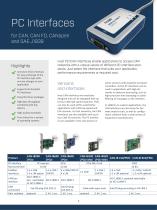
Highlights Common driver interface for easy exchange of the PC interface type without any changes to your application Supports all standard PC interfaces Powerful driver packages High data throughput combined with low latency Ixxat PC/CAN interfaces enable applications to access CAN networks with a unique variety of different PC interface standards. Just select the interface that suits your application, performance requirements or required cost. Versions and interfaces Ixxat CAN interfaces are modularly designed and can be equipped with up to four CAN high-speed channels. They can also be used...
Open the catalog to page 6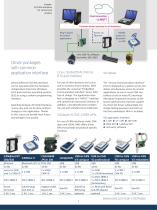
Sample: PC/CAN Interfaces for control and analysis Linux, SocketCAN, INtime, WindoWS RTX and VxWorks All the different PC/CAN interfaces can be operated with the hardware-independent drivers for Windows (VCI) and real-time operating systems (ECI) by using a uniform programming interface. Switching between PC/CAN interfaces is very easy and can be done without changes to the application. Thanks to this, users can benefit from future technologies very quickly. For use of CAN interfaces with Linux and in real-time environments, HMS provides the universal "Embedded Communication Interface" driver...
Open the catalog to page 7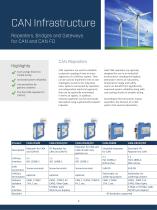
CAN Infrastructure Repeaters, Bridges and Gateways for CAN and CAN FD Highlights Cost savings thanks to simple wiring Increased system reliability Line protection by galvanic isolation The first CAN repeater for CAN FD CAN Repeaters CAN repeaters are used to establish a physical coupling of two or more segments of a CAN bus system. They can be used to implement tree or star topologies as well as for long drop lines. Systems connected by repeaters are independent electrical segments that can be optimally terminated in terms of signals. In addition, network segments can be electrically decoupled...
Open the catalog to page 8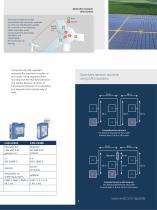
Application example: Wind turbine Three pitch control-drives shall communicate with the master controller via CAN. Ixxat CAN Repeaters enable star connection of the individual blades and enable stable communication by eliminating EMI effects and rebuild signals for transmission via sliprings. Node Repeater Nacelle Control Unit connected via CAN repeaters, increases the maximum number of bus nodes. Using repeaters does not influence the real-time behavior of a system because in terms of transmission behavior it corresponds to a network that consists only of lines.
Open the catalog to page 9
Highlights ^ Cost savings thanks to simplified wiring ^ Allows larger system expansion Filter and conversion functionality Increased system reliability Line protection by galvanic isolation Bridging of large distances and easy system access using Bluetooth, Ethernet and more CAN Bridges and Gateways The use of bridges and gateways opens up a large number of configuration possibilities. For example, CAN systems can be implemented over a larger area, devices without CAN interfaces can be connected to CAN systems or CAN systems can be coupled using different technologies, such as Bluetooth or Ethernet....
Open the catalog to page 10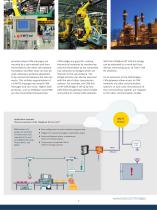
principle where CAN messages are received by a sub-network and then transmitted to the other sub-network. Translation and filter rules can also be used, allowing a protocol adaptation to be carried out between the sub-networks. This includes segmentation of a CAN FD message into several CAN messages and vice versa. Higher layer protocols, such as CANopen and J1939, are also transmitted transparently. CAN bridges are good for creating hierarchical networks by transferring only the information to the connected sub-networks via bridges which are relevant to the sub-network. The bridge function can...
Open the catalog to page 11
CAN Analyzing& DiagnosticcanAnalyser and Modules The canAnalyser is a powerful tool for development, testing and maintenance of CAN systems. The software is based on a modular concept and employs special features that offer exceptional openness and extensibility. The canAnalyser offers functions covering many areas of application, such as transmission of individual messages and signals, transmission of sequences, reception and interpretation of messages and signals and display of statistical data. The signals are managed within a database and can be loaded using special import filters. Import...
Open the catalog to page 12All IXXAT Automation catalogs and technical brochures
 IXXAT
IXXAT20 Pages
 IXXAT INpact
8 Pages
 CAN
CAN8 Pages
 IXXAT energy
4 Pages
 Safe
Safe5 Pages
 Automotive
7 Pages
 PC interfaces
20 Pages


- Automation software solution
- Analysis software solution
- Digital I/O
- Windows software
- IO module
- Cloud-based software
- Portable tester
- Digital IO module
- Communication gateway
- Measurement software
- Industrial gateway
- Ethernet gateway
- Fieldbus gateway
- Simulation software solution
- Fieldbus I/O module
- Development software
- Network software
- Test software
- Compact converter
- Compact I/O