
- Catalogs
- ITW Dynatec
- TPC-2

TPC-2

TPC-2
The TPC-2 Time-Based Pattern Controller by ITW Dynatec is designed for precise adhesive pattern application on fixed-speed production lines, particularly with pneumatic applicators. It features a dual-channel system with non-volatile memory capable of storing up to four programs, allowing for quick setup and adjustments without halting production.
Key Features
- Memory and Flexibility: The controller retains program settings even after power-off, ensuring seamless operation upon restart. It allows for on-the-fly pattern adjustments to maintain production efficiency.
- Adhesive Savings: By switching from a continuous adhesive bead to a skip pattern, adhesive consumption can be reduced by up to 50%.
- Security: A keyed lock-out feature prevents unauthorized programming changes.
Specifications
- Dimensions: Height: 29.4 cm (11.56 in), Depth: 13.3 cm (5.25 in), Width: 24.8 cm (9.76 in)
- Operating Temperature: 0°C to 45°C (32°F to 113°F)
- Storage Temperature: -10°C to 60°C (-14°F to 140°F)
- Channels and Programs: 2 channels, 4 programs, 4 events per program
- Output: 24 VDC, 26 watts per channel
- Trigger: 1 trigger, 24VDC nominal power supply, NPN or contact closure input signal
- Adjustable Range: .001 to 1.999 sec (.001 sec increments) or .01 to 19.99 sec (.01 sec increments)
- Power Supply: 120 or 240VAC, 50/60 Hz, 60 watts input
Contact Information
ITW Dynatec has offices in Asia, Americas, Japan, and Europe, providing global support and service. Visit their website at www.itwdynatec.com for more information.
Catalog excerpts
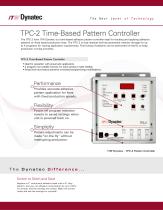
The Next Level of Technology TPC-2 Time-Based Pattern Controller The TPC-2 from ITW Dynatec is a time-based adhesive pattern controller ideal for tracking and applying adhesive patterns on fixed speed production lines. The TPC-2 is dual channel and has permanent memory storage for up to 4 programs for varying application requirements. Fine-tuning of patterns can be performed on-the-fly to keep production running smoothly. TPC-2 Time-Based Pattern Controller • Ideal for operation with pneumatic applicators. • 4 program non-volatile memory for quick product make readies. • Keyed lock-out feature prevents unwanted programming modifications. Performance Provides accurate adhesive pattern application for lines with fixed production speeds. Flexibility Power-off program retention reverts to saved settings when unit is powered back on. Simplicity Pattern adjustments can be made “on-the-fly” without interrupting production. ITW Dynatec - TPC-2 Pattern Controller The Dynatec Difference... Switch to Stitch and Save Replace a 6” continuous adhesive bead with a 6” skip pattern, and you cut adhesive consumption by up to 50%. It’s simple, and the savings are certain. Make the switch today and see the savings for yourself!
Open the catalog to page 1
TPC-2 Time-Based Pattern Controller Specifications Operating Temperature Storage Temperature Number of Events per Program Output Voltage Melters Feed Systems Hoses Applicators Nozzles Outout Wattage Related Products Number of Triggers Trigger Power Supply Trigger Input Signal Max. Adjustable Range (Operator selectable) 1 24VDC nominal NPN or contact closure .001 to 1.999 sec (.001 sec increments) or .01 to 19.99 sec (.01 sec increments) Power Supply Input Wattage 3/2012 ITW Dynatec ITW Dynatec reserves the right to discontinue or change specifications, designs, materials and equipment without...
Open the catalog to page 2All ITW Dynatec catalogs and technical brochures
 APEX™
APEX™2 Pages
 Dynamelt™ D
2 Pages
 Dynamini™
2 Pages
 Dynamelt™ SR
2 Pages
 DM55 DynaDrum™
2 Pages
 Ultra™ SCS
2 Pages
 Velocity™
2 Pages
 TPC-9
TPC-92 Pages
 DY2008
2 Pages
 EVC-1
EVC-12 Pages
 Dynamelt? GC Series
2 Pages
 ADS1
ADS12 Pages
 Adhesive Transfer Tower
2 Pages
 PINCH BOTTOM APPLICATOR
1 Page
 Vector - Spray Applicator
2 Pages
 Vector - Slot Applicator
2 Pages
 Adhesive Feeder
2 Pages
 Dynamelt S Product
1 Page
 Dynamelt M35
219 Pages


Archived catalogs
 DY 2008 PATTERN CONTROLLER
2 Pages
 APEX High Speed Slot Die
2 Pages

- Feeding unit
- Glue dispensing machine
- Adhesive melter
- Automatic feeding system
- Heated hose
- Hot melt glue melter
- Application head
- Hot-melt applicator
- Melter with gear pump
- Production line feeding system
- Hot-melt glue dispensing machine
- Adhesive heated hose
- Hot-melt heated hose
- Bead application head
- High-temperature heated hose
- High-speed application head
- Hot-melt glue feeding system