

ISOLEIKA’S MICROPOROUS & CALCIUM SILICATE & MINERAL FIBER

1 / 1 PageView full catalog
ISOLEIKA’S MICROPOROUS & CALCIUM SILICATE & MINERAL FIBER
Product catalog summary
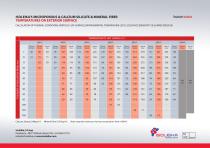
Overview: This document provides a detailed analysis of the thermal conditions for various insulation materials, specifically microporous, calcium silicate, and mineral fiber, when applied to a vertical flat surface. The environmental conditions considered include an ambient temperature of 20ºC, a cold face emissivity of 0.9, and no wind speed.
Specifications: The document outlines the temperature of the hot surface ranging from 200ºC to 1000ºC and the corresponding exterior surface temperatures for different thicknesses of insulation panels (measured in mm). The materials analyzed include Microporous ISO-NUD, Calcium Silicate, and Mineral Fibre.
Data Summary:
- For each material, the exterior surface temperature is calculated at various hot surface temperatures and insulation thicknesses.
- Calcium silicate and mineral fiber have a maximum hot face temperature limit of 900ºC.
- At higher temperatures, some materials are marked as 'Too hot', indicating they exceed safe operational limits.
Key Observations:
- Microporous ISO-NUD generally shows lower exterior surface temperatures compared to calcium silicate and mineral fiber at the same thickness and hot surface temperature.
- Increasing the thickness of the insulation panel generally results in lower exterior surface temperatures, enhancing insulation effectiveness.
- Calcium silicate and mineral fiber are suitable for applications up to 900ºC, beyond which they may not provide adequate insulation.
Recommendations:
- For applications requiring high-temperature insulation, consider using thicker panels of microporous ISO-NUD for better performance.
- Ensure that the operational temperature does not exceed the material's maximum hot face temperature limit to maintain safety and efficiency.
See more
Catalog excerpts
CALCULATION OF THERMAL CONDITIONS: VERTICAL FLAT SURFACE, ENVIRONMENTAL TEMPERATURE (20°C), COLD FACE EMISSIVITY (0.9), WIND SPEED (0) Microp ISO-NUD Calcium Silicate Microp ISO-NUD Calcium Silicate Microp ISO-NUD Calcium Silicate Microp ISO-NUD Calcium Silicate Microp ISO-NUD Calcium Silicate THICKNESS OF INSULATION PANEL mm Microp ISO-NUD Calcium Silicate Microp ISO-NUD Calcium Silicate Mineral Fibre Isoleika, S.Coop. Etxebarria , 48277 Bizkaia (Spain) Tel: +34 946167732 [email protected] www.isoleika.com ISOLEIHA insulation panels
Open the catalog to page 1All ISOLEIKA catalogs and technical brochures
 ISOTUBE
2 Pages
 ISONUD LLT
1 Page
 ISOPIPE
1 Page
 ISOTAPE
1 Page
 ISOVAC
1 Page
 ISOFLEX 25 ISOFLEX 50
2 Pages
 ISOCLOTH
2 Pages
 ISONUD
2 Pages

Related Searches
*Prices are pre-tax. They exclude delivery charges and customs duties and do not include additional charges for installation or activation options. Prices are indicative only and may vary by country, with changes to the cost of raw materials and exchange rates.
About DirectIndustry
DirectIndustry is a marketplace that offers B2B players a complete experience, from product sourcing to purchase. DirectIndustry is an entity of VirtualExpo Group.
Are you a buyer?
Are you a supplier?