

FNCT Tester

FNCT Tester
The document describes a tensile creep tester designed for testing environmental stress cracking in samples using the full notch creep test (FNCT). The tester is noted for its simple and safe operation, reliable test results, lasting efficiency, and state-of-the-art technology. It allows for the independent programming and operation of six stations at different test temperatures and forces.
Specifications
- Model Number: 1598
- Number of Stations: 6 traction units
- Temperature Range: 30°C above ambient to +95°C
- Temperature Accuracy: ±0.5°C
- Sample Dimensions: Max. 25 x 15 mm (width x thickness)
- Travel of Traction Unit: Max. 150 mm
- Force Measurement: Load cells available in 200-N, 500-N, 1000-N, 2000-N, 3000-N, 5000-N
- Preload: Preselectable up to max. force of load cell, max. preset time 9999 s
- Accuracy: ±0.5% of full scale of load cell plus ±0.1% per 5 K change in ambient temperature
- Max. Extension: Approx. 115 mm with a tank depth of 400 mm, Approx. 200 mm with a tank depth of 600 mm
- Distance Measurement: Via incremental encoder, accuracy ±0.5 mm
- Test Tank Capacity: Approx. 16 l per tank at 400 mm fill level, Approx. 23 l per tank at 600 mm fill level
- Permissible Ambient Temperature: +5 to +30°C
- Permissible Relative Humidity: Max. 70%, non-condensing
- Noise Emission: <70 dB(A)
- Dimensions: Width 1700 mm, Depth 850 mm, Height 2050 mm
- Weight: Approx. 650 kg (fully equipped)
- Voltage Data: 230/400 V, 50 Hz (other voltages on request)
Features
- Simple mounting of samples in clamping jaws
- Safe introduction of samples into the test tank without contact with fluid
- High accuracy of load and distance measurement
- Precise temperature compliance
- Smooth and torsion-free application of force
- High-quality components for reliability and long service life
- Operation via IptDataLogging®
- CE conformity
Catalog excerpts
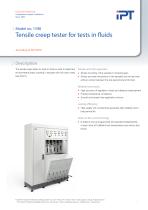
Institut für Prüftechnik Competence creates Confidence. Since 1969. Tensile creep tester for tests in fluids According to ISO 16770 Description The tensile creep tester for tests in fluids is used to determine environmental stress cracking in samples with full notch creep test (FNCT). Simple and safe operation Simple mounting of the samples in clamping jaws Simple and safe introduction of the samples into the test tank without contact between the test personnel and the fluid Reliable test results High accuracy of regulation of load and distance measurement Precise temperature compliance Smooth and torsion-free application of force Lasting efficiency High-quality unit components guarantee high reliability and a long service life State-of-the-art technology 6 stations can be programmed and operated independently of each other at 6 different test temperatures and various test forces © 2016 IPT Institut für Prüftechnik Gerätebau GmbH & Co. KG – Photos: IPT – Version: 08/16 – Data subject to change. All rights reserved. IPT Institut für Prüftechnik Gerätebau GmbH & Co. KG, Schulstr. 3, 86447 Todtenweis, Germany – [email protected]
Open the catalog to page 1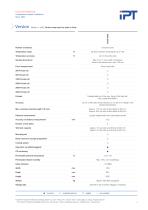
Institut für Prüftechnik Competence creates Confidence. Since 1969. Model no. 1598 Tensile creep tester for tests in fluids Temperature range 30 above ambient temperature up to +95 Temperature accuracy Sample dimensions Max. 25 x 15 mm (width x thickness) Travel of the traction unit: max. 150 mm Force measurement Across load cells 200-N load cell 500-N load cell 1000-N load cell 2000-N load cell 3000-N load cell 5000-N load cell Preload Preselectable up to the max. force of the load cell, max. preset time 9999 s ±0.5% of full scale of load cell plus ±0.1% per 5 K change in the ambient temperature...
Open the catalog to page 2All IPT Institut für Prüftechnik Gerätebau GmbH & Co. KG catalogs and technical brochures
 Circometer
2 Pages
 Rotational Microtome
3 Pages
 Moisture Content Unit
2 Pages
 Hardness Tester
2 Pages
 H3002
H30022 Pages
 Test oven
3 Pages
 Software IptDataLogging®
6 Pages
 H3019
H30197 Pages
 H3047
H30472 Pages
 1653
16533 Pages
 1411
14112 Pages
 1291
12912 Pages
 1665
16652 Pages
 H3000
H30002 Pages
 1643
16433 Pages
 Falling Weight Tester
4 Pages
 Laboratory Granulator
2 Pages
 MFR/MVR Tester
3 Pages
 Ringstiffness Tester 1663
2 Pages
 Ringstiffness Tester 1669
2 Pages




- Kiln
- Test machine
- Chamber kiln
- Measuring device
- Test cabinet
- Electric furnace
- Concentration analyzer
- Grinding mill
- Test stand
- Temperature test chamber
- Windows software
- Microscope
- Material test machine
- Indentation hardness tester
- Benchtop analyser
- Solids analyser
- Computer-controlled test machine
- CNC milling machine
- Cylindrical cap
- Optical microscope