
- Catalogs
- INTEWA GmbH
- RM Eco

RM Eco

RM Eco
The INTEWA RAINMASTER Eco is highlighted as the most economical rainwater system, saving over 75% of power compared to traditional systems. If implemented across Germany, it could save nearly 100 GWh annually. The system uses a diaphragm pump technology, which is more efficient than conventional centrifugal pumps, delivering only the necessary water flow for household needs, thus reducing power wastage.
The RAINMASTER Eco makes rainwater and greywater harvesting more financially viable due to its lower energy consumption and reduced system cost. Its innovative design and quality materials allow for economical use in various regions.
The RAINMASTER Eco operates at a significantly lower noise level (48 dB for Eco 10 and 58 dB for Eco 14) compared to traditional pumps, making it suitable for indoor installation without disturbing household tranquility.
The system features an attractive design and compact size, comparable to continuous flow heaters. It includes clear indicators for operating status and an optional fill level indicator for the cistern.
The RAINMASTER Eco is easy to assemble and install, with components like flexible hoses, an expansion tank, and a pressure gauge included. It is designed for wall mounting and connects easily to mains water and pressure lines. The system includes a float switch sensor for monitoring and a straightforward start-up process.
Catalog excerpts

INTEWA Ingenieur-Gesellschaft für Energie- und Wassertechnik mbH Verwaltung: Jülicher Straße 336 Lager: Jülicher Straße 342 D-52070 Aachen Telefon: 0049-(0)241-96 605-0 Telefax: 0049-(0)241-96 605-10 E-Mail: [email protected] Internet: www.intewa.de The most economical rain water system in the world On average, the INTEWA RAINMASTER Eco effectively saves more than 75 % power. Several systems were analyzed within the scope of an fbr Fachvereinigung Betriebs- und Regenwassernutzung e.V. [fbr] – approved investigation on the power consumption of Power measurement rainwater systems. If all the rainwater systems in Germany were equipped with the INTEWA RAINMASTER Eco instead of existing pumps almost 100 GWh of power per year could be saved. INTEWA has come to a new, smart way with the RAINMASTER Eco. Its new diaphragm pump technology stands it apart from convention centrifugal pumps which are power-hungry at approximately 900 Watts power input. While toilet flushing requires as little as 5 l/min for tank filling, the centrifugal pump delivers 80 l/min , total over-kill and a waste of 90 % of the pumps power. In contrast, the performance of the RAINMASTER Eco Diaphragm pump is perfectly designed for typical household use delivering a power saving 10 l/min, more than enough for basic household requirements. In principle, the diaphragm pump resembles the human heart: An elastic diaphragm is moved by an eccentric tappet. It draws liquid in on the downward stroke via the inlet valve. Simutaneously, the diaphragm forces the water out of the pump head via the outlet valve. It is used both in small applications (such as with nozzle systems) as well as in large-scale technology (such as the food and pharmaceutical industries). Diaphragm pumps ensure a wear-free operation and a safe shielding between the drive system and the pumping medium. Save more power
Open the catalog to page 1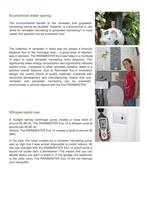
Economical water saving The environmental benefit of the rainwater and greywater harvesting cannot be doubted. However, is it economical to use tanks for rainwater harvesting or greywater harvesting? In most cases, this question can be answered "yes". The collection of rainwater in tanks was not always a financial pleasure due to the municipal fees – a good dose of idealism was in demand. The RAINMASTER Eco now helps in a multitude of ways to make rainwater harvesting more attractive. The significantly lower energy consumption and significantly reduced system price, compared to other rainwater...
Open the catalog to page 2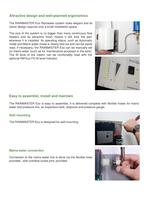
Attractive design and well-planned ergonomics The RAINMASTER Eco Rainwater system looks elegant and its clever design requires only a small installation space. The size of the system is no bigger than many continuous flow heaters and its attractive finish means it will look the part wherever it is installed. Its operating status, such as Automatic mode and Mains water mode is clearly laid out and can be easily read. If necessary, the RAINMASTER Eco can be manually set on mains water (such as for maintenance purposes in the tank). The fill level of the cistern can be comfortably read with the...
Open the catalog to page 3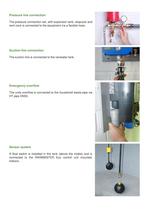
Pressure line connection The pressure connection set, with expansion tank, stopcock and vent cock is connected to the equipment via a flexible hose. Suction line connection The suction line is connected to the rainwater tank. Emergency overflow The units overflow is connected to the household waste pipe via HT pipe DN50. Sensor system A float switch is installed in the tank (above the intake) and is connected to the RAINMASTER Eco control unit mounted indoors.
Open the catalog to page 4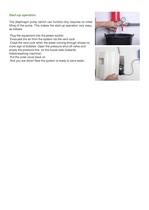
Start-up operation The diaphragm pump (which can function dry) requires no initial filling of the pump. This makes the start-up operation very easy, as follows: Plug the equipment into the power socket Evacuate the air from the system via the vent cock Close the vent cock when the water coming through shows no more sign of bubbles Open the pressure shut-off valve and empty the pressure line on the house side (towards toilets/washing machine) Put the outer cover back on And you are done! Now the system is ready to save water.
Open the catalog to page 5All INTEWA GmbH catalogs and technical brochures
 PLURAFIT
3 Pages
 AQUALOOP
3 Pages
 DRAINMAX
3 Pages
 PURAIN
3 Pages
 RAINMASTER Favorit
3 Pages
 RAINMASTER Eco
3 Pages

- Liquid filter
- Storage vessel
- Filter with cartridge
- Plastic vessel
- Centrifugal classifier
- Vertical tank
- Liquids separator
- Water pre-filter
- Horizontal tank container
- Water tank
- Y-strainer filter
- Hydraulic filter
- Liquids level gauge
- Basket filter
- In-line filter
- Pressure tank
- Easy cleaning filter
- Sight glass level indicator
- Self-backwashing filter