

S2600GZ and S2600GL

S2600GZ and S2600GL
This document provides the technical product specification for the Intel® Server Board S2600GZ/GL, detailing its features, architecture, and management functionalities.
The server board supports Intel® Xeon® processors and various memory configurations, with component identification and mechanical drawings included.
Details processor support, socket assembly, thermal design power, core features, supported technologies, and integrated memory controller.
Includes BIOS password protection, TPM module support, and Intel® Trusted Execution Technology.
Outlines support for Intel® Virtualization Technology and Intelligent Power Node Manager, specifying hardware requirements.
Discusses Baseboard Management Controller (BMC) firmware features, including IPMI 2.0, power control sources, and system fan management.
Emphasizes no licenses are granted and Intel assumes no liability for use in mission-critical applications.
Includes detailed information on POST Code Diagnostic LED Decoder, POST Code Errors, and Supported Intel® Server Systems.
Highlights the need for adequate airflow for cooling and Intel's non-responsibility for failures outside published limits.
Details memory configurations, DIMM population rules, operating modes, and error handling for the server boards.
Integrates features like PCI Express interfaces and supports up to 40 PCIe lanes.
Includes an Intel Ethernet Controller I350-AM4 with four Ethernet ports and pre-assigned MAC addresses.
Summarizes the architecture and features of the Intel Server Board S2600GZ/GL, focusing on memory error handling, I/O module capabilities, PCIe support, and network interface configurations.
Lists technical specifications including DDR2/3 interface, ADCs, fan tachometers, and various I/O ports.
Details USB interface support, video compression, and encryption for remote management.
Describes BIOS password protection, TPM module support, and Intel® Trusted Execution Technology.
Enhances virtualization capabilities with VT-d, VT-c, and VT-x features.
Addresses power and cooling challenges by monitoring power consumption and controlling power allocation.
Integrates hardware and software components for system health monitoring and thermal management.
Outlines various power control initiators including external signals and internal subsystems.
Provides an automatic recovery mechanism for system or component failures.
Allows a multiprocessor system to boot even if the bootstrap processor fails.
BMC monitors system hardware components and translates information into IPMI sensors.
Stores system events in non-volatile storage, accessible regardless of system power state.
BMC controls and monitors system fans, optimizing cooling and noise levels.
BMC uses IPMI sensors to control fan speeds based on thermal conditions.
Supports thermal management through throttling of system memory.
BMC supports communication interfaces including IPMB, LAN, and USB.
Details capabilities and configurations of LAN channels in server management.
Includes ARP, ICMP, VLAN, SSH, SOL 2.0, PEF, LAN alerting, and embedded web server support.
Captures low-level diagnostic data for enhanced debugging by Intel engineers.
Supports simplified management in Internet Portal Data Centers.
Supported by the BMC for authentication and authorization.
Enhances management features with KVM and media redirection capabilities.
Supports use of remote and local devices simultaneously, with media redirection for secure sessions.
Remotely mounted devices are recognized by the system's OS and BIOS for installation.
Features multiple power connectors for main power, riser cards, and peripheral devices.
Includes a 30-pin SSI compatible front panel header for various features.
Provides visual feedback on system health with different colors and blink rates.
Outlines critical errors that can halt the system and conditions leading to shutdowns.
Includes connectors for USB, video, and storage devices with pin-out tables.
Supports six system fans and two serial port connectors with pin-out details.
Describes jumper blocks for system recovery and password clearing procedures.
Includes LED indicators for troubleshooting system conditions.
Provides guidelines for stable power requirements and voltage regulation.
Details voltage requirements, capacitive loading, grounding, stability, and noise specifications.
Allows configuration of system settings with navigation options and screen categories.
Provides information on user login level, platform ID, BIOS version, and memory options.
Allows configuration of system components including processor, power, memory, and storage settings.
Includes options for QPI Link Frequency, Turbo Boost, SpeedStep, Hyper-Threading, and virtualization technologies.
Offers profiles for performance or energy efficiency optimization.
Details memory settings, operating modes, and error checking features.
Covers configuration of onboard mass storage controllers and RAID capabilities.
Includes options for memory mapping, onboard video, and PCIe tuning.
Discusses configuration of Legacy VGA video output for PCIe slots.
Allows enabling of both onboard and add-in video adapters.
Outlines configuration options for onboard and IO Module NICs.
Available for PXE, discs, and FCoE protocols with specific configurations.
Enables or disables PCI PME function for Wake on LAN capability.
Details configuration options for onboard and IO Module NICs.
Describes types of IO Modules and configuration options.
Provides options to enable or disable onboard NIC controllers.
Options to enable or disable Infiniband Controller Option ROM and FlexBoot.
Options to enable or disable specific ports on NICs.
Details configuration options for Serial A and Serial B ports.
Outlines USB controller options and bootability settings.
Includes options for thermal control and fan speed management.
Allows setting of passwords, TPM state, and front panel lockout options.
Provides configuration options for error handling, power management, and system monitoring.
Allows remote management of the server by redirecting console output to a serial port.
Options include None and RTS/CTS for preventing data overrun.
Options for serial port transmission speed.
Character formatting options for remote terminal applications.
Enables legacy OS redirection on a serial port.
Options for terminal screen area size.
Displays part numbers, serial numbers, and firmware revisions.
Allows configuration of BMC Baseboard LAN channel and Intel® RMM4 LAN channel.
Allows viewing and editing of the Gateway IPv6 address for the Baseboard LAN.
Users can view or edit the IPv6 Prefix Length.
Displays the presence of Intel® RMM4 components.
Determines whether IP parameters for IPv4 addressing can be edited.
Specifies IPv4 addressing details for the Intel® RMM4 DMN LAN.
Determines the editability of IPv6 parameters for the Intel® RMM4 DMN LAN.
Specifies IPv6 addressing details.
Editable when at least one IP Source or IPv6 Source is set to Dynamic.
Allows selection and configuration of user IDs and their privileges.
Enables or disables LAN access for users and allows editing of user names.
Allows setting a new password with a maximum length of 15 characters.
Displays bootable media and allows configuration of boot order.
Configurable timeout for BIOS pause at the end of POST.
Allows configuration of a boot timeout before loading third-party option ROMs.
Users can set the boot order for various device types.
Users can add or delete EFI boot options.
Determines whether newly discovered USB devices are prioritized.
Retains boot order positions for devices even if removed from the system.
Separate screens for configuring the boot order of different device types.
Procedures for managing EFI boot options.
Displays available boot devices for immediate booting.
Provides information on POST Error Codes.
Allows users to save or discard configuration changes.
Guidelines for handling server components and achieving optimal performance.
Information on BMC core sensors and their capabilities.
Lists error codes related to DIMM failures, SPD failures, BIOS settings corruption, and TPM device issues.
Indicate error conditions before system video initialization.
Outlines supported Intel® Server Systems and their features.
Includes support for Intel® Xeon® processors, memory configurations, and storage options.
Provides definitions for technical terms and acronyms used in the document.
Lists various reference documents related to the Intel® Server Board S2600GZ/GL.
Catalog excerpts

Intel® Server Board S2600GZ/GL Technical Product Specification
Open the catalog to page 1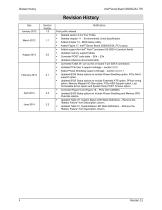
Revision History Intel® Server Board S2600GZ/GL TPS Revision History Date January 2012 Modifications First public release. Deleted section 6.9.2 Fan Profile. Deleted chapter 11 - Environmental Limits Specification. Added chapter 12 - BIOS Setup Utility. ® Added Figure 17. Intel Server Board S2600GZ/GL PCI Layout. Added support for Intel Xeon processor E5-2600 v2 product family Updated memory support tables Corrected POST code table - E0h – E3h Updated reference documents table Corrected Table 39 - pin out for on-board 7-pin SATA connectors. Updated PCIe Gen 3 support verbiage – section 3.2.5...
Open the catalog to page 2
Intel® Server Board S2600GZ/GL TPS Disclaimers INFORMATION IN THIS DOCUMENT IS PROVIDED IN CONNECTION WITH INTEL PRODUCTS. NO LICENSE, EXPRESS OR IMPLIED, BY ESTOPPEL OR OTHERWISE, TO ANY INTELLECTUAL PROPERTY RIGHTS IS GRANTED BY THIS DOCUMENT. EXCEPT AS PROVIDED IN INTEL'S TERMS AND CONDITIONS OF SALE FOR SUCH PRODUCTS, INTEL ASSUMES NO LIABILITY WHATSOEVER AND INTEL DISCLAIMS ANY EXPRESS OR IMPLIED WARRANTY, RELATING TO SALE AND/OR USE OF INTEL PRODUCTS INCLUDING LIABILITY OR WARRANTIES RELATING TO FITNESS FOR A PARTICULAR PURPOSE, MERCHANTABILITY, OR INFRINGEMENT OF ANY PATENT, COPYRIGHT...
Open the catalog to page 3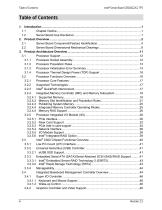
Intel® Server Board S2600GZ/GL TPS
Open the catalog to page 4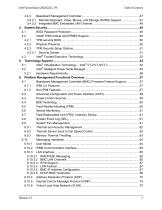
Intel® Server Board S2600GZ/GL TPS
Open the catalog to page 5
Intel® Server Board S2600GZ/GL TPS
Open the catalog to page 6
Intel® Server Board S2600GZ/GL TPS
Open the catalog to page 7
Intel® Server Board S2600GZ/GL TPS
Open the catalog to page 8
Intel® Server Board S2600GZ/GL TPS
Open the catalog to page 9
Intel® Server Board S2600GZ/GL TPS
Open the catalog to page 10
Intel® Server Board S2600GZ/GL TPS
Open the catalog to page 11
Intel® Server Board S2600GZ/GL TPS
Open the catalog to page 12
Intel8 Server Board SZ600GZ/GL TPS List of Tables
Open the catalog to page 13
Intel® Server Board S2600GZ/GL TPS This Technical Product Specification (TPS) provides board-specific information detailing the features, functionality, and high-level architecture of the Intel® Server Boards S2600GZ and S2600GL. Design-level information related to specific server board components and subsystems can be obtained by ordering External Product Specifications (EPS) or External Design Specifications (EDS) related to this server generation. EPS and EDS documents are made available under NDA with Intel and must be ordered through your local Intel representative. See the Reference Documents...
Open the catalog to page 15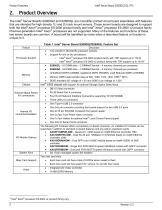
Product Overview Intel® Server Board S2600GZ/GL TPS Product Overview The Intel® Server Boards S2600GZ and S2600GL are monolithic printed circuit board assemblies with features that are intended for high density 1U and 2U rack mount servers. These server boards are designed to support both the Intel® Xeon® processor E5-2600 product family and Intel® Xeon® processor E5-2600 v2 product family. Previous generation Intel® Xeon® processors are not supported. Many of the features and functions of these two server boards are common. A board will be identified by name when a described feature or function...
Open the catalog to page 16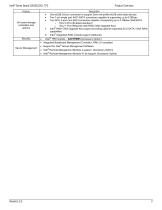
Intel® Server Board S2600GZ/GL TPS Feature On-board storage controllers and options Description One eUSB 2x5 pin connector to support 2mm low-profile eUSB solid state devices Two 7-pin single port AHCI SATA connectors capable of supporting up to 6 GB/sec Two SCU 4-port mini-SAS connectors capable of supporting up to 3 GB/sec SAS/SATA o SCU 0 Port (Enabled standard) o SCU 1 Port (Requires Intel RAID C600 Upgrade Key) ® Intel RAID C600 Upgrade Key support providing optional expanded SCU SATA / SAS RAID capabilities ® Intel Integrated RAID module support (Optional) Product Overview • Intel TPM module...
Open the catalog to page 17
Product Overview Intel8 Server Board SZ600GZ/GL TPS 2.1 Server Board Component/Feature Identification AHCl SAfAO --BtOS Pecg^e-ry. Jumper - —Password Clear Jumper - ME fOrc* Updale J umper --BtQS Delguh Setting Jumper [ Front Pygt
Open the catalog to page 18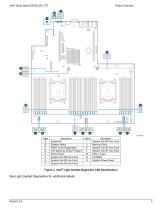
Intel® Server Board S2600GZ/GL TPS Product Overview Description System ID System Status POST Code Diagnostics 12V Stand-by Power Present CPU-2 Fault System Fan #6 Fan Fault System Fan #5 Fan Fault System Fan #4 Fan Fault Description System Fan #3 Fan Fault Memory Fault System Fan #2 Fan Fault System Fan #1 Fan Fault CPU-1 Fault CATERR System Power Good Figure 2. Intel Light Guided Diagnostic LED Identification See Light Guided Diagnostics for additional details.
Open the catalog to page 19
Product Overview Intel® Server Board S2600GZ/GL TPS Figure 3. Jumper Block Identification See Chapter 9 - Reset & Recovery Jumpers for additional details. Description NIC 1 NIC 2 NIC 3 NIC 4 Video Serial Port A USB Ports Figure 4. Intel Server Board S2600GZ/S2600GL External I/O Connector Layout Server Board Dimensional Mechanical Drawings Revision 2.3
Open the catalog to page 20
Intel® Server Board S2600GZ/GL TPS Product Overview Figure 5. Intel Server Board S2600GZ/GL – Primary Side Keepout Zone
Open the catalog to page 21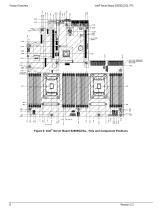
Product Overview Intel® Server Board S2600GZ/GL TPS Figure 6. Intel Server Board S2600GZ/GL– Hole and Component Positions
Open the catalog to page 22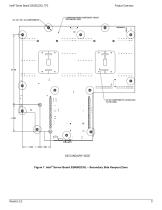
Intel® Server Board S2600GZ/GL TPS Product Overview Figure 7. Intel Server Board S2600GZ/GL – Secondary Side Keepout Zone
Open the catalog to page 23
Product Overview Intel® Server Board S2600GZ/GL TPS Figure 8. Intel Server Board S2600GZ/GL– Primary Side Height Restrictions
Open the catalog to page 24
Intel® Server Board S2600GZ/GL TPS Product Architecture Overview Product Architecture Overview The architecture of Intel® Server Boards S2600GZ and S2600GL is developed around the integrated features and functions of the Intel® Xeon® processor E5-2600 product family, the Intel® C602 chipset, the Intel® Ethernet Controller I350 GbE controller chip, and the Emulex* Pilot-III Server Management Controller. The following diagram provides an overview of the server board architecture, showing the features and interconnects of each of the major sub-system components. Figure 9. Intel Server Boards S2600GZ,...
Open the catalog to page 25
Product Architecture Overview Intel® Server Board S2600GZ/GL TPS Processor Support The server board includes two Socket-R (LGA2011) processor sockets and can support one or two of the following processors: Intel® Xeon® processor E5-2600 product family, with a Thermal Design Power (TDP) of up to 135W. Intel® Xeon® processor E5-2600 v2 product family, with a Thermal Design Power (TDP) of up to 130W. Note: Previous generation Intel® Xeon® processors are not supported on the Intel server boards described in this document. ® Table 2. Supported Intel Xeon processor product family feature comparison...
Open the catalog to page 26All Intel catalogs and technical brochures
 10th Gen Intel® Core
7 Pages
 10th Gen
8 Pages
 nuc-celeron
4 Pages
 Intel® NUC 8 Home Mini PC
4 Pages
 Intel® Xeon® Scalable Platform
14 Pages
 Intel® Ethernet Controller XL710
1726 Pages
 Intel® Xeon® Processor E3-1200 v5
130 Pages
 Intel® Quark™ SoC X1000 Series
934 Pages
 Intel® X99 Chipset
4 Pages
 Intel® Desktop Board DQ67EP
4 Pages
 Intel® Ethernet Switch FM4000
270 Pages
 Intel® NUC Board DE3815TYBE
82 Pages
 i7-lga2011
314 Pages
 c600-series
936 Pages
 b75-express
4 Pages
 desktop-board
4 Pages
 3rd-gen-core-desktops
2 Pages
 /3rd-gen-core
2 Pages


Archived catalogs
 Intel® Ethernet Controllers
2 Pages
 Intel® 3450 Chipset
2 Pages
 Intel® 3000 and 3010 Chipset
4 Pages
 Intel® X58 Express Chipset
4 Pages
 Intel® Server Board S1200BT
8 Pages
 Intel® Desktop Board DX58SO2
4 Pages


- Management software solution
- Analysis software solution
- Real-time software
- Computer-aided design software
- Cloud-based software
- Design software solution
- Monitoring software solution
- Interface software
- Visualization software solution
- Simulation software solution
- Programming software
- Development software
- Network software
- Creation software
- Test software
- Wireless module
- Optimization software
- Solid-state drive
- Internal solid-state drive
- High-performance software