

Intel® Xeon® Processor E3-1200 v5

Intel® Xeon® Processor E3-1200 v5
The document introduces the Intel® Xeon® Processor E3-1200 v5 Product Family, focusing on supported technologies, power and thermal management, and package support. It also discusses processor testability and related documents.
This section details the system memory interface, including DDR3L and DDR4 support, memory timing, organization modes, and frequency. It also covers PCI Express* Graphics Interface, Direct Media Interface (DMI), and processor graphics, including operating systems and API support.
The document discusses Intel® Virtualization Technology, security technologies like Intel® Trusted Execution Technology and Intel® AES-NI, and power and performance technologies such as Intel® Hyper-Threading and Turbo Boost Technology 2.0.
Power management strategies include ACPI states, processor core power management, integrated memory controller power management, and PCI Express* power management.
This section covers processor thermal management, including thermal considerations and Intel® Turbo Boost Technology 2.0 power monitoring and control.
The processors support a range of technologies including Intel® Virtualization Technology, Intel® Active Management Technology 11.0, Intel® Trusted Execution Technology, Intel® Hyper-Threading Technology, and Intel® Turbo Boost Technology 2.0.
The processors support various power management features including ACPI C-states, Enhanced Intel SpeedStep® Technology, and system power management states (S0/S0ix, S3, S4, S5).
Thermal management features include a Digital Thermal Sensor, Intel® Adaptive Thermal Monitor, and support for thermal throttling and fan speed control.
The processor is available in a 37.5 mm x 37.5 mm LGA package (LGA1151).
An XDP on-board connector is required for full debug capabilities. The processor includes boundary-scan for board and system level testability.
The processor supports two channels of DDR3L/-RS and DDR4/-RS memory with a maximum of two DIMMs per channel.
The document outlines the DRAM support for the Intel® Xeon® Processor E3-1200 v5 line, detailing supported memory speeds of 1866 MT/s and 2133 MT/s for DDR4 modules.
The datasheet lists supported configurations for DDR3L/-RS and DDR4/-RS ECC UDIMM modules.
The Integrated Memory Controller (IMC) supports various DDR speed bins and command signal modes.
The IMC supports single-channel and dual-channel modes, including Intel® Flex Memory Technology Mode.
Intel® Fast Memory Access technology includes Just-in-Time Command Scheduling, Command Overlap, and Out-of-Order Scheduling.
The processor supports a 16-lane PCI Express* interface, configurable into multiple narrower ports.
The document describes the PCI Express configuration space, divided into a PCI-compatible region and an extended PCI Express region.
The equalization of PCI Express links involves adjusting both the transmitter (TX) and receiver (RX) sides.
DMI connects the processor and the PCH, supporting 4 lanes Gen 3 DMI with 8 GT/s point-to-point interface.
The processor graphics is based on GEN 9 architecture, supporting up to 72 Execution Units (EUs).
The processor supports single eDP and multiple DDI interfaces, configurable as DisplayPort or HDMI.
The processor supports switchable graphics, allowing switching between integrated and discrete graphics.
GEN 9 architecture includes hardware support for video analytics filters and transcoding features.
The processor supports three simultaneous display outputs using DisplayPort, HDMI, or DVI interfaces.
The processor supports three High Definition audio streams over digital ports.
Single Display, Intel® Display Clone, and Extended Desktop modes are supported.
Intel® Virtualization Technology (VT) allows a single system to appear as multiple independent systems.
PECI provides a communication channel for processor temperature and performance management.
Intel® VT-x and VT-d provide hardware acceleration for virtualization, enhancing reliability and performance.
Intel® Trusted Execution Technology (Intel® TXT) and Intel® AES-NI provide platform-level enhancements for security.
SMAP enhances system protection by preventing malicious users from redirecting the operating system to user data.
Intel MPX provides hardware-accelerated memory testing to detect buffer overflow attacks.
SGX enhances processor security by creating protected memory regions called Enclaves.
Intel Hyper-Threading Technology (Intel HT) allows a processor core to function as two logical processors.
Enables the processor to run faster than its base frequency under certain conditions.
Extends the Intel instruction set with 256-bit integer instructions and other enhancements.
The document provides detailed information on power management states for the Intel® Xeon® Processor E3-1200 v5 Product Family.
Core States (C-states) include C0 (active), C1/C1E (auto-halt), C3 (deep sleep), C6 (deep power down), C7, and C8.
The document also describes system states such as G0/S0 (full on), G1/S3 (suspend-to-RAM), G1/S4 (suspend-to-disk), G2/S5 (soft off), and G3 (mechanical off).
Enhanced Intel SpeedStep® Technology allows the operating system to control processor frequency and voltage.
Idle states are used to save power when the processor is not executing code.
The processor supports auto-demotion of deeper C-states to shallower ones to improve battery life and idle power efficiency.
The document details how the processor exits low-power states in response to break events.
Package C0 State is the normal operating state where at least one processor core is active.
The LLC (Last Level Cache) is dynamically managed, being flushed or resized based on core state requests.
The IMC manages power by disabling unused memory outputs and employing various power-down modes for DRAM.
Active power management is supported using the L1 state.
Intel Rapid Memory Power Management (RMPM) places memory into self-refresh in deeper power states.
Reduces power consumption opportunistically, available on selected SKUs.
Processor Thermal Management ensures processor operates below maximum junction temperature (TjMAX) for reliability.
The Adaptive Thermal Monitor is designed to reduce processor IA core power consumption and temperature to stay below the maximum operating temperature.
Upon activation, the processor dynamically reduces temperature by lowering frequency and voltage.
If frequency/voltage changes are insufficient, clock modulation is used, turning clocks on and off at a specific duty cycle.
The processor includes multiple on-die DTS to detect instantaneous temperature.
PROCHOT# is asserted when the TCC is active, indicating high temperature.
PROCHOT# can protect voltage regulators by transitioning the processor to the lowest P-State when VR temperature limits are reached.
In catastrophic cooling failure, the package shuts down automatically when a critical temperature is reached.
This feature monitors package temperature for graceful shutdown before THERMTRIP# activation.
This auxiliary mechanism allows system software to force power reduction using clock modulation.
The processor can throttle memory traffic to protect system memory, with two levels of throttling based on customizable warm and hot thresholds.
SDP is a design specification for average power dissipation and junction temperature.
Detailed specifications for Thermal Design Power (TDP) and Thermal Test Vehicle (TTV) profiles are provided.
TTV case temperatures are measured at the geometric top center of the integrated heat spreader.
The document describes processor signals, categorized by interface or function.
The document outlines the signal names, descriptions, directions, buffer types, link types, and availability for DDR3L/-RS and DDR4/-RS memory interfaces.
The document details the signals for PCI Express* and DMI interfaces.
Configuration signals, platform reset, processor select, debug pins, and processor audio signals are described.
The document describes embedded DisplayPort* (eDP*) and Digital Display Interface (DDI) signals.
The document outlines the processor clocking signals, including differential bus clock inputs, and testability signals.
Signals related to catastrophic errors, platform environment control, processor temperature monitoring, and thermal trip are detailed.
The document describes signals related to processor power good indications, processor detect/socket occupied, and power management interfaces.
The document briefly mentions the processor IA cores power rail signal.
The document outlines the electrical specifications for the Intel® Xeon® Processor E3-1200 v5 Product Family.
The processor uses Flip Chip technology in a Land Grid Array (LGA) package.
Catalog excerpts

Intel® Xeon® Processor E3-1200 v5 Product Family Datasheet - Volume 1 of 2 October 2015
Open the catalog to page 1
Intel technologies’ features and benefits depend on system configuration and may require enabled hardware, software or service activation. Learn more at Intel.com, or from the OEM or retailer. Legal Lines and Disclaimers No computer system can be absolutely secure. Intel does not assume any liability for lost or stolen data or systems or any damages resulting from such losses. You may not use or facilitate the use of this document in connection with any infringement or other legal analysis concerning Intel products described herein. You agree to grant Intel a non-exclusive, royalty-free license...
Open the catalog to page 2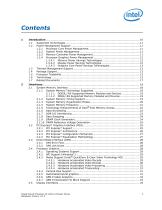
Intel® Xeon® Processor E3-1200 v5 Product Family Datasheet, Volume 1 of 2
Open the catalog to page 3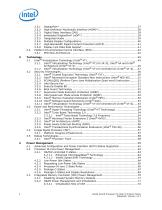
Intel® Xeon® Processor E3-1200 v5 Product Family Datasheet, Volume 1 of 2
Open the catalog to page 4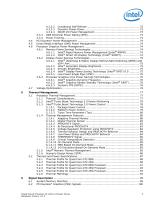
Intel® Xeon® Processor E3-1200 v5 Product Family Datasheet, Volume 1 of 2
Open the catalog to page 5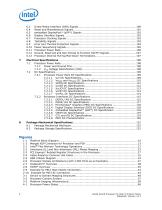
Intel® Xeon® Processor E3-1200 v5 Product Family Datasheet, Volume 1 of 2
Open the catalog to page 6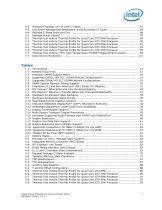
Intel® Xeon® Processor E3-1200 v5 Product Family Datasheet, Volume 1 of 2
Open the catalog to page 7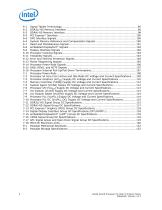
Intel® Xeon® Processor E3-1200 v5 Product Family Datasheet, Volume 1 of 2
Open the catalog to page 8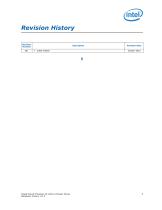
Revision History Revision Number 001 Initial release Revision Date October 2015 Intel® Xeon® Processor E3-1200 v5 Product Family Datasheet, Volume 1 of 2
Open the catalog to page 9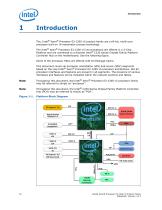
Introduction The, Intel® Xeon® Processor E3-1200 v5 product family are a 64-bit, multi-core processor built on 14-nanometer process technology. The Intel® Xeon® Processor E3-1200 v5 line processors are offered in a 2-Chip Platform and are connected to a discrete Intel® C230 Series Chipset Family Platform Controller Hub on the motherboard. See the following figure. Some of the processor SKUs are offered with On-Package Cache. This document covers all processor workstation (WS) and server (SRV) segments based on the new Intel® Xeon® Processor E3-1200 v5 processor architecture. Not all processor...
Open the catalog to page 10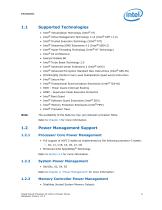
Supported Technologies • Intel® Virtualization Technology (Intel® VT) • Intel® Active Management Technology 11.0 (Intel® AMT 11.0) • Intel® Trusted Execution Technology (Intel® TXT) • Intel® Streaming SIMD Extensions 4.2 (Intel® SSE4.2) • Intel® Hyper-Threading Technology (Intel® HT Technology) • Intel® 64 Architecture • Execute Disable Bit • Intel® Turbo Boost Technology 2.0 • Intel® Advanced Vector Extensions 2 (Intel® AVX2) • Intel® Advanced Encryption Standard New Instructions (Intel® AES-NI) • PCLMULQDQ (Perform Carry-Less Multiplication Quad word) Instruction • Intel® Secure Key • Intel®...
Open the catalog to page 11
• DRAM Power Management and Initialization • Initialization Role of CKE • Conditional Self-Refresh • Dynamic Power Down • DRAM I/O Power Management • DDR Electrical Power Gating (EPG) • Power training Refer to Section 4.3 for more information. Processor Graphics Power Management Memory Power Savings Technologies • Intel® Rapid Memory Power Management (Intel® RMPM) • Intel® Smart 2D Display Technology (Intel® S2DDT) Display Power Savings Technologies • Intel® (Seamless & Static) Display Refresh Rate Switching (DRRS) with eDP* port • Intel® Automatic Display Brightness • Smooth Brightness • Intel®...
Open the catalog to page 12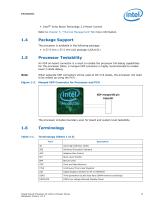
• Intel® Turbo Boost Technology 2.0 Power Control Refer to Chapter 5, “Thermal Management” for more information. Package Support The processor is available in the following package: • A 37.5 mm x 37.5 mm LGA package (LGA1151) Processor Testability An XDP on-board connector is a must to enable the processor full debug capabilities. For the processor SKUs, a merged XDP connector is highly recommended to enable lower C-state debug. When separate XDP connectors will be used at C8–C10 states, the processor will need to be waked up using the PCH. Merged XDP Connector for Processor and PCH The processor...
Open the catalog to page 13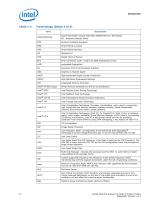
Terminology (Sheet 2 of 3) Term Fourth-Generation Double Data Rate SDRAM Memory Technology RS - Reduced Standby Power Decision Feedback Equalizer Direct Memory Access Direct Media Interface Digital Thermal Sensor Error Correction Code - used to fix DDR transactions errors embedded DisplayPort* Execution Unit in the Processor Graphics Graphics in System Agent High-bandwidth Digital Content Protection High Definition Multimedia Interface Integrated Memory Controller 64-bit memory extensions to the IA-32 architecture Intel® DPST Intel Display Power Saving Technology Intel Platform Trust Technology...
Open the catalog to page 14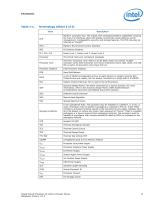
Terminology (Sheet 3 of 3) Term Platform Controller Hub. The chipset with centralized platform capabilities including the main I/O interfaces along with display connectivity, audio features, power management, manageability, security, and storage features. The PCH may also be referred as “chipset”. Platform Environment Control Interface Power Limit 1, Power Limit 2, Power Limit 3 The 64-bit multi-core component (package) Processor Core The term “processor core” refers to Si die itself, which can contain multiple execution cores. Each execution core has an instruction cache, data cache, and 256KB...
Open the catalog to page 15
Related Documents Related Documents Document Document Number / Location Intel® Xeon® Processor E3-1200 v5 Product Family Datasheet, Volume 2 of 2 6th Generation Intel® Core Processor Family Specification Update 6th Generation Intel® Processor Platform I/O Datasheet, Volume 1 of 2 6th Generation Intel® Processor Platform I/O Datasheet, Volume 2 of 2 6th Generation Intel® Processor Platform I/O Specification Update Advanced Configuration and Power Interface 3.0 High Definition Multimedia Interface specification revision 1.4 embedded DisplayPort* Specification revision 1.4 DisplayPort* Specification...
Open the catalog to page 16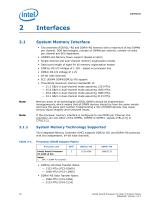
System Memory Interface • Two channels of DDR3L/-RS and DDR4/-RS memory with a maximum of two DIMMs per channel. DDR technologies, number of DIMMs per channel, number of ranks per channel are SKU dependent. • UDIMM and Memory Down support (based on SKU) • Single-channel and dual-channel memory organization modes • Data burst length of eight for all memory organization modes • DDR3L/-RS I/O Voltage of 1.35V - based on processor line • DDR4/-RS I/O Voltage of 1.2V • 64-bit wide channels • ECC UDIMM DDR4/DDR3L/-RS support • Theoretical maximum memory bandwidth of: — 21.3 GB/s in dual-channel mode...
Open the catalog to page 17All Intel catalogs and technical brochures
 10th Gen Intel® Core
7 Pages
 10th Gen
8 Pages
 nuc-celeron
4 Pages
 Intel® NUC 8 Home Mini PC
4 Pages
 Intel® Xeon® Scalable Platform
14 Pages
 Intel® Ethernet Controller XL710
1726 Pages
 Intel® Quark™ SoC X1000 Series
934 Pages
 Intel® X99 Chipset
4 Pages
 Intel® Desktop Board DQ67EP
4 Pages
 Intel® Ethernet Switch FM4000
270 Pages
 Intel® NUC Board DE3815TYBE
82 Pages
 S2600GZ and S2600GL
245 Pages
 i7-lga2011
314 Pages
 c600-series
936 Pages
 b75-express
4 Pages
 desktop-board
4 Pages
 3rd-gen-core-desktops
2 Pages
 /3rd-gen-core
2 Pages


Archived catalogs
 Intel® Ethernet Controllers
2 Pages
 Intel® 3450 Chipset
2 Pages
 Intel® 3000 and 3010 Chipset
4 Pages
 Intel® X58 Express Chipset
4 Pages
 Intel® Server Board S1200BT
8 Pages
 Intel® Desktop Board DX58SO2
4 Pages


- Management software solution
- Analysis software solution
- Real-time software
- Computer-aided design software
- Cloud-based software
- Design software solution
- Monitoring software solution
- Interface software
- Visualization software solution
- Simulation software solution
- Programming software
- Development software
- Network software
- Creation software
- Test software
- Optimization software
- Wireless module
- Solid-state drive
- Internal solid-state drive
- High-performance software