

2nd Generation Intel® Core? Processor and Pentium® Processor: Specification Update

2nd Generation Intel® Core? Processor and Pentium® Processor: Specification Update
This document is a specification update for the 2nd Generation Intel® Core™, Intel® Pentium®, and Intel® Celeron® Processor Families for desktop systems. It includes errata, specification changes, and clarifications intended for hardware system manufacturers and software developers.
The document provides information related to Intel products without granting any license to intellectual property rights. Intel disclaims liability for any use of its products in mission-critical applications and advises users to consult Intel's terms and conditions.
The document has undergone multiple revisions since its initial release in January 2011, with updates including new errata and processor identification information. The latest revision in December 2013 standardized the document without adding or removing errata.
The tables summarize errata, specification changes, and clarifications. Errata are design defects that may cause deviations from published specifications. Specification changes and clarifications provide more detail or modify existing specifications.
The document lists numerous errata for the 2nd Generation Intel® Core™ Processor Family Desktop, Intel® Pentium® Processor Family Desktop, and Intel® Celeron® Processor Family Desktop. Each erratum is identified by a unique number (BJ1 to BJ134) and describes specific issues that have been identified in the processors. The status for all listed errata is 'No Fix', indicating that these issues remain unresolved in the current processor versions.
- APIC errors and illegal vector reception leading to potential system hangs.
- Memory type changes causing memory-ordering violations.
- Debug exceptions and incorrect breakpoint flag settings.
- Performance monitoring inaccuracies and overcounts.
- PCIe-related issues, including incorrect error reporting and system hangs.
- Unexpected processor behavior during specific instruction executions and state transitions.
- Various cache and memory access errors leading to unpredictable system behavior.
The document notes that there are no specification changes or clarifications for this revision.
A clarification is provided for the On-Demand Clock Modulation feature.
The document provides details on identifying processor stepping using register contents, including notes on extended family, model numbers, and processor types.
The document provides detailed specifications for identifying processors using register contents. The EAX register contains values for Family, Extended Model, Processor Type, Family Code, Model Number, and Stepping ID. The EDX processor signature value after reset matches the EAX register output. Cache and TLB descriptor parameters are available in the EAX, EBX, ECX, and EDX registers after executing the CPUID instruction with a 2 in the EAX register.
Processor stepping can be identified through component markings. The document includes a table listing various processors, their S-Spec numbers, stepping, processor signature, core frequency, and other specifications.
The document outlines several errata affecting the processors:
- BJ1: Debug breakpoints may be incorrectly signaled after MOV SS/POP SS instructions followed by a floating point exception.
- BJ2: APIC errors may not be logged correctly, leading to missed error interrupts.
- BJ3: Uncorrectable errors may cause system hangs and additional errors to be logged.
- BJ4: Breakpoint flags in DR6 may be incorrectly set for non-enabled breakpoints under certain conditions.
- BJ5: Changing memory types for active pages may lead to memory-ordering violations.
- BJ6: Code segment faults on RSM may be serviced before higher priority interrupts, pushing incorrect addresses onto the stack.
- BJ7: Corruption of the CS segment register may occur during transitions from real mode to protected mode.
- BJ8: Debug exception flags may be incorrect for disabled breakpoints.
- BJ9: DR6.B0-B3 may not report all breakpoints matched when a MOV/POP SS is followed by certain instructions.
This document provides errata, specification changes, and clarifications for the 2nd Generation Intel® Core™ Processor Family Desktop, Intel® Pentium® Processor Family Desktop, and Intel® Celeron® Processor Family Desktop. It includes detailed descriptions of known issues and their implications, workarounds, and status updates.
- Errata Descriptions: The document lists various errata affecting the processors, detailing the problems, implications, and any identified workarounds. Each erratum is identified by a unique code (e.g., BJ10, BJ11) and includes a status update regarding the affected steppings.
- Procedures and Recommendations: Recommendations are provided for handling specific errata, such as ensuring synchronized paging structure modifications and TLB invalidations to avoid discrepancies in EFLAGS during page faults.
- Implications and Workarounds: The document outlines the potential impacts of each erratum on system performance and functionality. In many cases, no workaround is identified, and the document advises on best practices to mitigate issues.
- Technical Specifications: Detailed technical information is provided for each erratum, including conditions under which the issues occur and the specific processor features affected.
- Erratum BJ10: Describes an issue with EFLAGS discrepancy on page faults and EPT-induced VM exits after a translation change, with no identified implications or workaround.
- Erratum BJ11: Discusses unexpected values on stack frames due to faults on the ENTER instruction, with no workaround identified.
- Erratum BJ12: Highlights incorrect updates to the x87 FPU tag word by faulting MMX instructions, with no workaround.
- Erratum BJ13: Addresses issues with PEBS records during SMM, with no workaround identified.
- Erratum BJ14: Notes that general protection faults for instructions greater than 15 bytes may be preempted by lower priority faults.
- Erratum BJ15: Discusses incorrect exception error codes for segment selector descriptors straddling canonical boundaries.
- Erratum BJ16: Describes incorrect IO_SMI indications in SMRAM state save areas.
- Erratum BJ17: Details unexpected alignment check exceptions under certain conditions with the IRET instruction.
- Erratum BJ18: Notes unreliability of LER MSRs due to unexpected updates.
- Erratum BJ19: Discusses incorrect address reporting by LBR, BTS, and BTM during exceptions/interrupts in 64-bit mode.
- Erratum BJ20: Highlights incorrect setting of the overflow bit in MCi_Status on single DTLB errors.
- Erratum BJ21: Describes processor hangs due to MONITOR or CLFLUSH on local xAPIC address space.
- Erratum BJ22: Discusses debug exceptions instead of general-protection faults for MOV instructions to/from debug registers in V86 mode.
- Erratum BJ23: Notes PEBS record updates being ignored during probe mode.
- Erratum BJ24: Highlights undercounting of FP_MMX_TRANS_TO_MMX transitions.
- Erratum BJ25: Discusses incorrect data size or memory-ordering violations for REP MOVS/STOS crossing page boundaries with inconsistent memory types.
The document provides essential information for developers and system integrators to understand and mitigate the impact of known processor errata. It emphasizes the importance of adhering to recommended practices and being aware of potential issues in specific processor steppings.
Catalog excerpts

2nd Generation Intel® Core™ Processor Family Desktop, Intel® Pentium® Processor Family Desktop, and Intel® Celeron® Processor Family Desktop Specification Update December 2013
Open the catalog to page 1
INFORMATION IN THIS DOCUMENT IS PROVIDED IN CONNECTION WITH INTEL PRODUCTS. NO LICENSE, EXPRESS OR IMPLIED, BY ESTOPPEL OR OTHERWISE, TO ANY INTELLECTUAL PROPERTY RIGHTS IS GRANTED BY THIS DOCUMENT. EXCEPT AS PROVIDED IN INTEL'S TERMS AND CONDITIONS OF SALE FOR SUCH PRODUCTS, INTEL ASSUMES NO LIABILITY WHATSOEVER AND INTEL DISCLAIMS ANY EXPRESS OR IMPLIED WARRANTY, RELATING TO SALE AND/OR USE OF INTEL PRODUCTS INCLUDING LIABILITY OR WARRANTIES RELATING TO FITNESS FOR A PARTICULAR PURPOSE, MERCHANTABILITY, OR INFRINGEMENT OF ANY PATENT, COPYRIGHT OR OTHER INTELLECTUAL PROPERTY RIGHT. Legal Lines...
Open the catalog to page 2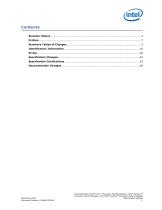
2nd Generation Intel® Core™ Processor Family Desktop, Intel® Pentium® Processor Family Desktop, and Intel® Celeron® Processor Family Desktop December 2013 Specification Update
Open the catalog to page 3
2nd Generation Intel® Core™ Processor Family Desktop, Intel® Pentium® Processor Family Desktop, and Intel® Celeron® Processor Family Desktop Specification Update December 2013
Open the catalog to page 4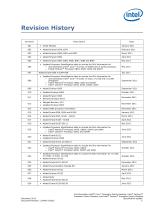
Revision History Revision Initial Release Updated Processor Identification table to include the SKU information for — 2nd Generation Intel® Core™ i5-2310, i5-2405S and i3-2105 processors — Intel® Pentium® Processor G850, G840, G620 and G620T Updated Processor Identification table to include the SKU information for — 2nd Generation Intel® Core™ i5-2320, i3-2125, i3-2130 and i3-2120T processors — Intel® Pentium® Processor G860, G630 and G630T — Intel® Celeron® Processor G540, G530, G530T, G440 Added Erratum BJ96 Removed Erratum BJ73 Skipped Revision -012 Updated Erratum BJ65 Added G460 processor...
Open the catalog to page 5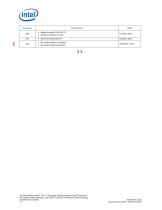
2nd Generation Intel® Core™ Processor Family Desktop, Intel® Pentium® Processor Family Desktop, and Intel® Celeron® Processor Family Desktop Specification Update December 2013
Open the catalog to page 6
Preface This document is an update to the specifications contained in the Affected Documents table below. This document is a compilation of device and documentation errata, specification clarifications and changes. It is intended for hardware system manufacturers and software developers of applications, operating systems or tools. Information types defined in Nomenclature are consolidated into the specification update and are no longer published in other documents. This document may also contain information that was not previously published. Affected Documents Document Number Document Title 2nd...
Open the catalog to page 7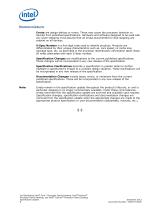
Nomenclature Errata are design defects or errors. These may cause the processor behavior to deviate from published specifications. Hardware and software designed to be used with any given stepping must assume that all errata documented for that stepping are present on all devices. S-Spec Number is a five-digit code used to identify products. Products are differentiated by their unique characteristics such as, core speed, L2 cache size, package type, etc. as described in the processor identification information table. Read all notes associated with each S-Spec number. Specification Changes are...
Open the catalog to page 8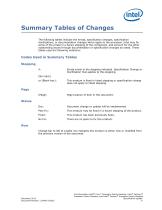
Summary Tables of Changes The following tables indicate the errata, specification changes, specification clarifications, or documentation changes which apply to the processor. Intel may fix some of the errata in a future stepping of the component, and account for the other outstanding issues through documentation or specification changes as noted. These tables uses the following notations: Codes Used in Summary Tables X: Errata exists in the stepping indicated. Specification Change or Clarification that applies to this stepping. or (Blank box): This erratum is fixed in listed stepping or specification...
Open the catalog to page 9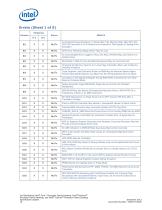
Errata (Sheet 1 of 5) Steppings Number An Enabled Debug Breakpoint or Single Step Trap May Be Taken after MOV SS/ POP SS Instruction if it is Followed by an Instruction That Signals a Floating Point Exception APIC Error “Received Illegal Vector” May be Lost An Uncorrectable Error Logged in IA32_CR_MC2_STATUS May also Result in a System Hang B0-B3 Bits in DR6 For Non-Enabled Breakpoints May be Incorrectly Set Changing the Memory Type for an In-Use Page Translation May Lead to MemoryOrdering Violations Code Segment Limit/Canonical Faults on RSM May be Serviced before Higher Priority Interrupts/Exceptions...
Open the catalog to page 10
Errata (Sheet 2 of 5) Steppings Number Reported Memory Type May Not Be Used to Access the VMCS and Referenced Data Structures Single Step Interrupts with Floating Point Exception Pending May Be Mishandled Storage of PEBS Record Delayed Following Execution of MOV SS or STI The Processor May Report a #TS Instead of a #GP Fault VM Exits Due to “NMI-Window Exiting” May Be Delayed by One Instruction Pending x87 FPU Exceptions (#MF) May be Signaled Earlier Than Expected Values for LBR/BTS/BTM Will be Incorrect after an Exit from SMM Unsupported PCIe* Upstream Access May Complete with an Incorrect Byte...
Open the catalog to page 11
Errata (Sheet 3 of 5) Steppings Number A Write to the IA32_FIXED_CTR1 MSR May Result in Incorrect Value in Certain Conditions Instruction Fetch May Cause Machine Check if Page Size and Memory Type Was Changed Without Invalidation Reception of Certain Malformed Transactions May Cause PCIe* Port to Hang Rather Than Reporting an Error PCIe* LTR Incorrectly Reported as Being Supported Performance-Counter Overflow Indication May Cause Undesired Behavior XSAVE Executed During Paging-Structure Modification May Cause Unexpected Processor Behavior C-state Exit Latencies May be Higher Than Expected MSR_Temperature_Target...
Open the catalog to page 12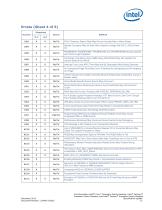
Errata (Sheet 4 of 5) Steppings Number PCIe* Presence Detect State May Not be Accurate After a Warm Reset Display Corruption May be Seen After Graphics Voltage Rail (VCC_AXG) Power Up PCMPESTRI, PCMPESTRM, VPCMPESTRI and VPCMPESTRM Always Operate with 32-bit Length Registers VM Entries That Return From SMM Using VMLAUNCH May Not Update The Launch State of the VMCS Interrupt From Local APIC Timer May Not Be Detectable While Being Delivered An Unexpected Page Fault May Occur Following the Unmapping and Re-mapping of a Page A PCIe* Device That Initially Transmits Minimal Posted Data Credits May...
Open the catalog to page 13All Intel catalogs and technical brochures
 10th Gen Intel® Core
7 Pages
 10th Gen
8 Pages
 nuc-celeron
4 Pages
 Intel® NUC 8 Home Mini PC
4 Pages
 Intel® Xeon® Scalable Platform
14 Pages
 Intel® Ethernet Controller XL710
1726 Pages
 Intel® Xeon® Processor E3-1200 v5
130 Pages
 Intel® Quark™ SoC X1000 Series
934 Pages
 Intel® X99 Chipset
4 Pages
 Intel® Desktop Board DQ67EP
4 Pages
 Intel® Ethernet Switch FM4000
270 Pages
 Intel® NUC Board DE3815TYBE
82 Pages
 S2600GZ and S2600GL
245 Pages
 i7-lga2011
314 Pages
 c600-series
936 Pages
 b75-express
4 Pages
 desktop-board
4 Pages
 3rd-gen-core-desktops
2 Pages
 /3rd-gen-core
2 Pages


Archived catalogs
 Intel® Ethernet Controllers
2 Pages
 Intel® 3450 Chipset
2 Pages
 Intel® 3000 and 3010 Chipset
4 Pages
 Intel® X58 Express Chipset
4 Pages
 Intel® Server Board S1200BT
8 Pages
 Intel® Desktop Board DX58SO2
4 Pages


- Management software solution
- Analysis software solution
- Real-time software
- Computer-aided design software
- Cloud-based software
- Design software solution
- Monitoring software solution
- Interface software
- Visualization software solution
- Simulation software solution
- Programming software
- Development software
- Network software
- Creation software
- Test software
- Wireless module
- Optimization software
- Solid-state drive
- Internal solid-state drive
- High-performance software