
- Catalogs
- Integrated Hydraulics
- Flow Dividers 2CFD50

Flow Dividers 2CFD50

1 / 2 PagesView full catalog
Flow Dividers 2CFD50
Product catalog summary
Overview: The document describes the 2CFD series flow divider/combiner valves, which are designed to split input flow into two equal parts and recombine flow in the reverse direction. These valves ensure equal flow distribution despite pressure variations, making them suitable for synchronizing actuator movements under different load conditions.
Specifications: The 2CFD50 model operates with a nominal viscosity range of 5 to 500 cSt and can handle up to 40 litres/min (10.5 US GPM). It is constructed with hardened and ground steel parts, with a zinc-plated external steel body. The valve can withstand a maximum pressure of 350 bar (5000 psi) and operates within a temperature range of -20°C to +90°C. The standard division ratio is 50/50, and the recommended filtration level is BS5540/4 Class 18/13 (25 micron nominal).
Operation: The valve uses matched orifices and compensating springs to ensure equal flow division. Excess flow causes the spool to adjust and maintain equilibrium. In reverse, the spools regulate the flow through radial ports.
Applications: The valve is versatile, suitable for integration into line bodies, custom-designed hydraulic circuits, or other hydraulic equipment. It is particularly useful for synchronizing actuator movements in systems with varying load conditions.
Features: The valve synchronizes flow in both directions with high accuracy under load and pressure imbalance conditions. It offers cartridge construction for versatile application and can be fitted with different seal kits (Nitrile or Viton) depending on the fluid and temperature requirements.
Ordering Information: The basic code for ordering is 2CFD50 for the cartridge only and 2CFD55 for the cartridge and body. Various port sizes and body materials are available, including BSP and SAE options in aluminium and steel.
Pressure Drop: The document includes a graph illustrating the pressure drop across the valve at different flow rates, indicating the valve's efficiency in maintaining pressure balance.
Notes: Blocking one leg of the valve significantly reduces flow from the other. Valves with higher working pressures are available upon request. When used with cylinders, the valve should be sized to match the return flow rate.
See more
Catalog excerpts
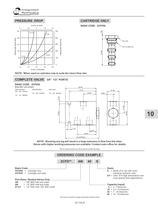
7.10 50.5018.50 90 APPROX Where measurements are critical request certified drawings 2CFD50 =Cartridge only S =Nitrile (For use with mostindustrial hydraulic oils) 2CFD55 =Cartridge and body SV =Viton (For high temperature andmost special fluid applications) > 3W =3/8 BSP inlet and outlet 4W =1/2Ԕ BSP inlet and outlet > 8T-6T =1/2 SAE inlet, 3/8Ԕ SAE outlet 5 =2 - 5 litres/min 10 =3.3 -10 litres/min 20 =7 - 20 litres/min 40 =15 - 40 litres/min > We reserve the right to change specifications without notice
Open the catalog to page 2All Integrated Hydraulics catalogs and technical brochures
 Industrial Valves
8 Pages
 Industrial Hose Master Catalog
366 Pages
 Directional Controls
174 Pages
 pct_292502
198 Pages
 pct_292303
124 Pages
 pct_292302
74 Pages
 pct_285346
170 Pages
 pct_292306
124 Pages
 Solenoid Valves Coil
2 Pages
 Needle Valves 2CN20
2 Pages
 Motion Control 1CE20
2 Pages
 Dual Relief Valves 1DDR35
2 Pages
 Shuttle Valves 1SH10
2 Pages
 Check 3CP2
2 Pages
 Reducing Valves 1PD20
2 Pages
 Relief Valves 1AR60
2 Pages


Related Searches
- Control valve
- Flap valve
- Check valve
- Directional control valve
- Double-acting cylinder
- Hydraulic cylinder
- Oil valve
- Hydraulic valve
- Hydraulic directional control valve
- Flow control valve
- Hydraulically-operated valve
- Electrically-operated hydraulic directional control valve
- Hydraulic check valve
- Tie-rod cylinder
- Cartridge valve
- Proportional valve
- Cartridge check valve
- Solenoid-operated hydraulic directional control valve
*Prices are pre-tax. They exclude delivery charges and customs duties and do not include additional charges for installation or activation options. Prices are indicative only and may vary by country, with changes to the cost of raw materials and exchange rates.
About DirectIndustry
DirectIndustry is a marketplace that offers B2B players a complete experience, from product sourcing to purchase. DirectIndustry is an entity of VirtualExpo Group.
Are you a buyer?
Are you a supplier?