
- Catalogs
- Instrument Systems
- PTFE Integrating Spheres for UV measurement in lab & production

PTFE Integrating Spheres for UV measurement in lab & production

PTFE Integrating Spheres for UV measurement in lab & production
- Complete UV measurement solutions with high sensitivity for UV radiation from 200 nm.
- Integrating spheres suitable for measurements up to 2500 nm (IR).
- New PTFE material with negligible fluorescence and PTB traceable calibration.
Instrument Systems provides comprehensive solutions for measuring UV-A, -B, and -C radiation starting from 200 nm. The use of PTFE integrating spheres with spectroradiometers like the CAS series allows for high sensitivity measurements of UV radiant flux. Calibration standards such as ACS-570-2x ensure accuracy.
PTFE is used as a reflective material in integrating spheres, offering high reflectance in the UV range down to 200 nm and temperature stability up to 150 °C. This enables high throughput for UV-B and UV-C emitters, where other materials like barium sulfate are less effective.
All UV measurement solutions come with PTB traceable calibration. Optional numerical stray light correction is available for CAS spectroradiometers, enhancing measurement accuracy and reducing noise.
PTFE integrating spheres are available in sizes from 75 mm to 250 mm, with customizable adapter ports for various configurations. Protective windows and domes are recommended to prevent contamination.
The document outlines specifications for different models of integrating spheres, including inner diameters, usable wavelength ranges, and port configurations. It also details the protective accessories available for each model.
Detailed ordering information is provided for various models and accessories, including fiber bundles, connectors, and calibration options.
Catalog excerpts

Instrument Systems KONICA MINOLTA Group UV Measurement for Laboratory and Production
Open the catalog to page 1
Key features at a glance y Complete UV measurement solutions y High sensitivity measurements for UV radiation from 200 nm y Integrating spheres suitable up to 2500 nm (IR) y New PTFE material with permanently negligible fluorescence y PTB traceable calibration Instrument Systems offers complete measurement solutions for UV-A, -B and -C radiation starting from 200 nm. The operation of the proven Instrument Systems spectroradiometers, e.g. CAS series, with integrating spheres made of PTFE (Polytetrafluoroethylene), facilitate high sensitivity measurements of UV radiant flux. The absolute values...
Open the catalog to page 2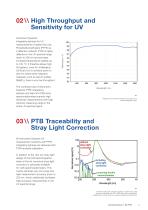
Instrument Systems’ integrating spheres for UV measurements of radiant flux use Polytetrafluoroethylene (PTFE) as a reflective material. PTFE is highly reflective in the UV spectral range down to 200 nm and provides increased temperature stability up to 150 °C. It therefore allows high throughput, even for challenging UV-B and UV-C emitters down to 200 nm where other reflective materials, such as barium sulfate (BaSO4), have a very low throughput. The combined use of Instrument Systems PTFE integrating spheres and high-end CAS array spectroradiometers permits high sensitivity measurements with...
Open the catalog to page 3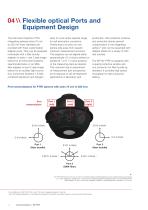
04 \\ Flexible optical Ports and Equipment Design The Instrument Systems PTFE integrating spheres (sizes 75 mm to 250 mm inner diameter) are provided with three customizable adapter ports. They can be equipped individually with a fiber bundle adapter on ports 1 and 3 (see image below) for an Instrument Systems spectroradiometer, or an SMA fiber adapter on port 2 (see image below) for an auxiliary light source (e.g. Instrument Systems’ LS 500, combined deuterium and halogen lamp to cover entire spectral range, for self absorption correction). Positioning of all ports on one sphere side away from...
Open the catalog to page 4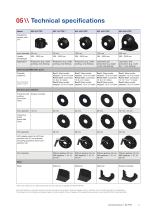
3) Note: Use of ACS-570-24 (~280 nm) and ACS-570-26 (~305 nm) not possible with the ISP75PTFE. Instrument Systems is continually working to develop and improve its products. Technical changes, errors or misprints do not constitute grounds for compensation. The company’s terms of delivery and payment apply in all other respects. Product images are for representation purposes only and may differ from the actual product. Instrument Systems ► ISP-P
Open the catalog to page 5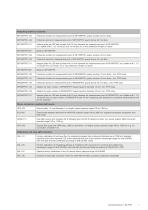
Instrument Systems ► ISP-PTFE
Open the catalog to page 7
Instrument ^ Systems KONICA MINOLTA Group Instrument Systems GmbH Kastenbauerstr. 2 81677 Munich, Germany ph: +49 (0)89 45 49 43-58 fax: +49 (0)89 45 49 43-11 [email protected] www.instrumentsystems.com
Open the catalog to page 8All Instrument Systems catalogs and technical brochures
 VTC 2400
2 Pages
 CAS 125-HR
2 Pages
 Photometers
24 Pages
 ITS Integrating Spheres
12 Pages
 CAS 125 Array Spectrometer
4 Pages
 SpecWin Pro software
12 Pages
 LEDGON 100
4 Pages
 Products & Solutions
16 Pages


- Power supply unit
- DC power supply
- Digital imager
- Visible imager
- Test cabinet
- CMOS camera module
- Industrial camera module
- Automation software solution
- Analysis software solution
- Infrared imager
- Process software
- Temperature test chamber
- Real-time software
- Windows software
- Control software
- Monochrome camera module
- Monitoring software solution
- Measurement software
- Interface software
- Visualization software solution