
- Catalogs
- Instrument Systems
- ITS Integrating Spheres

ITS Integrating Spheres

ITS Integrating Spheres
The document discusses integrating spheres and their applications, particularly by the Optronik Division of Instrument Systems GmbH, known for its expertise in light measurement technology for automotive and aerospace sectors.
Explains Lambert’s Cosine Law, essential for integrating spheres, which function through multiple diffuse reflections.
Integrating spheres spatially integrate radiant flux from various sources, with efficiency influenced by port size, baffles, and coating. Applications include light collection, uniform light sources, laser power measurement, LED spectral measurement, and reflectance/transmittance measurement.
Describes using integrating spheres for measuring total luminous flux of electric lamps, a method requiring calibration with a standard lamp.
Details construction standards (DIN 5032 and CIE 84) for lamp flux measurement, contrasting with absolute methods like goniophotometry.
Integrating spheres measure material reflectance and transmittance, providing uniform light sources for these measurements.
Describes ITS 500 and ITS 1000 systems for measuring luminous flux, color, and spectral distribution of lamps, featuring precision power supply and optional software.
Highlights the Digilumen 9500 photometer's precision, thermostatic stabilization, and electronic display, with options for range extension and system integration.
Details accessories like lamp sockets and standard lamps, and characteristics of photometer paint for integrating spheres.
Mentions SNT 10 series DC power supplies for automotive lighting applications.
Describes LDN 500 as a uniform light source with color temperature regulation, suitable for photometer testing and calibration, featuring automatic luminance maintenance and PC control interface.
Summarizes the comprehensive information on integrating spheres, their construction, applications, and associated equipment, emphasizing their role in precise light measurement and calibration.
- Table housing with optional 19" configuration integration.
- Lamp power supply for 100 W halogen bulb.
- Microprocessor-controlled regulation for voltage, luminance, or color temperature.
- Color temperature regulation range: 2500 K to 3000 K.
- Graphic LC display for digital display of lamp parameters.
- Integrated lamp burning time and cycle counter.
- RS 232 interface for remote control and data readout.
- Mains supply: 230 V / 50 Hz, max. 130 W with Euro plug.
- Calibration traceable to PTB standard with certificate.
- KMS 500 measures luminous reflectance and transmittance using an integrating sphere.
- Complies with DIN 5036 Section 3 and CIE Publication No. 38 (1987).
- Suitable for ECE-R46 and ISO 5740–1982 standards for rear mirror reflectance.
- Applicable for scenarios requiring reflectance and transmittance data.
- Calibration standards with certificate: regular and diffuse reflecting standards.
- Equipment for measuring reflectance and transmittance.
- Integrating sphere with 500 mm diameter, sample holders, and photometer head.
- Moveable illuminant source with color temperature control.
- Power supply and control circuit with international compatibility.
- Digital display unit Digilux 9500 with amplifier and RS 232 interface.
- Instrument Systems GmbH, Kaiserin-Augusta-Allee 16-24, 10553 Berlin, Germany.
- Tel.: +49 30 34 99 41-0
- Fax: +49 30 34 55 054
- Email: [email protected]
- Website: www.instrumentsystems.com/optronik
Catalog excerpts

We bring quality to light. Integrating Spheres
Open the catalog to page 1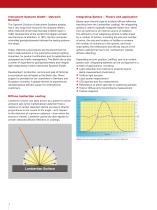
Instrument Systems GmbH – Optronik Division The Optronik Division of Instrument Systems already has a very long track record for its company history. When Optronik GmbH was founded in Berlin back in 1968, development of the world’s first digital luxmeter was the focus of attention. In 1972, the first computercontrolled goniophotometer followed for testing automotive lamps. Today, Optronik Line products are the benchmark for tailor-made solutions in the automotive exterior lighting industries, for product certification and for applications in aerospace and traffic management. The Berlin site is...
Open the catalog to page 2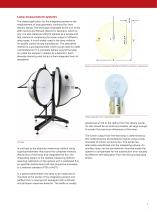
Lamp measurement systems The oldest application for the integrating sphere is the measurement of total geometric luminous flux from electric lamps. The technique originated at the turn of the 20th century (by Richard Ulbricht in Germany, which is why it is also called an Ulbricht sphere) as a simple and fast method of comparing the lumen output of different lamp types. It is still widely used in the lamp industry for quality control during manufacture. The alternative method is a goniophotometer which would need to rotate a photodetector in a complete sphere around the lamp (or rotate the sample...
Open the catalog to page 3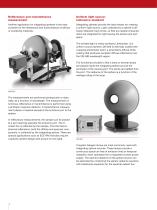
Reflectance and transmittance measurement Uniform light source: luminance standard Another application for integrating spheres is the measurement of the reflectance and transmittance of diffuse or scattering materials. Integrating spheres provide the ideal means for creating a uniform light source. Light collected by a sphere is diffusely reflected many times, so that any spatial characteristics are integrated for light leaving the sphere exit port plane. The emitted light is nearly perfectly Lambertian. Our uniform source sphere LDN 500 is internally coated with a special photometer paint, a...
Open the catalog to page 4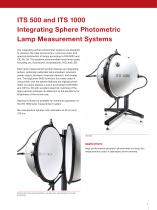
ITS 500 and ITS 1000 Integrating Sphere Photometric Lamp Measurement Systems Our integrating sphere photometer systems are designed to measure the total luminous flux, luminous color, and spectral distribution of lamps according to DIN 5032 and CIE No. 84. The systems accommodate most lamp types, including arc, fluorescent, incandescent, HID, and LED. Each lamp measurement system features an integrating sphere, optionally calibrated lamp standard, precision power supply, photopic response detector, and display unit. The Digilumen 9500 luminous flux meter used in conjunction with the sphere features...
Open the catalog to page 5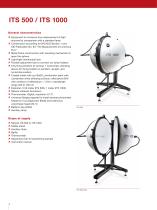
ITS 500 / ITS 1000 General characteristics Equipment for luminous flux measurement of light sources by comparison with a standard lamp Construction according to DIN 5032 Section 1 and CIE Publication No. 84 “The Measurement of Luminous Flux” Metal frame construction with swiveling mechanism to open the sphere Light-tight mechanical lock Flexible adjustment bar to connect our lamp holders burning positions (2 vertical, 1 horizontal), clamping 3 device for fixing holders in pendent, upright, and horizontal position Coated inside with our BaSO4 photometer paint with Lambertian white...
Open the catalog to page 6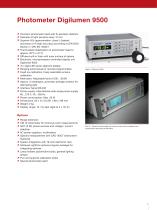
Photometer Digilumen 9500 Precision photometer head with Si-photopic detector Diameter of light sensitive area: 12 mm Superior V()-approximation, class L (highest accuracy) or A (high accuracy) according to DIN 5032 Section 7, DIN-EN 13032-1 Thermostatic stabilization of photometer head to approx. 35°C ± 0.1°C Diffuser built-in flush with inner surface of sphere Electronic, microprocessor-controlled display unit Digilumen 9500 1/2 -digit LED seven segment display 4 Ranging auto/manual or remote programmable Fixed lux calibration, freely selectable lumens calibration Attenuator:...
Open the catalog to page 7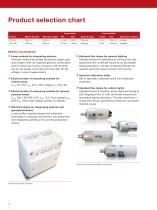
Product selection chart Lamp ratings Lamp standard Sphere diameter Spectral range Application software Sphere accessories Lamp sockets for integrating spheres Precision measuring sockets are special quadri-pole lamp holders with two separate galvanic connections, each of which has a point of contact with the lamp, one for the supply of the lamp and the other for the voltage / current measurement. Electrical data of measuring sockets for vehicle lamps Unom 24 V DC, Imax 20 A, Test voltage Utest 50 V DC. Electrical data of measuring sockets for general purpose lamps Unom 250 V AC/300 V DC,...
Open the catalog to page 8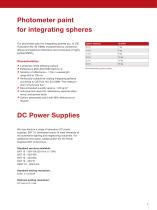
Photometer paint for integrating spheres Our photometer paint for integrating spheres acc. to CIE Publication No. 84 (1989), characterized by Lambertian diffuse and selective reflectance and composed of highly purified BaSO4. Lambertian white diffusing surface Reflectance 80% (DIN 5036 Section 3) Variation of reflectance < 1.5% in wavelength range 400 to 700 nm Particularly suitable for coating integrating spheres according to CIE Publ. No. 84 (1989) ”The measure- ment of luminous flux” Recommended quantity approx. 1.25 kg/m2 Individual test report for reflectance, spectral reflec-...
Open the catalog to page 9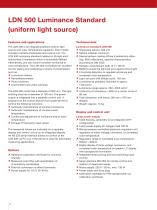
LDN 500 Luminance Standard (uniform light source) Features and applications Technical data The LDN 500 is an integrating sphere uniform light source with color temperature regulation. Each model includes a sphere photometer and control unit. The LDN 500 luminance standard creates on its light emitting surface a luminance which is accurately defined. Alternatively, you can control constant luminance or color temperature. The LDN 500 is therefore an excellent tool for testing and calibrating a variety of photometers, such as: Luminance meters Retroreflectometers Photo receivers Colorimeters...
Open the catalog to page 10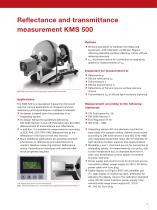
Reflectance and transmittance measurement KMS 500 Options Working standards to calibrate the measuring equipment, with calibration certificate: Regular reflecting standard (surface reflecting mirror), diffuse reflecting standard dif -illuminant source for connection to integrating sphere for measurements of dif KMS 500 transmittance and reflectance measurement instrument Reflectance Diffuse reflectance d Transmittance Diffuse transmittance d Reflectance of flat and convex surface rearview mirrors Transmittance dif at diffuse light incidence (optional) Applications The...
Open the catalog to page 11All Instrument Systems catalogs and technical brochures
 VTC 2400
2 Pages
 CAS 125-HR
2 Pages
 Photometers
24 Pages
 CAS 125 Array Spectrometer
4 Pages
 SpecWin Pro software
12 Pages
 LEDGON 100
4 Pages
 Products & Solutions
16 Pages


- Digital imager
- Visible imager
- Test cabinet
- CMOS camera module
- Industrial camera module
- Automation software solution
- Analysis software solution
- Infrared imager
- Process software
- Temperature test chamber
- Real-time software
- Windows software
- Control software
- Monochrome camera module
- Monitoring software solution
- Measurement software
- Interface software
- Visualization software solution