


- Company
- Products
- Catalogs
- News & Trends
- Exhibitions
The ultimate guide to lightweight materials and parts testing in Automotive and Aerospace

The ultimate guide to lightweight materials and parts testing in Automotive and Aerospace
The document highlights the growing significance of impact testing for lightweight and composite materials in the automotive and aerospace sectors. It focuses on the latest drop weight impact testing methods and technologies aimed at minimizing disruptions and optimizing time to market.
Emerging Trends and Challenges
Light alloys and composites are increasingly vital due to their durability and low weight, which are essential for reducing CO2 emissions and supporting electric vehicle production. The rise of 3D printing and reshoring due to supply chain disruptions are also notable trends, leading to stricter testing requirements for materials like carbon-fiber composites.
Drop Weight Impact Test
This test evaluates the impact resistance of materials by striking them with a weight from a height, following international standards such as ISO 179, ISO 6603, and ASTM 3763. It ensures the use of appropriate materials for vehicle and aircraft parts, enhancing safety and reliability.
Increasing Testing Capacity
To manage the growing volume of materials requiring testing, the guide recommends simplifying setup, accelerating data acquisition, and minimizing human errors. This involves utilizing advanced drop tower technology with integrated software for efficient and accurate testing.
Adapting to New Materials and Methods
Testing must evolve to accommodate new materials like 3D-woven composites and 3D-printed thermoplastics. Strategies include refining force scales, employing high-speed cameras for data acquisition, and ensuring transparency in testing processes.
Integrating Virtual and Real Testing
Combining Computer-Aided Engineering (CAE) with physical testing enhances accuracy and efficiency. Data capture and analysis software facilitates the integration of these processes, enabling comprehensive data sharing and anomaly detection.
Safety Considerations
Safety is paramount when using drop weight impact testing technology due to potential risks of impact-related injuries and exposure to toxic fumes or dust. Key safety features include fully enclosed designs with integrated safety circuits, optional fan extractors, and automatic safety notifications.
Conclusion
The document underscores the necessity of adapting testing strategies to meet the evolving demands of the automotive and aerospace industries, ensuring safety, reliability, and efficiency in material and component testing.
About the Author
Alessandro Tomaiuolo, a Drop Tower Application Expert at Instron, has been providing technical support since 2016. He holds a Master's degree in Material Science from the University of Turin.
About Instron
Instron is a leader in impact testing innovation, offering comprehensive support from initial inquiry to delivery. It is part of the Illinois Tool Works group, with a global presence and a focus on customer collaboration and calibration services.
Catalog excerpts
THE ULTIMATE GUIDE TO LIGHTWEIGHT MATERIALS AND PARTS TESTING IN AUTOMOTIVE AND AEROSPACE How to meet the latest drop weight impact test requirements
Open the catalog to page 1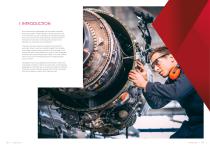
INTRODUCTION As the demand for lightweight and composite materials continues to grow,1 impact testing is becoming more and more critical to success in design and manufacturing. But how do you ensure that added testing requirements don’t translate into downtime and disruption to just-in-time workflows in automotive and aerospace? This guide will give materials engineers and scientists working in these industries valuable insight into the latest drop weight impact testing methods and technology. It will provide you with useful guidance on how to make composite materials and parts testing simpler,...
Open the catalog to page 2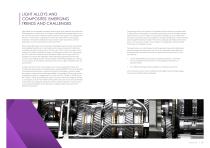
LIGHT ALLOYS AND COMPOSITES: EMERGING TRENDS AND CHALLENGES Light Alloys and composites are rapidly becoming the go-to materials for automotive and aerospace manufacturers. According to analysts Market Insight Reports, over the next five years the composite material market is set to grow at a CAGR greater than 5%, mainly due to surging demand from the automotive and aerospace industries.2 Demand for high-performance alloys is also expected to continue growing by over 3% a year between 2020 and 2027.3 What makes light alloys and composites increasingly popular are their key benefits, including...
Open the catalog to page 3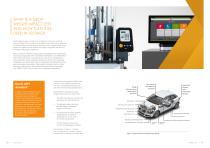
WHAT IS A DROP WEIGHT IMPACT TEST AND HOW CAN IT BE USED IN TESTING? What happens when a material or component is hit by an external object at speed? This is what a drop weight impact test tries to establish. It involves striking a material/part specimen with a weight falling from a height; the higher and the heavier the weight, the greater the amount of energy impacting the specimen. When it comes to materials, impact tests are regulated by the international standards including ISO 179,12 ISO 6603,13 ISO 8256,14 and ASTM 3763,15 which define specimen characteristics as well as test configurations...
Open the catalog to page 4
The use of computer-aided engineering (CAE) tools such as LS-Dyna or Abaqus now enable engineers to simulate how materials and parts perform during impact. However, it is always recommended that virtual tests are validated by a physical impact test. This is key to improving the reliability of CAE-based testing As illustrated in the table below, impact testing often needs to be adapted to individual components. Test application Common standards Adhesives Testing Wedge Peel Test Measures dynamic resistance to cleavage [N/mm] by pushing wedge between adherents Tensile impact test Measures the force...
Open the catalog to page 5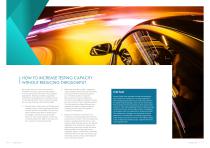
HOW TO INCREASE TESTING CAPACITY WITHOUT REDUCING THROUGHPUT We’ve seen how the volume and variety of materials and parts requiring impact testing is on the rise across automotive and aerospace applications. Ensuring a reliable, repeatable, and efficient testing process is, therefore, key to minimising downtime. There are three key steps you can take to achieve this ambitious goal. 1. Simplify setup: a fast, easy, and flexible setup process is key to switching between different samples quickly and smoothly. Look for drop tower solutions that allow for simple setup of carriage, masses, force sensors...
Open the catalog to page 6
HOW TO ADAPT TESTING TO NEW MATERIALS AND MANUFACTURING METHODS Adapting to growing volumes of composites isn’t the only challenge testing is up against. It also needs to meet new requirements deriving from the use of new lightweight materials and manufacturing methods. For example, 3D-woven composites are becoming a popular choice in the production of various aircraft and vehicles parts due to their unique properties. But a recent study found that small variations occurring in the weaving process can affect physical and mechanical properties quite significantly . Similarly, the mechanical properties...
Open the catalog to page 7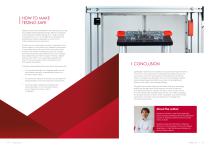
HOW TO MAKE TESTING SAFE Safety is another key consideration when selecting and using drop weight impact testing technology. With test conditions involving impact masses weighing up to 70 kg or pushed to a speed of 24 m/s, it is not difficult to understand why protecting the workers operating the machine from impact-related injuries is paramount. Another common risk workers may face is exposure to toxic fumes, vapours, or dust that can be released by specimens of composites when they are hit by the drop tower striker. A study by the Health and Safety Executive, for example, found that 3D-printed...
Open the catalog to page 8
About Instron At Instron (www.instron.com) we maintain our position at the leading edge of impact testing innovation through design and collaboration,both with our customers, leading university and industry researchers. We lead by example, by meeting customer testing needs across any application requirement. Our Sales, R&D, and Tech Support teams work together with you from initial enquiry through to delivery, offering full access to demonstration models at our design facilities around the world. We lead in calibration, with accredited certification available through our dedicated Service teams....
Open the catalog to page 9All Instron catalogs and technical brochures
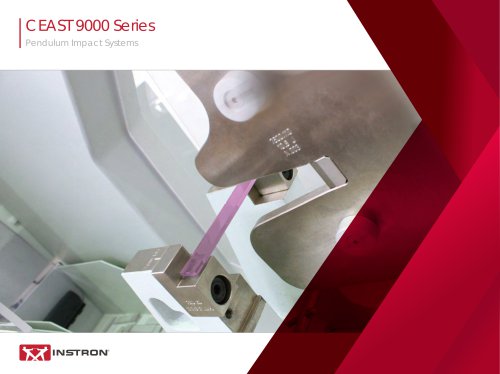 CEAST 9000 Series
20 Pages
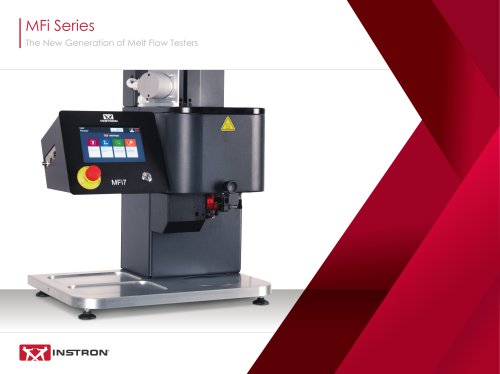 MFi Series Melt Flow Testers
16 Pages
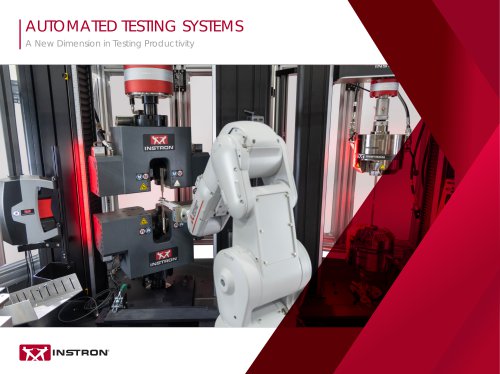 Automated Testing Systems
20 Pages
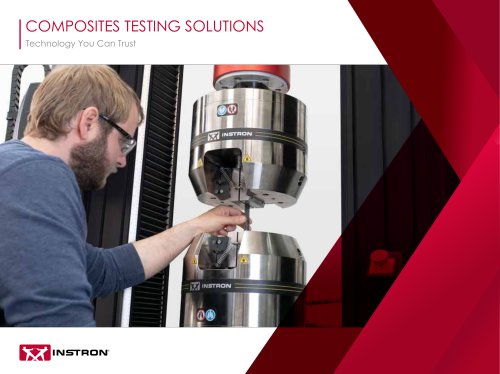 Composites Testing Solutions
20 Pages
 DX MODELS
3 Pages
 2580 Series Load Cells
3 Pages
 HDX Models
2 Pages
 DAMPER TEST SYSTEMS BI-7080
2 Pages
 HIGH STRAIN RATE VHS SYSTEM
4 Pages
 Automated XY Testing System
3 Pages
 CEAST 9400 Series
20 Pages
 COMPRESSION PLATENS
2 Pages
 LOW CYCLE FATIGUE
11 Pages
 ElectroPuls™
10 Pages
 Pneumatic Side-Action Grips
4 Pages
 HDT AND VICAT TESTING SYSTEMS
16 Pages
 AlignPRO™ Alignment System
2 Pages
 CEAST Melt Flow Series
20 Pages
 CEAST SmartRheo Series
16 Pages


Archived catalogs
 CEAST HDT Vicat Series
9 Pages
- Valve
- Control valve
- Kiln
- Instron testing machine
- Actuator
- Instron load cell
- Chamber kiln
- Test cabinet
- Linear actuator
- Automation software solution
- Management software solution
- Positioning table
- Electric valve
- Test stand
- Process software
- Instron tension/compression load cell
- Temperature test chamber
- Real-time software
- Instron Windows software