


- Company
- Products
- Catalogs
- News & Trends
- Exhibitions
Instron Stiffness Based Tuning

Instron Stiffness Based Tuning
Tuning is a critical process in fatigue testing, ensuring the system can control the machine effectively for accurate and repeatable data. Traditional tuning involves complex and time-consuming steps, which can be challenging for less experienced users.
Fatigue systems require tuning to operate at high frequencies in load or strain control. Proper tuning optimizes performance and control for specific specimen materials and geometries, preventing system instability and unreliable data.
This innovative method simplifies the tuning process by using a simple ramp within the specimen's elastic limit to measure stiffness. Patented algorithms then calculate optimal control gains quickly, reducing complexity and preventing specimen damage.
Stiffness Based Tuning is now available on all Instron systems with the 8800MT controller, extending its success from ElectroPuls™ systems to Servohydraulic testing systems. The tuning algorithms are continuously improved for enhanced performance.
- Quicker Process: Over 75% time saving compared to traditional methods, with all control channels tuned using a single measurement.
- More Accessible: Simplified process increases user confidence and reduces errors, allowing experienced operators to focus on complex applications.
- No Pre-Cycling: Eliminates pre-test cycles, preserving specimen integrity and providing more representative fatigue life.
- Improved Accuracy: Perfectly tuned systems enhance waveform quality, improving test accuracy and repeatability.
Stiffness Based Tuning offers a streamlined, efficient, and accurate approach to tuning, making it accessible for users of all experience levels and enhancing the reliability of test data.
Catalog excerpts
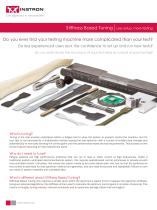
Stiffness Based Tuning Less setup, more testing Do you ever find your testing machine more complicated than your test? Do less experienced users lack the confidence to set up and run new tests? Do you ever doubt the accuracy of your test data as a result of poor tuning? Tuning is the vital process undertaken before a fatigue test to allow the system to properly control the machine, and for your test to run successfully. It traditionally involves loading the test specimen with a number of sudden step changes and automatically or manually iterating the control gains until the performance meets the test requirements. This process is time consuming and daunting for less experienced users. Fatigue systems are high performance machines that can run in load or strain control at high frequencies. Unlike a traditional position controlled electromechanical system, this requires sophisticated control techniques to provide smooth and controlled motion. Ultimately, this means the system needs to be tuned before each new test so that the performance and control is optimized for that specimen material and geometry, and your data is accurate and repeatable. Failure to tune can result in system instability and unreliable data. What is different about Stiffness Based Tuning? Stiffness Based Tuning only requires a simple ramp within the specimen’s elastic limit to measure the specimen stiffness. Using our patented algorithms, this stiffness is then used to calculate the optimum control gains in a matter of seconds. This means no lengthy tuning process, reduced complexity and no specimen damage before the test begins!
Open the catalog to page 1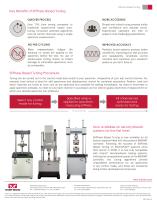
Stiffness Based Tuning Key Benefits of Stiffness Based Tuning QUICKER PROCESS MORE ACCESSIBLE Over 75% time saving compared to traditional square-wave based autotuning. Innovative patented algorithms tune all control channels using a single specimen measurement. Simple and robust tuning process builds user confidence and reduces errors. Experienced operators are free to support more challenging applications. IMPROVED ACCURACY More representative fatigue life because no cycles are applied to the specimen before the test. No use of square-wave cycling means no impact damage to vulnerable specimens,...
Open the catalog to page 2All Instron catalogs and technical brochures
 CEAST 9000 Series
20 Pages
 MFi Series Melt Flow Testers
16 Pages
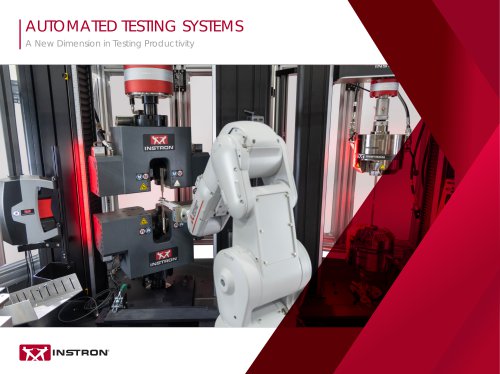 Automated Testing Systems
20 Pages
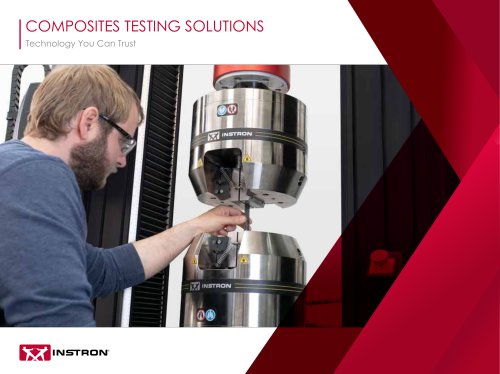 Composites Testing Solutions
20 Pages
 DX MODELS
3 Pages
 2580 Series Load Cells
3 Pages
 HDX Models
2 Pages
 DAMPER TEST SYSTEMS BI-7080
2 Pages
 HIGH STRAIN RATE VHS SYSTEM
4 Pages
 Automated XY Testing System
3 Pages
 CEAST 9400 Series
20 Pages
 COMPRESSION PLATENS
2 Pages
 LOW CYCLE FATIGUE
11 Pages
 ElectroPuls™
10 Pages
 Pneumatic Side-Action Grips
4 Pages
 HDT AND VICAT TESTING SYSTEMS
16 Pages
 AlignPRO™ Alignment System
2 Pages
 CEAST Melt Flow Series
20 Pages
 CEAST SmartRheo Series
16 Pages




Archived catalogs
 CEAST HDT Vicat Series
9 Pages
- Valve
- Control valve
- Kiln
- Actuator
- Instron load cell
- Chamber kiln
- Test cabinet
- Linear actuator
- Automation software solution
- Management software solution
- Positioning table
- Electric valve
- Analysis software solution
- Test stand
- Process software
- Instron tension/compression load cell
- Temperature test chamber
- Real-time software
- Instron Windows software