


- Company
- Products
- Catalogs
- News & Trends
- Exhibitions
Composites Testing Solutions
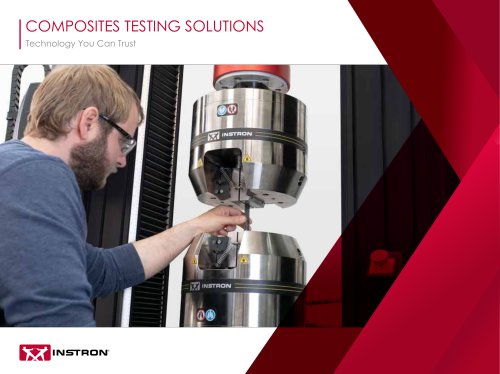
Composites Testing Solutions
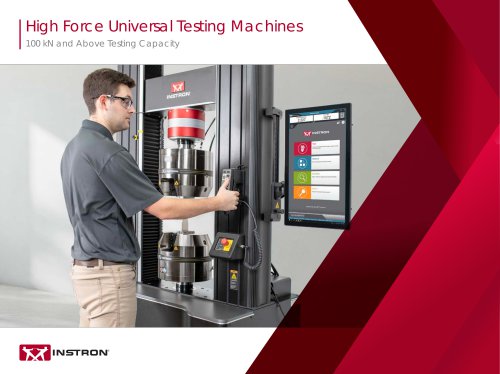
Instron® is a leader in mechanical testing systems, specializing in solutions for composite materials testing. Their systems are known for accuracy, reliability, and adherence to industry standards.
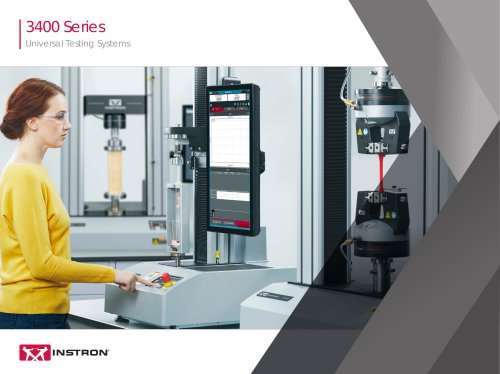
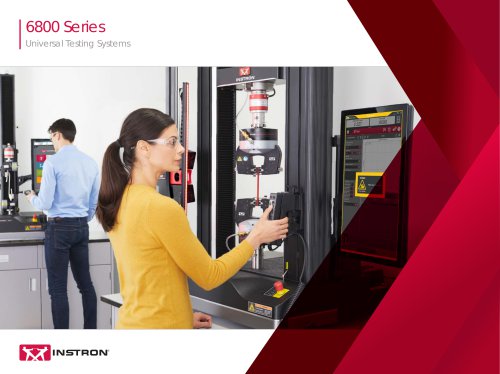
Instron offers a wide range of testing systems for tensile, compression, shear, flexure, torsion, and peel tests, compliant with ASTM, ISO, and other standards.
Instron’s machines are designed for composite materials, capable of in-plane tensile, interlaminar shear, and compression tests, and are configurable for various test types.
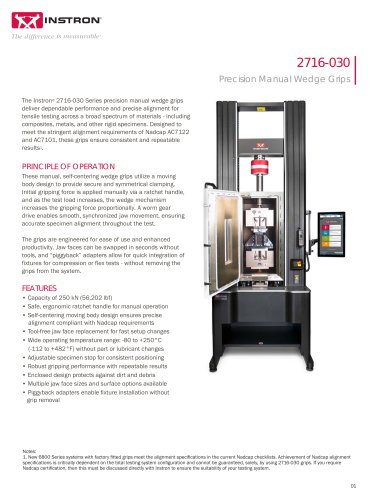
Instron provides manual and hydraulic wedge grips for reliable specimen handling, operable over a wide temperature range and meeting Nadcap alignment requirements.
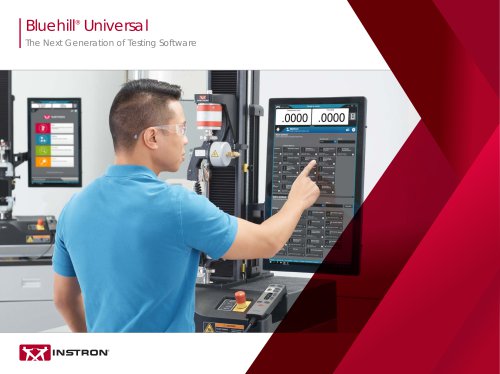
Features include pre-loaded bearings, precision ball screws, and low-stretch drive belts. The Bluehill® Universal software offers an intuitive interface and a comprehensive test method library.
Instron offers environmental chambers for temperature range testing and advanced strain measurement solutions like video extensometers.
Bluehill Universal software enhances testing workflows with features like prompted tests and TestProfiler, supporting operator training and testing safety.
Instron provides accurate, reliable, and efficient testing systems for composite materials, supported by decades of expertise and global support.
The Bluehill Universal Composites Module standardizes composites testing, supporting aerospace standards like ISO 527-4/5 and ASTM D3039.
Instron offers diverse training options for operators and developers, available online, in-person, and on-site.
This feature enables secure screen sharing with service professionals and facilitates test method and data file sharing.
Instron provides calibration and verification services, with a global team offering fast on-site service and remote support tools.
Instron ensures data integrity and services over 30,000 systems annually, used by 96% of Fortune 100 manufacturing companies.
Catalog excerpts
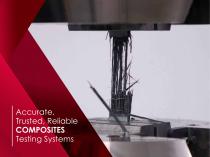
Accurate, Trusted, Reliable COMPOSITES Testing Systems
Open the catalog to page 2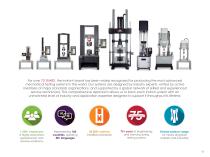
For over 75 YEARS, the Instron® brand has been widely recognized for producing the most advanced mechanical testing systems in the world. Our systems are designed by industry experts, vetted by active members of major standards organizations, and supported by a global network of skilled and experienced service technicians. This comprehensive approach allows us to back each Instron system with an unmatched level of industry and application expertise designed to support it throughout its lifetime. 1,500+ employees A highly-educated, experienced, and diverse workforce Representing 160 countries,...
Open the catalog to page 3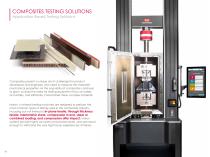
COMPOSITES TESTING SOLUTIONS Application-Based Testing Solutions Composites present a unique set of challenges for product developers and engineers who need to measure the material's mechanical properties. As the popularity of composites continues to grow, so does the need for testing equipment that can safely, accurately, and efficiently characterize these complex materials. Instron’s universal testing machines are designed to perform the most common types of testing used in the composites industry, including but not limited to in-plane tensile, through thickness tensile, interlaminar shear,...
Open the catalog to page 4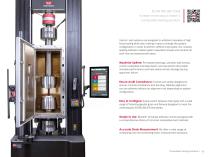
SCAN THE QR CODE to learn more about Instron’s composites testing solutions Instron® test systems are designed to withstand decades of high force testing while also making it easy to change the system configuration in order to perform different test types. Our industry leading software makes system operation simple and intuitive for both new and experienced users. Maximize Uptime: Pre-loaded bearings, precision ball screws, a thick crosshead and base beam, and low-stretch drive belts increase performance and help reduce shock damage during specimen failure. Ensure Audit Compliance: Frames are...
Open the catalog to page 5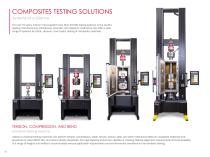
COMPOSITES TESTING SOLUTIONS Systems at a Glance For over 75 years, Instron® has supplied more than 50,000 testing systems to the world’s leading manufacturing, educational, scientific, and research institutions. We offer a wide range of systems for static, dynamic, and impact testing of composite materials. TENSION, COMPRESSION, AND BEND Universal Testing Systems Instron’s universal testing machines can perform tensile, compression, shear, flexure, torsion, peel, and other mechanical tests on composite materials and structures to meet ASTM, ISO, and other industry standards. Our high-capacity...
Open the catalog to page 6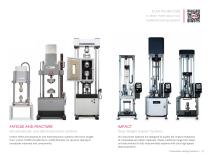
SCAN THE QR CODE to learn more about our materials testing systems Instron offers servohydraulic and electrodynamic systems with force ranges from 1 kN to 5,000 kN (200 lbs to 1,000,000 lbs), for dynamic testing of composite materials and components. Our drop tower systems are designed to qualify the impact resistance of composites and other materials. These machines range from basic un-instrumented to fully instrumented systems with ultra high-speed data acquisition. Servohydraulic and Electrodynamic Systems Drop Weight Impact Systems Composites Testing Solutions | 07
Open the catalog to page 7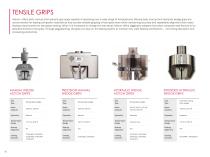
Instron® offers both manual and hydraulic grip types capable of operating over a wide range of temperatures. Moving body manual and hydraulic wedge grips are recommended for testing composite materials as they provide reliable gripping of test specimens while maintaining accurate and repeatable alignment that meets Nadcap requirements for aerospace testing. When it is necessary to change the test setup, Instron offers piggyback adapters that allow composite test fixtures to be attached directly to the grips. Through piggybacking, the grips can stay on the testing system to maintain any valid...
Open the catalog to page 8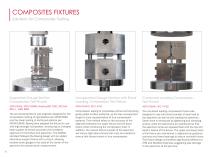
COMPOSITES FIXTURES Solutions for Composites Testing Supported Gauge Section Compression Test Fixture Unsupported Gauge Section with Shear Loading Compression Test Fixture Combined Loading Compression Test Fixture ASTM D695, ASTM D3846, Boeing BSS 7260, SACMA SRM-1, prEN 2850 Compression testing of composites without anti-buckling guide plates is often preferred, as the free unsupported length is more representative of true compression behavior. This method relies on the accuracy of the alignment between the upper fixture and the lower fixture while introducing the compression load. In addition,...
Open the catalog to page 10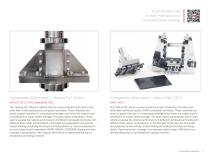
SCAN THE QR CODE to learn more about our composites fixture offerings Compression After Impact - “Boeing CAI” Fixture Compression After Impact - Airbus AITM 1-0010 The “Boeing CAI” fixture is used to test the impact resistance of carbon and other fiber-reinforced polymer composite laminates. These materials are prone to great reduction in compressive strength even when the impact load is insufficient to cause visible damage. The post-impact compression test is used to assess the relative performance of different composite laminates with different fiber matrix combinations. Laminates are subjected...
Open the catalog to page 11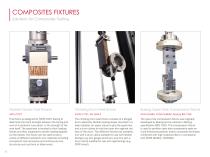
COMPOSITES FIXTURES Solutions for Composites Testing Flatwise Tension Test Fixtures Climbing Drum Peel Fixture Boeing Open Hole Compression Fixture ASTM D6484, ASTM D6484M, Boeing BSS 7260 This fixture is designed for ASTM C297 testing to determine the bond strength between the facing and core of a sandwich core panel, or the strength of the core itself. The specimen is bonded to thick loading blocks and then subjected to tensile loading applied via the blocks. The fixture can be used to test a variety of different sandwich core materials including honeycomb core structures and continuous core...
Open the catalog to page 12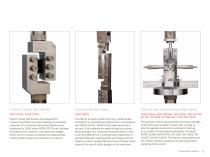
V-Notch Shear Test Fixtures Composites Rail Shear Flexural and Interlaminar Shear Bend Instron® shear test fixtures are designed for in-plane or interlaminar shear testing of composite materials. The V-Notched Rail Shear Method was introduced in 2005 under ASTM D7078 and includes the distinctive V-notches in the specimen design, which serve to create a localized and approximate uniform shear stress zone between the notches. This fixture is used to determine the in-plane shear strength of a composite laminate panel in accordance with ASTM D4255. ASTM D4255 describes both 2 rail and 3 rail methods...
Open the catalog to page 13All Instron catalogs and technical brochures
 CEAST 9000 Series
20 Pages
 MFi Series Melt Flow Testers
16 Pages
 Automated Testing Systems
20 Pages
 DX MODELS
3 Pages
 2580 Series Load Cells
3 Pages
 HDX Models
2 Pages
 DAMPER TEST SYSTEMS BI-7080
2 Pages
 HIGH STRAIN RATE VHS SYSTEM
4 Pages
 Automated XY Testing System
3 Pages
 CEAST 9400 Series
20 Pages
 COMPRESSION PLATENS
2 Pages
 LOW CYCLE FATIGUE
11 Pages
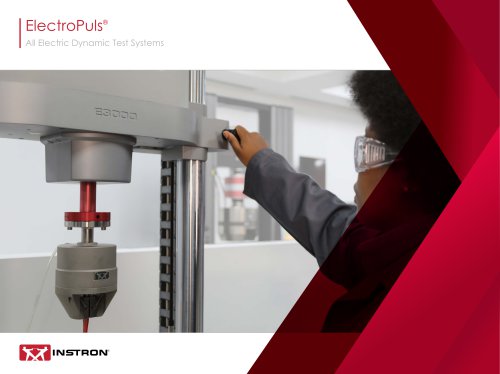
 ElectroPuls™
10 Pages
 Pneumatic Side-Action Grips
4 Pages
 HDT AND VICAT TESTING SYSTEMS
16 Pages
 AlignPRO™ Alignment System
2 Pages
 CEAST Melt Flow Series
20 Pages
 CEAST SmartRheo Series
16 Pages


Archived catalogs
 CEAST HDT Vicat Series
9 Pages
- Valve
- Kiln
- Control valve
- Actuator
- Instron load cell
- Chamber kiln
- Test cabinet
- Linear actuator
- Automation software solution
- Management software solution
- Positioning table
- Electric valve
- Analysis software solution
- Test stand
- Process software
- Instron tension/compression load cell
- Temperature test chamber
- Real-time software
- Instron Windows software