


- Company
- Products
- Catalogs
- News & Trends
- Exhibitions
CEAST 9000 Series
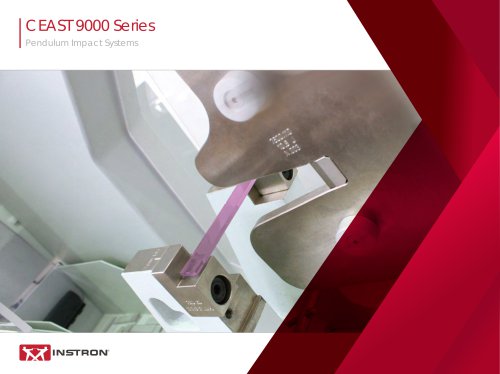
CEAST 9000 Series
Catalog excerpts

CEAST 9000 Series Pendulum Impact Systems
Open the catalog to page 1
Pendulum Impact Systems 02
Open the catalog to page 2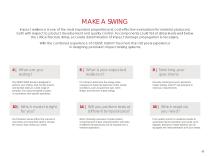
MAKE A SWING Impact resilience is one of the most important properties and cost-effective evaluations for material producers, both with respect to product development and quality control. As components could fail at stress levels well below the critical fracture stress, accurate determination of impact damage propagation is necessary. With the combined experience of CEAST, Instron® has more than 50 years experience in designing pendulum impact testing systems. 6|W hat is your expected resilience? 8|N otching your specimens The CEAST 9000 Series is designed to perform your Charpy, Izod, Tensile...
Open the catalog to page 3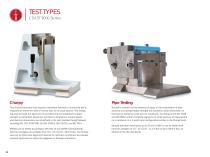
TEST TYPES Pipe Testing This 3-point bend test that requires a standard notched or unnotched bar is impacted on either the wide or narrow face of its cross-section. The energy required to break the specimen is recorded and the subsequent impact strength is calculated. Specimen and fixture dimensions, impact speed, and hammer dimensions are all defined in the test standard being followed, including ISO 179, ASTM D6110, DIN 53453, DIN 53753, and BS 7413. Scientific research on the material of pipes or the examination of pipe sections and tubing impact strength are suitable to yield information...
Open the catalog to page 4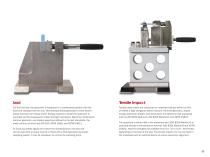
Tensile Impact For the Izod test, the specimen is impacted in a cantilevered position with the fixed end clamped into the vice. This testing method generates a more severe stress test than the Charpy mode. Energy required to break the specimen is recorded and the subsequent impact strength calculated. Specimen dimensions, hammer geometry, and impact speed are defined by the test standards, the most common of which are ISO 180, ASTM D256, and ASTM D4812. Tensile impact tests are conducted on materials that are either too thin or exhibit a high elongation before fracture. Hammer geometry, impact...
Open the catalog to page 5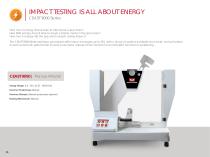
IMPACT TESTING IS ALL ABOUT ENERGY CEAST 9000 Series How much energy does it take to fully break a specimen? How little energy does it take to begin a failure mode in the specimen? How much energy did the specimen absorb during impact? The CEAST 9000 Series tabletop pendulums offer impact energies up to 50 J with a range of options available from basic manual testers to semi-automatic systems that include pneumatic release of the hammer and motorized hammer re-positioning. CEAST 9050 | Manual Model Energy Range: 0.5 - 50 J (0.37 - 36.9 ft-lb) Hammer Positioning: Manual Hammer Release: Manual...
Open the catalog to page 6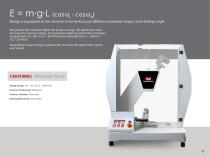
I 0 Energy is equivalent to the hammer’s momentum per difference between impact and starting angle The greater the mass the higher the impact energy. The lighter the mass the lower the impact energy. Our pendulum systems use hammer energies ranging from 0.5 - 50 J (0.37 - 36.9 ft-lbs) and velocities from 1 - 3.80 m/s (3.2 - 12.4 ft/s). Regardless of your energy requirements, we have the system that meets your needs. CEAST 9050 | Motorized Model Energy Range: 0.5 - 50 J (0.37 - 36.9 ft-lb) Hammer Positioning: Motorized Hammer Release: Pneumatic Braking Mechanism: Pneumati
Open the catalog to page 7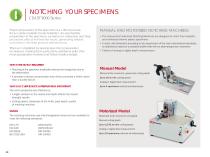
NOTCHING YOUR SPECIMENSCEAST 9000 Series Proper preparation of the specimen is a critical process for accurate material characterization. An appropriate preparation of the specimen, as well as an adequate notching procedure affects the final test results, generating reliable outcomes in the finish product performances. This is accomplished by several specimen preparation techniques, making them particularly suitable to select the most appropriate material and failure results analysis. MANUAL AND MOTORIZED NOTCHING MACHINES • The manual and motorized Notching Machines are designed to notch thermoplastic...
Open the catalog to page 8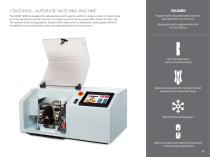
CEAST AN50 – AUTOMATIC NOTCHING MACHINE The CEAST AN50 is designed for laboratories which need to perform a large number of impact tests. Up to 50 specimens can be notched in a single cycle with the key parameters stored for later use. The optional knife cooling system, double notch loader and an adjustable cutting speed allow for consistent time saving and accurate notching operations at the same time. FEATURES Programmable motorized knife movement and speed from 1 to 21m/min Single pass depth, programmable from 0.01 to 0.25mm Up to 50 specimens notched simultaneously Optional slicing device...
Open the catalog to page 9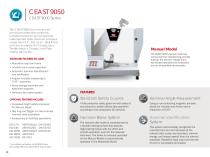
CEAST 9050 CEAST 9000 Series The CEAST 9050 is an advanced pendulum tester that performs uninstrumented to semi-automatic instrumented tests. Hammer energies range from 0.5 - 50 J (0.37 - 36.9 ft-lbs) and are available for Charpy, Izod, Tensile Impact, Dynstat, and Pipe testing standards. Manual Model The CEAST 9050 manual model has manual hammer repositioning and disc braking. The hammer release has a two-handed operation that is standard but can be specified as pneumatic. STANDARD FEATURES INCLUDE: • Monolithic cast iron frame • Intuitive touch panel operation •A utomatic hammer identification...
Open the catalog to page 10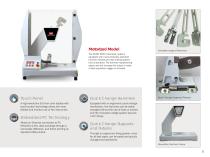
Motorized Model Complete range of Hammers The CEAST 9050 motorized model is equipped with a pneumatically operated hammer release and disc braking system that is standard. The hammer repositioning eases use and increase the output in tests. A data acquisition trigger is included. Touch Panel Quick Change Hammers A high-resolution 6.5-inch color display with touch-screen technology allows the most flexible and intuitive use of the instrument. Equipped with an ergonomic quick-change mechanism, the hammers can be easily changed without the use of tools or screws and the innovative wedge system assures...
Open the catalog to page 11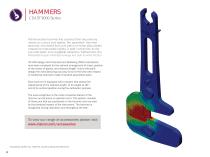
This innovative hammer line evolved from two primary needs: accuracy and rigidity. The patented* hammer structure, machined from one piece of metal alloy plates, ensures incomparable rigidity, a solid connection to the encoder shaft, and negligible vibrations. Furthermore, the flattened shape minimizes energy lost due to wind friction. 3D CAD design and Finite Element Modeling (FEM) calculations have been employed for the optimal arrangement of mass, position of the center of gravity, and reduced length. Due to this solid design the manufacturing accuracy is by far the best with respect to traditional...
Open the catalog to page 12All Instron catalogs and technical brochures
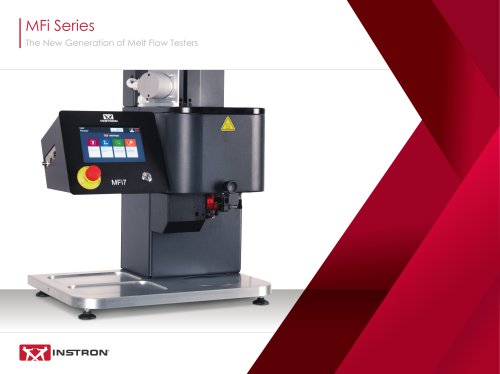 MFi Series Melt Flow Testers
16 Pages
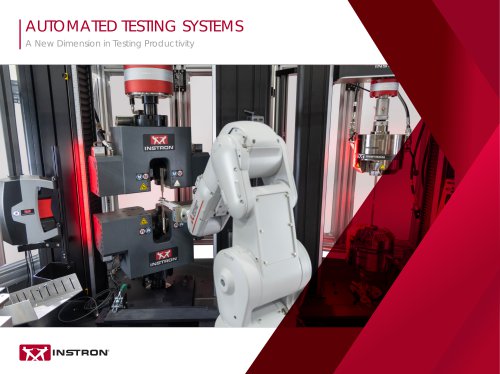 Automated Testing Systems
20 Pages
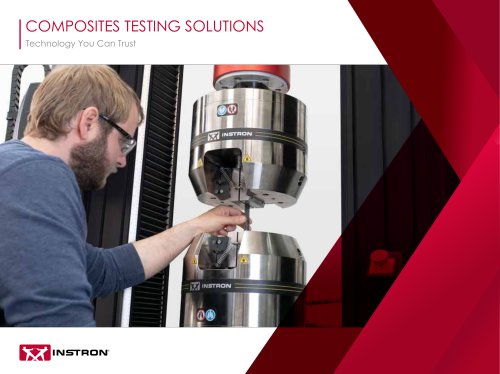 Composites Testing Solutions
20 Pages
 DX MODELS
3 Pages
 2580 Series Load Cells
3 Pages
 HDX Models
2 Pages
 DAMPER TEST SYSTEMS BI-7080
2 Pages
 HIGH STRAIN RATE VHS SYSTEM
4 Pages
 Automated XY Testing System
3 Pages
 CEAST 9400 Series
20 Pages
 COMPRESSION PLATENS
2 Pages
 LOW CYCLE FATIGUE
11 Pages
 ElectroPuls™
10 Pages
 Pneumatic Side-Action Grips
4 Pages
 HDT AND VICAT TESTING SYSTEMS
16 Pages
 AlignPRO™ Alignment System
2 Pages
 CEAST Melt Flow Series
20 Pages
 CEAST SmartRheo Series
16 Pages



Archived catalogs
 CEAST HDT Vicat Series
9 Pages
- Valve
- Control valve
- Kiln
- Instron testing machine
- Actuator
- Chamber kiln
- Test cabinet
- Linear actuator
- Automation software solution
- Management software solution
- Positioning table
- Electric valve
- Analysis software solution
- Test stand
- Process software
- Instron tension/compression load cell
- Temperature test chamber
- Real-time software
- Instron Windows software