


- Company
- Products
- Catalogs
- News & Trends
- Exhibitions
8800 Tower Control Electronics

8800 Tower Control Electronics
The 8800 Tower Control Electronics is a sophisticated digital controller designed for materials testing, developed by Instron. It integrates hardware and firmware to provide precise control and data acquisition for static and dynamic tests.
Key Features
- Data Acquisition: Continuous synchronous data acquisition at 5 kHz across all channels with 19-bit resolution ensures high data quality.
- Transducer Management: Automatic identification and calibration of compatible transducers prevent configuration errors.
- Specimen Protection: A function to avoid damage during test setup and completion.
- Adaptive Control: Continuous PID control term updates optimize parameters for changing specimen stiffness.
- Expandable Architecture: Supports numerous analog and digital channels.
Console Software
The Console Software serves as the primary user interface, allowing configuration and control of the 8800 controller. It supports control-loop optimization, operational limit settings, and simple cyclic tests. It also integrates with advanced application software for more complex testing.
Handset and Power Controls
The hardware interface includes a handset and power controls for machine operation, including emergency stop, power mode switching, and actuator positioning.
Specifications
- Control Capabilities: Supports 1-6 axes of control and up to 24 sensor conditioning channels.
- Control Loop: Features PID, Lag, Feed Forward, and Notch control types with a 5 kHz update rate.
- Waveform Generation: Frequency range from 0.00001 to 1,000 Hz with various waveform options.
- Signal Conditioning: Compatible with resistive bridges, AC, and DC devices, with automatic transducer recognition.
- Measurement Accuracy: High accuracy for position, load, and strain measurements, meeting international standards.
General Specifications
- Dimensions: Height 650 mm, Width 280 mm, Depth 530 mm.
- Weight: 32 kg (71 lb).
- Power Supply: 90-132 and 180-264V, 45-65 Hz single phase.
- Environmental Conditions: Operates between 10 to 38°C and 10 to 90% humidity.
Contact Information
Instron provides contact details for their worldwide and European headquarters, as well as their industrial products division.
Catalog excerpts

8800 Tower Control Electronics The 8800 controller is a state-of-the-art, fully digital dynamic controller that utilizes Instron® core technologies and is capable of running static and high-frequency dynamic tests. Found at the heart of Instron’s servohydraulic testing systems, the 8800 controller provides full system control, machine safety, transducer conditioning, and data acquisition, as well as acts as the foundation for the user interface to the testing machine. Features • Dedicated materials testing hardware and firmware-based controller developed through years of research, development, and continuous use • Continuous synchronous data acquisition at 5 kHz on all channels • 19-bit data resolution across the entire span of each transducer provides maximum data quality • Automatic identification and calibration of all compatible transducers prevents configuration errors and simplifies setup • Specimen Protect function helps to avoid damage of the specimen and fixtures during test setup and end of test • Continuous update of PID control terms with Adaptive Control - optimizes the control parameters throughout a test to suit the changing stiffness characteristics of the specimen • Expandable architecture, a plethora of analog, and digital channel capabilities Console Software Console Software is the main user interface to the 8800 controller. Running on a PC, it allows all controller functions to be viewed and configured including control-loop optimization, setting of operational limits, and running of simple cyclic tests. Console provides the foundation for running more demanding tests in application software such as WaveMatrix™, Bluehill®, or specific software, such as the Low Cycle Fatigue or Fracture Mechanics suite. www.instron.com Handset and Power Controls The handset, power controls. and emergency stop button make up the hardware interface that is rigidly mounted to the testing machine. Their functionality includes switching the machine off, into low power or high power mode; offering coarse or fine positioning of the actuator; and where fitted, opening and closing of hydraulic grips. And when a waveform is running or when in load control, the handset is locked from operating.
Open the catalog to page 1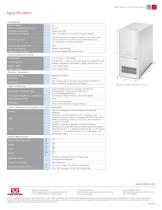
8800 Tower Control Electronics Specifications Configuration Axes of control Sensor conditioning channels Channels as Standard Spare Channel Slot for Position and Load Strain 1 and Strain 2 or any other compatible sensors Control Loop Type Type PID (Proportional, Integral, Derivative), Lag, Feed Forward (2 term), Notch (4 term) and External Compensation Input (e.g. Acceleration or Pressure Feedback) Control Loop Update Rate Auto Loop Shaping Adaptive Loop Shaping Position Load and Strain Continually Updated PID Terms at 1 kHz Analog Input Analog Outputs 4 Off Per Axis, +/-10V with 20% Over-Range,...
Open the catalog to page 2All Instron catalogs and technical brochures
 CEAST 9000 Series
20 Pages
 MFi Series Melt Flow Testers
16 Pages
 Automated Testing Systems
20 Pages
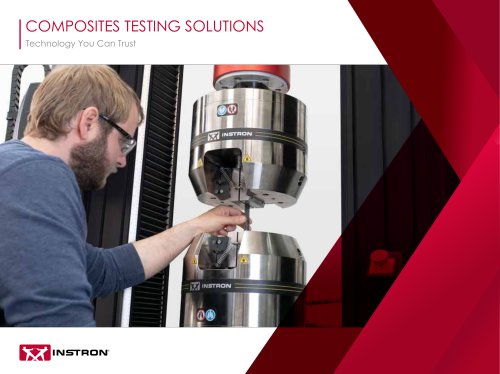 Composites Testing Solutions
20 Pages
 DX MODELS
3 Pages
 2580 Series Load Cells
3 Pages
 HDX Models
2 Pages
 DAMPER TEST SYSTEMS BI-7080
2 Pages
 HIGH STRAIN RATE VHS SYSTEM
4 Pages
 Automated XY Testing System
3 Pages
 CEAST 9400 Series
20 Pages
 COMPRESSION PLATENS
2 Pages
 LOW CYCLE FATIGUE
11 Pages
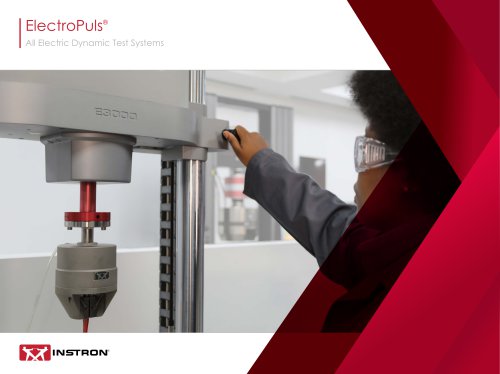
 ElectroPuls™
10 Pages
 Pneumatic Side-Action Grips
4 Pages
 HDT AND VICAT TESTING SYSTEMS
16 Pages
 AlignPRO™ Alignment System
2 Pages
 CEAST Melt Flow Series
20 Pages
 CEAST SmartRheo Series
16 Pages


Archived catalogs
 CEAST HDT Vicat Series
9 Pages
- Valve
- Control valve
- Kiln
- Instron load cell
- Chamber kiln
- Test cabinet
- Linear actuator
- Automation software solution
- Management software solution
- Positioning table
- Electric valve
- Analysis software solution
- Test stand
- Process software
- Instron tension/compression load cell
- Temperature test chamber
- Real-time software
- Instron Windows software