


- Company
- Products
- Catalogs
- News & Trends
- Exhibitions
2580 Series Load Cells

2580 Series Load Cells
- Force capacities range from ±500 N to ±600 kN.
- High accuracy with measurements down to 1/1000th of the load cell capacity.
- Automatic transducer recognition and electrical calibration for ease of use.
- Overload capability of 150% without calibration change and 300% without mechanical failure.
- Temperature compensation ensures accuracy across a range of conditions.
- Compliance with international standards such as ASTM E4, ISO 7500-1 class 0.5, and JIS B7721, B7733.
- Linearity and repeatability are maintained at ±0.15% of reading from 1 to 100% of force capacity.
- Hysteresis and creep are controlled at ±0.1% of force capacity.
- Temperature effects on zero and sensitivity are minimal, ensuring stable performance.
- Compatible with Quick Change and Piggy Back Adapters for efficient load cell changeover.
Catalog excerpts

2580 SERIES STATIC LOAD CELLS 500 N - 600 kN Instron load cells are a key part of a materials testing system. Among our competitors, Instron is the only global materials testing supplier that designs and manufactures its own load cells. This ensures that Instron load cells meet the unique requirements of materials testing such as; high accuracy over a wide measurement range, high stiffness, resistance to offset loads, accurate alignment and excellent zero stability. ® The 2580 Series load cells are specifically designed for use with 6800 and 5900 testing systems; offering exceptional performance with the ability to measure forces as low as 1/1000th of the force capacity to an accuracy of 0.5% of reading. Automatic transducer recognition and electrical calibration, makes them easy to use. The load cells can withstand loads up to 150% of their force capacity without damage and 300% without mechanical failure. The load cells allow the user to zero out the tare weight of a grip or fixture that weighs up to 10% of the force capacity, while still maintaining the full specified accuracy. All Instron load cells are individually temperature-compensated and tested for accuracy and repeatability on calibration apparatus that is traceable to international standards, with a measurement uncertainty that does not exceed one-third of the permissible error of the load cell. Instron 2580-xxxN Series load cells are precision force transducers consisting of a full strain gauge bridge bonded to a stiff and highly linear elastic element. When the element is subjected to a force, the electrical resistance of the gauges changes, providing an output signal proportional to the applied force. • Force capacities from ±500 N to ±600 kN (50 - 60,000 kgf or 112 -137,000 lbf) • Suitable for a range of test types, including tension, compression, cyclic and reverse stress • Accurate measurements down to 1/1000th of load cell capacity means fewer load cells and fewer load cell changes • Automatic recognition with electronic serial number and electrical calibration allows for simple, error-free operation • 150% of force capacity overload capability –reduces the possibility of damage • Tare weight 10% of force capacity – can be used with a wide range of grips and fixtures • Can be used with optional Quick Change and Piggy Back Adapters to facilitate a quick changeover of load cells • Precision machining and construction along with high axial and lateral stiffness helps to maintain system alignment • Low sensitivity to offset loads improves consistency of results • Complies with all international force measurement standards, including ASTM E4, ISO 7500-1 class 0.5, and JIS B7721, B7733 The load cells are designed to operate in tension, compression, cyclic and reverse stress. They have a wide measurement range allowing accurate force measurements to be made down to 1/1000th of the load cells capacity, reducing the need t
Open the catalog to page 1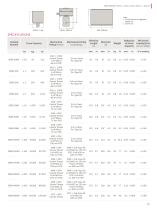
2580 SERIES STATIC LOAD CELLS 500 N - 600 kN Notes: 1. For Quick-Mount and Piggy Back Adapter Kits 2. 100 kN max SPECIFICATIONS Catalog Number Force Capacity Mechanical Fitting (Load String) Effective Length Mechanical Fitting (Frame) Deflection Off-Center at Force Loading Error Capacity (10 mm offset)
Open the catalog to page 2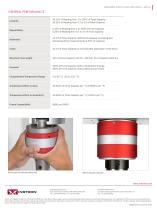
2580 SERIES STATIC LOAD CELLS 500 N - 600 kN GENERAL PERFORMANCE Linearity ±0.15% of Reading from 1 to 100% of Force Capacity ±0.25% of Reading from 0.1 to 1% of Force Capacity 0.15% of Reading from 1 to 100% of Force Capacity 0.25% of Reading from 0.1 to 1% of Force Capacity ±0.1% of Force Capacity (difference between increasing and decreasing force measurements at 50% of capacity) ±0.1% of Force Capacity (3 minutes after application of full force) Maximum Tare weight 10% of Force Capacity (50 0N - 400 kN), 5% of Capacity (600 kn) 150% of Force Capacity without Calibration Change, 300% of Force...
Open the catalog to page 3All Instron catalogs and technical brochures
 CEAST 9000 Series
20 Pages
 MFi Series Melt Flow Testers
16 Pages
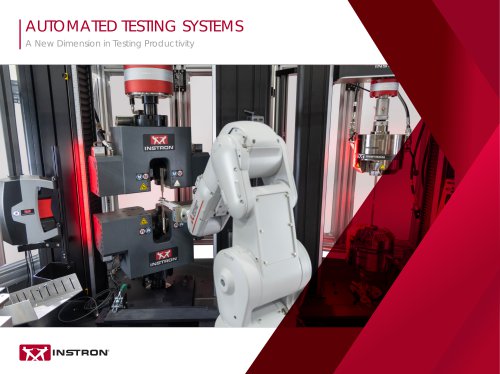 Automated Testing Systems
20 Pages
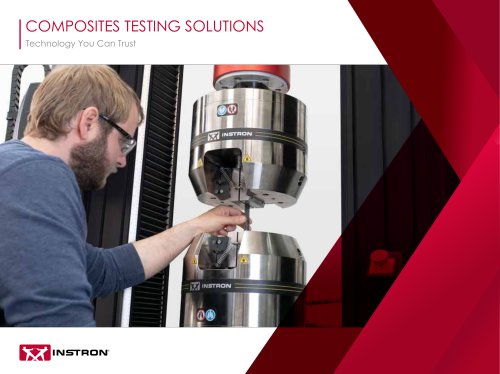 Composites Testing Solutions
20 Pages
 DX MODELS
3 Pages
 HDX Models
2 Pages
 DAMPER TEST SYSTEMS BI-7080
2 Pages
 HIGH STRAIN RATE VHS SYSTEM
4 Pages
 Automated XY Testing System
3 Pages
 CEAST 9400 Series
20 Pages
 COMPRESSION PLATENS
2 Pages
 LOW CYCLE FATIGUE
11 Pages
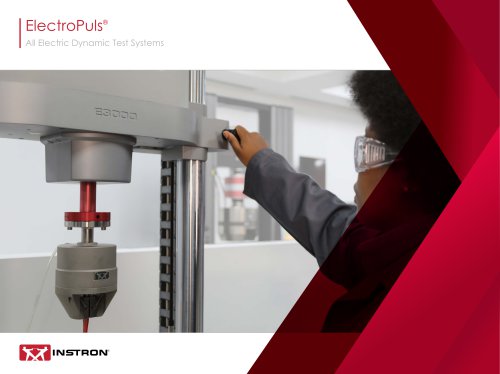
 ElectroPuls™
10 Pages
 Pneumatic Side-Action Grips
4 Pages
 HDT AND VICAT TESTING SYSTEMS
16 Pages
 AlignPRO™ Alignment System
2 Pages
 CEAST Melt Flow Series
20 Pages
 CEAST SmartRheo Series
16 Pages


Archived catalogs
 CEAST HDT Vicat Series
9 Pages
- Valve
- Control valve
- Kiln
- Instron testing machine
- Actuator
- Chamber kiln
- Test cabinet
- Linear actuator
- Automation software solution
- Management software solution
- Positioning table
- Electric valve
- Analysis software solution
- Test stand
- Process software
- Instron tension/compression load cell
- Temperature test chamber
- Real-time software
- Instron Windows software