

ESD 100

ESD 100
The ESD 100 is an element-specific detector designed to enhance the capabilities of elemental analysers by measuring concentrations and isotopic ratios of elements such as C, H, N, O, S, and Ar. It is compatible with both new and existing analysers, offering improved sensitivity and performance.
Specifications
The ESD 100 features a computer-controlled mass spectrometric detector with a mass range of 1-100 amu. It operates on a main voltage of 230V with a power consumption of 250 VA. The system is Microsoft Windows® based and interfaces with elemental analysers via an RS232 connection. The dimensions are 500 x 560 x 620 mm, and it weighs approximately 60 kg.
Advantages
- Measures both total elemental and individual isotope concentrations, providing enhanced capabilities over conventional elemental analysers.
- Offers 100-1000 times better sensitivity than thermal conductivity detectors (TCD), improving trace-level measurements.
- High dynamic range ensures reliable trace-level component measurements.
- Excellent reproducibility for confidence in results.
- Fully-automated sample handling minimizes operator interaction.
- Compact design conserves laboratory space.
- Offers an excellent price/performance ratio.
Compatibility and Operation
The ESD 100 can be easily interfaced with elemental analysers from manufacturers such as Bruker Elemental, Thermo, Elementar, EuroVector, and Leco. It supports fully automatic operation of complete sample sequences and flexible data processing with IPI-ISOSTAR software. Data can be transferred to external networks or other laboratory computers.
Conclusion
The ESD 100 significantly enhances the capabilities of elemental analysers by providing higher sensitivity, improved performance, and additional measurement capabilities at a competitive price.
Catalog excerpts
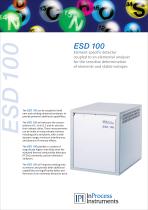
ESD 100 Element specific detector coupled to an elemental analyser for the sensitive determination of elements and stable isotopes The ESD 100 can be coupled to both new and existing elemental analysers to provide powerful additional capabilities. The ESD 100 will measure the concentrations of C, H, N, O, S and Ar and also their isotopic ratios. These measurements can be made in many sample matrices including soils and plants, with a wide dynamic range, minimum interferences, and absence of memory effects. The ESD 100 provides 2-3 orders of mag-nitude higher sensitivity than the standard thermal conductivity detectors (TCD‘s) commonly used on elemental analysers. The ESD 100 will improve existing measurements and provide both additional capabilities and significantly better performance at an extremely attractive price. nProcess nstruments
Open the catalog to page 1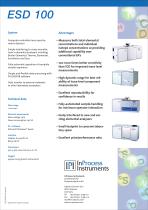
Computer-controlled mass spectro-metric detector Simple interfacing to many manufacturers elemental analysers including Bruker Elemental, Thermo, Elementar, EuroVector and Leco Fully automatic operation of complete sample sequences Simple and flexible data processing with IPI-ISOSTAR software Data transfer to external networks or other laboratory computers • Measures both total elemental concentrations and individual isotope concentrations so providing additional capability over conventional EA's • 100-1000 times better sensitivity than TCD for improved trace-level measurements • High dynamic...
Open the catalog to page 2All InProcess Instruments catalogs and technical brochures
 IMU 2000
4 Pages
 GAM 2000
2 Pages
 GAM 3000 datasheet
2 Pages
 LGA 407
2 Pages
 LGA 200
2 Pages
 IMU 200
2 Pages
 GIA 522
2 Pages
 GAM 500 UT
2 Pages
 GAM 400
2 Pages
 GAM 300
2 Pages
 GAM 300 ATEX
2 Pages
 GAM 200
2 Pages
 GAM 200 ATEX
2 Pages
 EDA 407
2 Pages
 Corporate Profile
8 Pages
 Product Profile
4 Pages
- Gas analyzer
- Automatic analyser
- Spectrometer
- Gas detector
- Integration analyzer
- Industrial detector
- Laboratory spectrometer
- Quality control analyzer
- Mass spectrometer
- Compact spectrometer
- Process detector
- Process spectrometer
- Laboratory detector
- High-sensitivity spectrometer
- Monitoring spectrometer
- Automated spectrometer
- Industrial spectrometer
- Spectrometer for the pharmaceutical industry
- Chemistry spectrometer
- Fast spectrometer