
- Catalogs
- Innovative Sensor Technology IST AG
- iST_Whitepaper_Moisture in Oil


iST_Whitepaper_Moisture in Oil
iST_Whitepaper_Moisture in Oil
Oil plays a critical role in industrial machinery, serving functions such as cooling, lubrication, insulation, and power transmission. Monitoring the condition of lubricants is essential for the safe and stable operation of equipment like gearboxes and transformers. Over time, oil degrades due to chemical and physical aging, which can lead to machine downtime and costly repairs if not properly managed.
Continuous monitoring of moisture in oil is vital for preventive maintenance and can help trigger automated counter-measures. This is particularly important for equipment operating under extreme conditions, such as offshore wind turbines and heavy-duty vehicles. The use of capacitive humidity sensors, which measure moisture content in oil, is recommended for maintaining optimal oil conditions.
Capacitive humidity sensors work by measuring the capacitance changes caused by water diffusion into a polymer layer. These sensors are suitable for harsh conditions found in oil environments. The iST MK33 sensor is specifically designed for moisture monitoring in oil, requiring precise calibration against relative humidity and temperature. Traditional methods like Karl-Fischer titration measure absolute water content but do not account for changes in oil solubility due to aging.
Long-term measurements demonstrate the stability of sensors in both ester and mineral oils. The sensors provide continuous in-process measurement, allowing for easy interpretation and adaptation to changing conditions. This approach offers advantages over traditional laboratory analysis by considering the actual condition of the oil and environmental factors.
Innovative Sensor Technology IST AG specializes in developing sensors for various industrial applications. Their products, such as the MK33-W mini and HYT 271 Module, are designed for harsh environments and offer reliable moisture monitoring solutions. These sensors are part of a broader effort to enhance process control and extend equipment lifespan.
Catalog excerpts
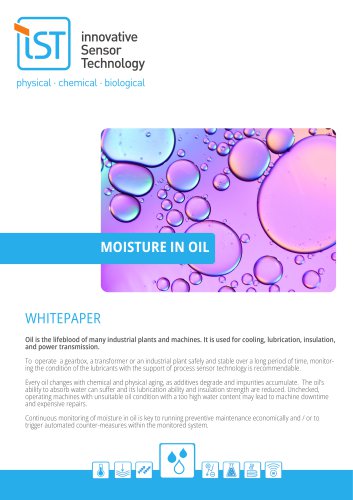
WHITEPAPER Oil is the lifeblood of many industrial plants and machines. It is used for cooling, lubrication, insulation, and power transmission. To operate a gearbox, a transformer or an industrial plant safely and stable over a long period of time, monitoring the condition of the lubricants with the support of process sensor technology is recommendable. Every oil changes with chemical and physical aging, as additives degrade and impurities accumulate. The oil’s ability to absorb water can suffer and its lubrication ability and insulation strength are reduced. Unchecked, operating machines with unsuitable oil condition with a too high water content may lead to machine downtime and expensive repairs. Continuous monitoring of moisture in oil is key to running preventive maintenance economically and / or to trigger automated counter-measures within the monitored system.
Open the catalog to page 1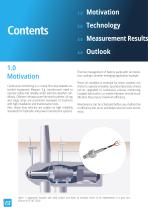
Contents 1.0 Motivation Continuous monitoring is a crucial first step towards extended equipment lifespan. E.g. transformers need to operate safely and reliably under extreme weather conditions. Offshore infrastructure like wind turbines, oil rigs and cargo ships are prominent examples of machines with high installation and maintenance costs. Also, heavy duty vehicles are subject to high reliability standards for hydraulic and power transmission systems. Measurement Results Thermal management of battery packs with oil immersion cooling is another emerging application example. Prime oil condition...
Open the catalog to page 2
Figure 2: Measuring principle of a capacitive humidity sensor element: A concentration gradient driven diffusion of water molecules in and out of the polymer layer effects the capacitance of the sensor 2.0 Technology Capacitive humidity sensors are common in air monitoring systems. The polymer layer of the sensor is in contact with the surrounding air through the porous top electrode. Water can diffuse through the pores of the electrode from the surrounding air into the polymer layer and vice versa until an equilibrium state is established (see figure 2). The amount of polymerbound water influences...
Open the catalog to page 3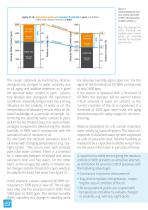
Figure 3: Control window for process control expressed in %RH (corresponding to water activity aw) Note: The displayed reaction threshold and absolute water content values are randomly selected for illustrative purposes only The results obtained by Karl-Fischer titration disregard any changes in water solubility due to oil aging and additive depletion as it gives the absolute water content in ppm. Laboratory analysis also disregards the operational conditions. Especially temperature has a strong influence on the solubility of water in oil. The interpretation of laboratory results relies on detailed...
Open the catalog to page 4
3.0 Measurement Results It takes time to reach physical equilibrium with dissolved water evenly spread throughout a certain volume of liquid oil (see figure 4). The dissolving process of water in oil is sped up at higher temperature and with effective high-speed mixing. Sample homogenity remains the limiting factor for a reliable data read-out. The response time of the humidity sensor to its immediate surroundings is significantly faster. Figure 4: The slow dissolving process of water in oil is demonstrated by monitoring moisture in oil after the addition of sufficient water to saturate the oil...
Open the catalog to page 5
Innovative Sensor Technology IST AG Your partner and manufacturer for physical, chemical and biological sensors With more than 30 years of experience Innovative Sensor Technology IST AG is one of the world’s leading manufacturers of physical, chemical and biological sensors. We specialize in the development and manufacturing of temperature sensors, thermal mass flow sensors and modules, humidity sensors and modules, conductivity sensors and biosensors. In addition to our standard products, we offer sensor adaptions to individual, customerspecific application needs – right up to the joint development...
Open the catalog to page 6All Innovative Sensor Technology IST AG catalogs and technical brochures
 iST_Corporate_Brochure
17 Pages
 iST_Market Flyer_HVAC
6 Pages
 iST_Market Flyer_Fuel cell
3 Pages









Archived catalogs
 LFS1107 Brochure en
3 Pages
 Pt 150 °C Series Brochure en
3 Pages
 LV5 Brochure en
5 Pages
 LFS1710 Brochure en
3 Pages
 Ni 150 °C Series Brochure en
4 Pages
 IV4 Brochure en
3 Pages
 300 °C Series Brochure en
7 Pages
 Pt 750 °C Series Brochure en
3 Pages
 TSic 716 Brochure en
4 Pages
 TSic 206/203/201 Brochure en
4 Pages
 SMD Series Brochure en
8 Pages
 Pt 400 °C Series Brochure en
6 Pages
 Pt 200 °C Series Brochure en
6 Pages
 Ni 300 °C Series Brochure en
4 Pages
 HYT 271 Brochure en
3 Pages
 LFS1505 Brochure en
3 Pages
 FlipChip Series Brochure en
5 Pages
 BondSens series Brochure en
2 Pages
 P14 Rapid Brochure en
3 Pages
 MK33-W Brochure en
3 Pages
 HYT 221 Brochure en
3 Pages
 P14-W Brochure en
3 Pages
 K5-W Brochure en
2 Pages
 LFS1305 Brochure en
3 Pages
 Pt 600 °C Series Brochure en
8 Pages
 FS7.4W Brochure en
2 Pages
 FS2 Brochure en
2 Pages
 P14 2FW Thermo Brochure en
3 Pages
 FS7 Brochure en
2 Pages
 SFS01 Brochure en
3 Pages
 PW Series Brochure en
3 Pages
 Ni 200 °C Series Brochure en
8 Pages
 Category Flyer Flow Sensors
3 Pages
 Category Flyer Bio Sensors
3 Pages
 Category Flyer Micro Heaters
3 Pages
 Flyer Medical Devices
2 Pages
 Application Flyer HVAC
2 Pages
 Application Flyer Fuel Cells
3 Pages
 Application Flyer Space
2 Pages
 SFS01 EvaKit Brochure en
7 Pages


- Flowmeter
- Liquid flow monitor
- IST resistance temperature sensor
- Stainless steel flow monitor
- Industrial flow monitor
- IST Pt100 temperature sensor
- Water flow monitor
- Stainless steel temperature transducer
- Humidity and temperature probe
- Mass flow monitor
- Resistance heater
- IST RTD temperature sensor
- Relative humidity and temperature sensor
- IST Pt1000 temperature sensor
- IST precision temperature sensor
- IST compact temperature sensor
- IST process temperature sensor
- Flow switch