


- Products
- Catalogs
- News & Trends
- Exhibitions
Flexible power solutions with the Jenbacher J920 FleXtra gas engine

Flexible power solutions with the Jenbacher J920 FleXtra gas engine
This document outlines various energy sources and heating systems, focusing on electricity and heating supply chains, including renewable and conventional energy sources.
Main Sections and Components:
- Energy Sources: The document lists multiple energy sources such as electricity from the German grid, oil, gas, waste incineration plants, wood, and renewable energy.
- Heating Systems: Heating is supplied through gas/oil boilers, district heating networks, and combined heat and power (CHP) plants with heat storage capabilities.
- Energy Distribution: Electricity and heat are distributed via grids and networks, including gas distribution systems and district heating networks.
- Renewable Energy Integration: The document references the Renewable Energy Law and highlights electricity generation from renewable sources, including CHP plants and heat storage systems.
Key Elements and Relationships:
- Electricity and heating demands are met through a combination of grid electricity, renewable energy, and fossil fuels.
- Waste incineration plants contribute both electricity and heating.
- CHP plants play a central role by producing both heat and electricity, supported by heat storage to balance supply and demand.
- District heating networks and gas distribution systems serve as infrastructure for delivering heat and gas respectively.
Critical Parameters and Considerations:
- Integration of renewable energy sources is emphasized to comply with the Renewable Energy Law.
- Heat storage is crucial for managing fluctuations in heat supply from CHP plants and renewable sources.
- Multiple fuel types (oil, gas, wood, waste) are used, indicating a hybrid approach to energy supply.
Summary:
The document presents a comprehensive schematic of energy and heating supply systems combining conventional and renewable sources. It highlights the importance of CHP plants with heat storage, district heating networks, and the role of regulatory frameworks like the Renewable Energy Law in shaping energy supply strategies. The integration of diverse energy sources and infrastructure components aims to meet electricity and heat demands efficiently while promoting renewable energy utilization.
Catalog excerpts

GE Power Distributed Power Flexible power solutions with the Jenbacher J920 FleXtra gas engine The J920 FleXtra gas engine from GE allows the city of Rosenheim to generate flexible distributed power & heat by operating in a highly efficient combined heat and power application mode. “With the accelerating growth of renewable installations, more flexible power is essential. Its quick startup capability makes GE’s J920 FleXtra gas engine the ideal solution to complement intermittently available wind and solar energy sources.” Dr. Gotz Briihl, CEO of the Stadtwerke Rosenheim, Germany One of GE's ecomagination-qualified J920 FleXtra large gas engines was installed at the Stadtwerke Rosenheim, where it works with a waste incineration plant and four additional GE gas engines to create a combined heat and power (CHP) plant. Offering low environmental impact, the plant generates about 40 percent of the electricity and 20 percent of the heat required by the city of Rosenheim. Since the CHP plant stores heat, it greatly increases the daily operating hours for the gas engines and makes them an ideal complement to intermittently available wind and solar energy supplies. By innovatively providing highly efficient, low-emissions power and heat to the city of Rosenheim, this project is a role model for Germany’s energy turnaround efforts. By 2025, Rosenheim will be able to obtain all of its energy without any additional greenhouse gas emissions. Stadtwerke Rosenheim: a pioneer in distributed power generation Stadtwerke Rosenheim supplies water, electricity, gas, process steam and district heating for residential and local industrial customers. Using CHP gas engine technology is a critical piece of the company’s energy concept. Given the fast-growing presence of renewable energy sources such as wind and solar power, it is essential to create a more flexible energy supply infrastructure such as gas engine-based distributed CHP plants.
Open the catalog to page 1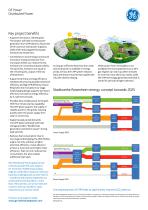
GE Power Distributed Power Key project benefits • Supports Germany’s climate goals: The project will help increase power generation from CHP plants to 25 percent of the country’s total power supply by 2020 while reducing greenhouse gas emissions by 40 percent. • Contributes to local energy turnaround: Innovative energy production from municipal utilities can reduce the C02 emissions of conventional power plants. The saved C02 emissions are equal to the remaining C02 output of the city of Rosenheim. • Supports Germany’s energy efficiency initiatives: By ensuring excellent electrical efficiency...
Open the catalog to page 2All INNIO catalogs and technical brochures
 Jenbacher gas engines
2 Pages




- Power generator
- Industrial genset
- Stationary genset
- Diesel engine
- Multi-cylinder engine
- Turbocharged engine
- Cylinder engine
- In-line engine
- Liquid-cooled engine
- Generator set engine
- Gas generator set
- Water-cooled engine
- Power generation engine
- Pump engine
- High-efficiency engine
- Agriculture engine
- Oil-cooled engine
- 8-cylinder engine
- Natural gas engine