- Catalogs
- INKA FIXING SYSTEMS
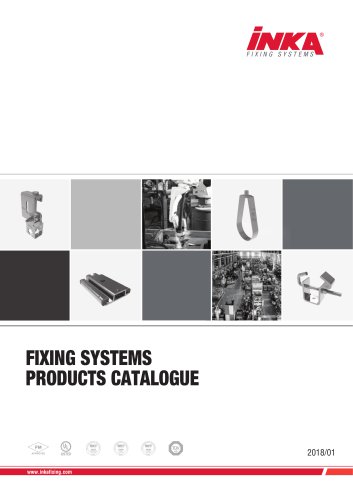
- MSS INDUSTRIAL PRODUCTS CATALOGUE


MSS INDUSTRIAL PRODUCTS CATALOGUE

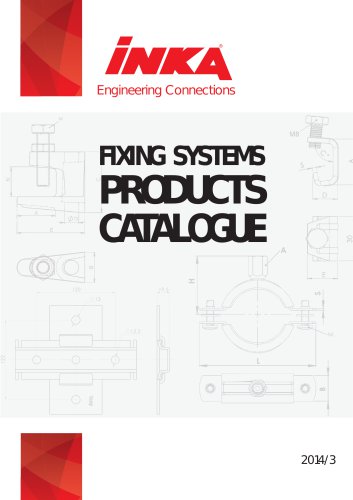
MSS INDUSTRIAL PRODUCTS CATALOGUE
- Compliance with ASME, NFPA, DIN EN, and MSS standards is required.
- Quality assurance includes welding qualifications and adherence to ISO and OHSAS standards.
- Submittals must include product data for various types of hangers and supports.
- Products must be provided by INKA Fixing Systems, Istanbul-Turkey.
- Various types of horizontal and vertical pipe hangers and supports are specified, including clevis hangers, pipe clamps, and U-bolts.
- Building attachments include beam clamps and welded-steel brackets.
- Saddles and shields are used to protect insulation, and thermal hanger shield inserts are specified for both cold and hot piping.
- Installation must comply with MSS SP-69 and SP-89 standards.
- Hangers and supports should allow for thermal and seismic movement.
- Specific instructions are provided for trapeze pipe hangers, metal framing systems, and fastener systems.
- Load distribution and pipe slopes must be managed to prevent stress on connected equipment.
- Metal fabrications for hangers and supports must be cut, drilled, and fitted to form hairline joints.
- Field welding must comply with AWS D1.1 standards.
- The contractor is responsible for providing all labor, materials, and equipment necessary to execute the project as per the drawings and specifications.
- The work must comply with various standards including ASME, NFPA, DIN EN, and MSS specifications.
- Horizontal Piping Hangers and Supports: Various types of hangers and supports are specified for different pipe sizes and conditions, including clevis hangers, pipe clamps, and roller hangers.
- Vertical Pipe Supports: Includes riser clamps for supporting pipe risers.
- Building Attachments: Includes beam clamps and welded-steel brackets for attaching to structural elements.
- Saddles and Shields: Protection saddles and shields are used to prevent insulation damage.
- Thermal Hanger Shield Inserts: Insulation materials for cold and hot piping, including calcium silicate and polyurethane blocks.
- Steel Pipe Hanger Installation: Must comply with MSS SP-69 and SP-89 standards, ensuring proper support from the building structure.
- Trapeze Pipe Hanger Installation: Grouping of parallel piping runs on trapeze hangers, fabricated from ASTM A 36/A 36M steel.
- Thermal-Hanger Shield Installation: Installation in pipe hangers or shields for insulated piping.
- Fastener System Installation: Use of powder-actuated fasteners and INKA anchors in concrete.
- Pipe Stand Installation: Assembling components on smooth surfaces without penetrating membranes.
- Includes cutting, drilling, and fitting metal fabrications for hangers and supports, with field welding complying with AWS D1.1 standards.
- Welding processes must be qualified according to ASME standards.
- Compliance with NFPA 13 for fire protection system components.
- Engineering responsibility for design and preparation of shop drawings by a qualified professional engineer.
- Manufacturers must comply with ISO 9001-2008, ISO 14001-2004, and OHSAS 18001-2007 quality management systems.
- Fastener System Installation: Use powder-actuated fasteners for lightweight concrete, ensuring operators are licensed and follow the manufacturer's manual. INKA anchors should be installed after concrete curing.
- Pipe Stand Installation: Components should be assembled and mounted on smooth surfaces without penetrating membranes.
- Hangers and Supports: Install with necessary accessories to allow thermal and seismic movement, ensuring freedom between pipe anchors and facilitating expansion joints.
- Lateral Bracing: Install with hangers and supports to prevent swaying.
- Building Attachments: Attach within concrete slabs or to structural steel, with additional attachments for concentrated loads.
- Load Distribution: Ensure hangers and supports do not transmit loads and stresses to connected equipment.
- Pipe Slopes: Install to provide indicated slopes and comply with ASME B31.9 deflection limits.
- Insulated Piping: Attach clamps and spacers, using thermal-hanger shields for pipes operating below ambient temperature.
- Cut, drill, and fit metal fabrications for pipe hangers and supports, ensuring hairline joints and compliance with AWS D1.1 welding procedures.
- Comply with ASME standards for power, process, and building services piping, as well as NFPA 13 for sprinkler systems.
- Follow DIN EN standards for process piping design, fabrication, and testing.
- Welding processes and operators must be qualified according to ASME standards.
- Comply with NFPA and MSS standards for hangers and supports.
- Manufacturers should have a Quality Management System compliant with ISO standards.
- INKA Fixing Systems products are specified for various types of hangers, supports, and attachments, with detailed descriptions of their applications and dimensions.
- Protection Saddles: Install MSS SP-58, Type 39 protection saddles for insulated pipes without vapor barriers. Fill voids with matching insulation.
- Protective Shields: Use MSS SP-58 & SP-69 Type 40 shields on stormwater and domestic water pipes with vapor barriers, covering 180 degrees.
- Shield Dimensions: Vary by pipe size, ranging from 305 mm to 610 mm in length and 1.22 mm to 2.67 mm in thickness.
- Insert Material: Must be at least as long as the protective shield.
- Thermal-Hanger Shields: Insulation should match the thickness of the pipe insulation.
- Fabrication: Cut, drill, and fit metal for trapeze pipe hangers and supports. Ensure hairline joints and field weld as needed.
- Welding: Follow AWS D1.1 procedures, ensuring minimal distortion and high-quality welds. Remove flux immediately and finish welds smoothly.
- Pipe Hanger and Support Spacing: Detailed spacing requirements for various pipe sizes, adhering to NFPA 13 standards.
- Clevis Hangers: Available in various sizes and materials, designed for both insulated and non-insulated pipes. Vertical adjustments are possible post-installation.
- Finish Options: Electro-galvanization and hot-dipped galvanization, compliant with ASTM standards.
- Approvals: Complies with MSS SP-58, MSS SP-69, and NFPA-13 standards. FM Approved and UL listed.
- Detailed specifications for various hanger and clamp models, including dimensions, load capacities, and material details.
- Adjustable Clevis Hanger: Designed for economical suspension of pipes, allowing vertical adjustments. It includes a rubber lining for noise reduction.
- Double Bolt Pipe Clamp: Used for suspending insulated pipelines, offering flexibility and accommodating up to 100 mm of insulation.
- Steel Pipe Clamp: Suitable for suspending cold and hot pipes with minimal insulation requirements.
- Adjustable Steel Band Hanger: Designed for non-insulated stationary pipes and sprinkler systems, allowing vertical adjustments.
- Riser Clamp: Supports vertical pipe runs, transmitting load to the structure through side ears.
- Welded Beam Attachment: Suitable for heavy loads and large hanger rod sizes, can be welded in place.
- U-Bolt: Supports or guides pipe runs, available in a wide range of sizes.
- Adjustable Side Beam Clamp: Designed for top of beams, eliminating the need for drilling holes.
- Pipe Strap: Economical product for pipes not subject to expansion or contraction.
Key Data from Tables: The tables provide detailed specifications for each product, including size ranges, material specifications, load capacities, and weights per 100 pieces. Each product type has a corresponding code for ordering, with variations for hot-dipped galvanized finishes.
This document provides detailed specifications for various pipe support and protection products, including anchor supports, pipe covering protection saddles, single pipe rollers, and heavy-duty riser clamps. The materials used are primarily carbon steel, compliant with MSS SP 58-TABLE A2/A2M standards. The document includes dimensions, forces, and load capacities for each product type.
Installation procedures require specifying pipe size, figure number, name, and finish. Welding must comply with ASME Section IV and AWS D1.1 standards. Special sizes can be designed to meet specific project requirements.
All products comply with the Manufacturer’s Standardization Society (MSS) SP 58 & SP 69 standards. Finishes include electro-galvanization according to ASTM B 633/ASTM F 1941 and hot-dipped galvanization according to ASTM A 153/123.
Products are designed to support pipes, restrict movement, and protect insulation from crushing. They are suitable for use in environments where axial movements are allowed, and vertical adjustments are required.
The document includes tables listing product codes, dimensions, forces, and weights. For example, the GSH700 series lists axial, lateral, and vertical forces for different sizes. The IE-39 series provides details on pipe covering protection saddles, including maximum load capacities and weights per 100 pieces.
Key parameters include material specifications, compliance with standards, and load capacities. Limitations are noted for specific sizes and configurations, with options for customization to meet project needs.
Catalog excerpts

PRODUCTS CATALOGUE
Open the catalog to page 1
PRODUCTS CATALOGUE
Open the catalog to page 2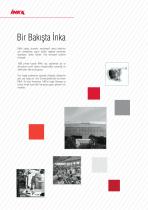
Bir Bakıta ‹nka NKA; inşaat, otomotiv, yenilenebilir enerji sektörleri için standartlara uygun kaliteli bağlantı elemanları tasarlayan, üreten tamamı Türk sermayeli endüstri firmasıdır. 1986 yılında kurulan NKA; sac, paslanmaz sac ve alüminyum profil işleme süreçlerindeki uzmanlığı ile sektörünün lider kuruluşudur. Dev inşaat projelerinin yapıldığı Ortadoğu ülkelerinin yanı sıra Rusya ve Türk Cumhuriyetlerinde de bilinen NKA, 20 yıldır ihracatının %80’ini başta Almanya ve sviçre olmak üzere Batı Avrupa’ya yapan, güvenilir bir markadır.
Open the catalog to page 3
‹nka at a Glance NKA is an industry company with completely Turkish capital that designs and produces quality fixing materials in accordance with the standards for construction and automative sectors as well as renewable energy sectors. Being founded in the year of 1986, NKA has become the leader establishment of the sector thanks to its specialty in such processes as the processing of sheet metal, stainless sheet and aluminium profile. Being known in the Middle East countries where huge construction projects take place in addition to Russia and the Turkish Republics, NKA is a reliable brand...
Open the catalog to page 4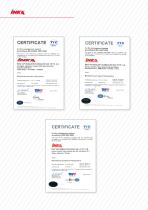
The proof of the conforming application with the regulation was furnished and in accordance with certification procedure it is certified iNKA YAPI BAGLANTI ELEMANLARI SAN. VE TiC. A.$. ISTANBUL ANADOLU YAKASI ORG.SAN. BOLGESI 34953 TUZLA - ISTANBUL / TURKEY Manufacturing and sales of fixing system Certificate Registrar The proof of the conforming application with the regulation was furnished and in accordance with certification procedure it is certified iNKA YAPI BAGLANTI ELEMANLARI SAN. VE TiC. A.S. istanbul Anadolu Yakasi Organize Sanayi Bolgesi Gazi Burvan No: 7, 34953 Tuzla - istanbuJ / Turkey...
Open the catalog to page 5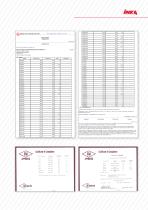
Sec Go-era" Infa-rnaTia-' 'oi -a'jc-'s. P INKA YAPI BAGLANTI ELE MAN LARI 5ANAVI VE TICARET A S ISTANBUL ANADOLU YAKAEI ORGANIZE SANAYI BGLGESI 34953 ISTANBUL, TUZLA TURKEY H-anger Type The IEKSP, IEKSS and IEKCH, wh* all? "amod. use L~e fc CM-inc n?ninc ;-;nv:nt cn: r JJL's hollow-Up 5ei vice. Only : es t xod-ci: r;lla«-!_ p jo-v o: A .■-■ayi ecu fa- trie Mark o UL permits the re prod uctior cf the -later a I container the Online Co't' tatio" Dir^utoi .■ on tree: to the "ollortinc cone lio"s: G"_ :L ,SC 'v t c ■ nb io-j C: '5t-. ct on;, DC-J gn;, G-; it; ni. e -d/oi Co" -'cation; ["'cs! nuit...
Open the catalog to page 6
TURK STANDARDLARI ENSTITUSU CERTIFICATE OF CONFORMANCE TO CRITERIA BELGENiN SON GECERLlLlK TAfllH BELGE SAHlalKUHULJSJfJAOl BELGE .jgiJNAORESl TESCiLLi TlC fill MAfiKASI IGlLl BELGELENDtRMF KRllERl INKA VAPI BAGLANTI ELEMANLARI SAN.VE TIC.A.S ISTANBUL AWADOLIJ VAKASI ORGANIZE SANAYI BOLGESI ISTANBUL AHADOLU VAX A31 ORGANIZE SANAVI BOLGESI GAZ TURK STANDARDLARI ENSTITUSU KRITERE UYGUNLUK BELGESI TURKISH STANDARDS INSTITUTION CERTIFICATE OF CONFORMANCE TO CRITERIA BELGE SAHIB I KURULU^UN Al PIBAGLANTl ELEfitANLARI SAN.VE TIC.A.S. iSI ORGANIZE SANAYl BOLGESI GAZI ' DUBELLEtt-CELlK MAUEMEDEd . p$Mt...
Open the catalog to page 7
Some References from MENA • • • • • • • • • • • • • • • • • • • • • • • • • • • • • • • • • • • • • • • • • King Abdullah Bin Abdulaziz Third Saudi Expansion of Holy Haram - Makkah/ K.S.A. King Abdul Aziz International Airport Project – Jeddah/ K.S.A. Madinah Airport – Madinah/K.S.A. North South Railway Project – K.S.A. Jabal Omar Development Project – Makkah/K.S.A. University of Dammam – Dammam/K.S.A. Baha University – Baha/K.S.A. KAP-1 Project – Riyadh/K.S.A. Sang Housing Project – Riyadh/K.S.A. Taif University – Taif/K.S.A. Al Iman General Hospital – Riyadh/K.S.A. King Faisal Medical City...
Open the catalog to page 8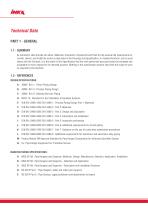
Technical Data PART 1 - GENERAL 1.1 - SUMMARY A. Contractor shall provide all Labour, Materials, Contractor’s Equipment and Plant to fully execute the requirements to furnish, deliver, and install the works as described in the Drawings and Specification, or implied therefrom, and in accor dance with the Contract. It is the intent of this Specification that the work performed pursuant hereto be complete and acceptable in every respect for its intended purpose. Nothing in this specification section shall limit the scope of work as required by the Contract. 1.2 - REFERENCES DESIGN SPECIFICATIONS...
Open the catalog to page 9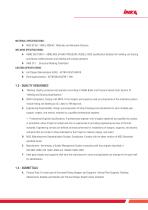
MATERIAL SPECIFICATIONS : A- MSS SP 58 : TABLE A2M/A2 : Materials and Allowable Stresses WELDING SPECIFICATIONS : A- ASME SECTION IV : ASME BOILER AND PRESSURE VESSEL CODE Qualification Standard for welding and brazing procedures,welders,brazers and welding and brazing operators B- AWS D1.1 : Structural Welding Code/Steel COATING SPECIFIATIONS: A- Hot Dipped Galvanisation (HDG) : ASTM A153/153M-09 B- Electrogalvanisation : ASTM B633/ASTM F 1941 Welding: Qualify processes and operators according to ASME Boiler and Pressure Vessel Code: Section IX, “Welding and Brazing Qualifications.” B- NFPA...
Open the catalog to page 10
PART 2 - PRODUCTS 2.1 - MANUFACTURER A. Subject to compliance with requirements, provide products by INKA Fixing Systems, Istanbul-Turkey. 2.2 - HORIZONTAL PIPING HANGERS AND SUPPORTS A. Select size of hangers and supports to exactly fit pipe size for bare piping, and around piping insulation with saddle or shield for insulated piping. Unless otherwise indicated, install the following types: 1) INKA Standard Clevis Hanger (IEKCHL) (MSS Type 1): For suspension of noninsulated or insulated stationary pipes, DN15 to DN750. 2) INKA Double Bolt Pipe Clamp (MSS Type 3); For suspension of pipes,DN20...
Open the catalog to page 11
2.3 - VERTICAL PIPE SUPPORTS A. Select size of vertical piping clamps to exactly fit pipe size of bare pipe. Unless otherwise indicated, install one of the following. 1) INKA Riser Clamp (IEKRC)(MSS Type 8) for support of pipe risers, DN20 to DN500. 2) INKA Heavy Duty Riser Clamp (IEKHRC) (MSS Type 42): For support of pipe risers, DN20 to DN500, if longer ends are required for riser. 2.4 - BUILDING ATTACHMENTS A. INKA Center-Beam Clamps (MSS Type 21): For attaching to center of bottom flange of beams. B. INKA Welded Beam Attachment (MSS Type 22): For attaching to bottom of beams if loads are...
Open the catalog to page 12All INKA FIXING SYSTEMS catalogs and technical brochures
 STRUT SYSTEMS CATALOGUE
68 Pages
 Reference List
14 Pages
 Coupling Parts Catalogue
53 Pages
 General Catalogue
105 Pages
 AUTOMOTIVE INDUSTRY
7 Pages
 Cast Iron Drainage Systems
44 Pages
 COUPLINGS & FITTINGS CATALOGUE
44 Pages