
- Catalogs
- Infralytic
- The combination of IR and UV for oil layer thickness measurement

The combination of IR and UV for oil layer thickness measurement
The combination of IR and UV for oil layer thickness measurement
The document discusses the combination of infrared (IR) and ultraviolet (UV) methods for measuring oil layer thickness. It highlights the advantages and limitations of each method and presents a solution that combines both techniques.
Why Calibrate UV with IR?
IR absorption is a proven method that provides accurate absolute values but requires larger housing due to the size of its components. In contrast, UV fluorescence requires less installation space, allowing for smaller housings.
Limitations of Solely Using UV Fluorescence
The UV measurement method is highly dependent on the medium being measured. Complex lubricants require individual calibration, and even different batches of the same lubricant can show variations.
Solution: Combining IR and UV Methods
The document proposes a combination of IR and UV methods to address the limitations of using UV alone. Both methods measure the same spatial area, allowing the IR reflectivity to normalize the UV fluorescence strength.
Current Development
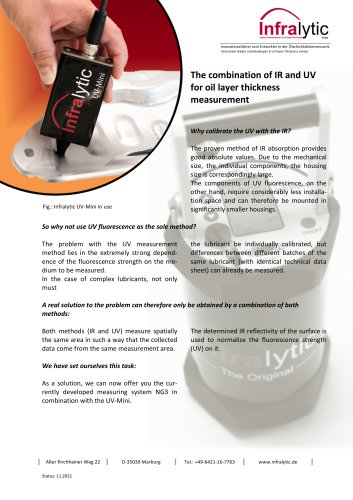
The document introduces the NG3 measuring system combined with the UV-Mini as a solution to the challenges discussed.
Conclusion
By integrating both IR and UV methods, the system offers a more reliable and accurate measurement of oil layer thickness, addressing the limitations of using either method alone.
Catalog excerpts
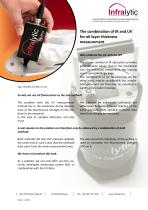
Innovationsführer und Entwickler in der Ölschichtdickensensorik Innovation leader and developer in oil layer thickness sensor The combination of IR and UV for oil layer thickness measurement Why calibrate the UV with the IR? The proven method of IR absorption provides good absolute values. Due to the mechanical size, the individual components, the housing size is correspondingly large. The components of UV fluorescence, on the other hand, require considerably less installation space and can therefore be mounted in significantly smaller housings. So why not use UV fluorescence as the sole method? The problem with the UV measurement method lies in the extremely strong dependence of the fluorescence strength on the medium to be measured. In the case of complex lubricants, not only must the lubricant be individually calibrated, but differences between different batches of the same lubricant (with identical technical data sheet) can already be measured. A real solution to the problem can therefore only be obtained by a combination of both methods: Both methods (IR and UV) measure spatially the same area in such a way that the collected data come from the same measurement area. The determined IR reflectivity of the surface is used to normalize the fluorescence strength (UV) on it. We have set ourselves this task: As a solution, we can now offer you the currently developed measuring system NG3 in combination with the UV-Mini. Alter Kirchhainer Weg 22 Status: 11.2021
Open the catalog to page 1All Infralytic catalogs and technical brochures
 Infralytic GmbH
2 Pages
- Measuring device
- Thickness gauge
- Portable thickness gauge
- Automatic measuring module
- Coating thickness gauge
- Digital display thickness gauge
- USB measuring module
- Hand-held gauge
- Calibration gauge
- Precision thickness gauge
- Thickness measuring instrument
- 3D measuring instrument
- Sensing head
- Paint thickness gauge
- Bluetooth gauge
- Battery-powered thickness gauge
- Oil measuring device
- Quality control thickness gauge
- Process monitoring thickness gauge
- Oil layer thickness gauge