
- Catalogs
- Inductotherm
- MTCL Mill roll hardening machines catalogue

MTCL Mill roll hardening machines catalogue

MTCL Mill roll hardening machines catalogue
Induction heating is a highly effective method for surface heating of steel parts, particularly in hardening rolling-mill rolls. This process enhances roll quality by providing a hardened metal layer and improving residual stress distribution, thus extending the roll's lifespan and reducing the need for retreatments. The quality of a roll is influenced by its chemical composition, manufacturing care, preliminary heat treatments, and final surface hardening. INDUCTOTHERM Belgium has significantly contributed to the global development of induction hardening of rolls through their progressive system.
Progressive Induction Hardening Principle
The roll is vertically suspended in a machine with a metal frame and support systems. It rotates at approximately 30 rpm for uniform heating and hardening. The roll traverses through inductors and quench systems at adjustable speeds, depending on the roll diameter.
Frequency Selection
The frequency used depends on the desired performance and roll diameter:
- 1000 Hz for hardening depths of 12-15 mm on rolls 250-500 mm in diameter.
- 250 Hz for depths of 15-20 mm on rolls 250-1000 mm in diameter.
- Dual-frequency 50/250 Hz for large rolls (1200 mm or more) achieving depths of 20-25 mm.
Inductors and Quenching
Heating is achieved with one or two cylindrical inductors. An annular quench unit below the inductor rapidly cools the heated zone, converting the structure to martensitic. Post-quenching, the roll is submerged in water to maintain low temperatures and prevent self-annealing.
Schematic Diagram for Progressive Hardening Installation
The installation includes equipment for both 50 Hz and 250 Hz systems, featuring starting stations, induction regulators, line controls, phase balancers, capacitor banks, chokes, and heating transformers.
Engineering and Installation
INDUCTOTHERM BELGIUM offers comprehensive engineering services for mechanical, electrical, and hydraulic plant installations, ensuring maximum profitability and reliability.
Main Advantages of Progressive Induction Preheating and Hardening
- Uniform and rapid heating limited to the roll surface.
- No risk of distorting journals or annealing phenomena.
- Accurate programming and regulation.
- Increased output and better residual stress distribution.
- Reduced handling time and space requirements.
- Lower consumption of heating power and cooling water.
- Flexible power control and reduced oxidation.
- Lower maintenance costs with only one yearly overhaul needed.
Catalog excerpts

Induction heating is nowadays the process best suited to the surface heating of steel parts. This technique finds many applications, especially in hardening rolling-mill rolls, in which case it is particularly efficient. The continually expanding development of cold mills in which the rolls are subjected to important stresses, is being pursued in parallel with research to obtain rolls of high strength and resistance to surface wear. Induction heating has obviously contributed to improvements in roll quality by giving a final layer of metal hardened in depth combined with an improvement in the...
Open the catalog to page 2
Traversing through inductors and quench systems is carried out at a constant speed that can however be adjusted to suit roll diameters form 0.2 to 2 mm/sec. Rotation is performed at a speed of some 30 rpm, ensuring uniformity of heating and therefore of roll hardening > PRINCIPLE The roll is hung vertically in a machine that mainly consists in a metal frame fitted with support and guidance systems for the various movements. A frequency of 1000 Hz gives a hardening depth of 12 to 15 mm on rolls from 250 to 500 mm dia. A frequency of 250 Hz gives a hardening depth of 15 to 20 mm on rolls from 250...
Open the catalog to page 3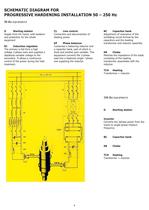
SR Choke TCH Heating Matches the impedance of the loads consisting of the heating transformer assemblies with the inductor. Transformer + inductor Adjustment of resonance of the oscillating circuit formed by the capacitors and the heating transformer and inductor assembly BC Capacitor bank EP Phase balancer Comprises a balancing inductor and a capacitor bank, part of which is fixed and another part variable. This equipment converts the 3-phase load into a balanced single-^phase one supplying the inductor. Connection and disconnection of heating power CL Line control > RI Induction regulator >...
Open the catalog to page 4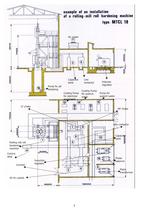
A ir cooler Capacitor bank Line contactor Inductor regulator Pump for pit emptying Cooling Pump for quench water Cooling Pump for electrical equipment Pump for quench water MF choke Line contactor Capacitor bank LF choke Rollin g mill roll hardening machine Control desk Inverter Induction regulator Phase balancer Mains transformer 50 Hz cubicle 6 >
Open the catalog to page 6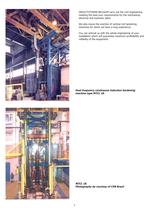
Dual frequency continuous induction hardening machine type MTCL 18. MTCL 18. Photography by courtesy of CSN Brazil 7 INDUCTOTHERM BELGIUM carry out the civil engineering meeting the best your requirements for the mechanical, electrical and hydraulic plant. We also insure the erection of vertical roll hardening machines for which we have a long experience. You can entrust us with the whole engineering of your installation which will guarantee maximum profitability and reliabilty of the equipment. >
Open the catalog to page 7
OF PROGRESSIVE INDUCTION PREHEATING Better uniformity and rapidity of heating Heating is limited to the surface of the roll No risk of distorting journals or of annealing phenomena Accurate programming and regulation > OF PROGRESSIVE INDUCTION HARDENING Increased output Quick surface heating, the centre of the roll remaining relatively cold Better distribution of residual stresses No risk of deformation, the roll being suspended throughout the operation Progressive heating and quenching No heating of the journals Saving of space Reduced handling time, heating and quenching being carried out on...
Open the catalog to page 8