


- Company
- Products
- Catalogs
- News & Trends
- Exhibitions
Tool holders catalogue METAL/WOOD

Tool holders catalogue METAL/WOOD
IMS is a global distributor of tool holders, operating in 95 countries with exclusive distributors in the US, Spain, and the Czech Republic. The company focuses on aligning with Industry 4.0 needs by developing innovative solutions for product identification and selection, aiming to meet customer expectations through a synergy between manufacturers, retailers, and users.
The catalogue is designed to guide users through selecting the appropriate tool holder by defining machine and tool connection types, and choosing optional features and finishes. It includes sections for accessories and components, emphasizing the importance of understanding product characteristics.
The catalogue details various tool holders, including collet chucks with and without collet nuts for ER and EOC collets, adhering to DIN standards. It provides part codes, descriptions, dimensions, connection types, and balancing RPMs for each product.
Sections cover a range of accessories such as petal collets, ball clamping systems, wrenches, tool clampers, and spindle shank wipers. Components include collet nuts, ER and EOC collets, pull studs, coolant tubes, and tap collets.
The catalogue offers tips for easy collet chuck setup and emphasizes the versatility of collet chucks for high-speed milling operations. It also provides guidance on selecting optional materials and finishes to enhance product performance.
IMS aims to enhance customer experience by providing comprehensive product information and facilitating the selection process through a well-structured catalogue.
This document provides detailed specifications for various milling arbors, focusing on their dimensions, connections, and balancing capabilities. The arbors are categorized based on their compatibility with different HSK connections, which are essential for configuring toolholders.
The milling arbors are listed with part codes, descriptions, dimensions (D, H, M), number of locking screws (N°/TK), connection type, and balancing RPM. The document includes arbors for different systems such as 'Weinig' and 'SCM', with specific HSK connections like HSK 85 W and HSK 85 S.
A comprehensive list of available HSK connections is provided, each with a unique code. These connections are crucial for setting up toolholders and ensuring compatibility with various milling machines.
The document also details hydro chucks, which are ideal for detailing, milling, and drilling operations. These chucks offer high concentricity and ease of setup. Specifications include part codes, dimensions (D, d, L, L1), connection type, and balancing RPM.
The milling arbors and hydro chucks are manufactured from steel, ensuring durability and performance in woodworking mills.
This document serves as a technical guide for selecting the appropriate milling arbors and hydro chucks based on specific requirements and machine compatibility. It emphasizes the importance of choosing the correct HSK connection for optimal toolholder configuration.
The document provides a comprehensive list of shrink fit tool holders, categorized by part codes (D001 to D039) and specifications. Each tool holder is described by its version, length (L), angle (α), HSK connection type, and balancing speed (RPM). The tool holders are designed for precision and efficiency in machining operations.
- Versions: Slim versions 3 to 25, with varying lengths (75, 90, 120, 160 mm).
- Angle: Consistently 3° across all models.
- HSK Connections: Multiple options including HSK 25 E, HSK 32 A-E, HSK 40 A-E, HSK 50 A-E-F, HSK 63 A-E-F, HSK 80 A, and HSK 100 A.
- Balancing: Ranges from 18,000 to 70,000 RPM depending on the model.
The document lists specific codes for each HSK connection type, which are essential for configuring the tool holders. These codes are crucial for ensuring compatibility with different machining systems.
All tool holders are manufactured from high-quality steel, ensuring durability and performance.
The document also includes information on tap holders with double compensation, designed for precise threading operations. These are categorized by part codes (AX00 to AX04) and include specifications such as diameter (D), length (L), and connection type.
Detailed tapping specifications are provided, including tool shaft standards and collet styles, ensuring compatibility with various threading operations.
This document serves as a detailed guide for selecting the appropriate shrink fit tool holders and tap holders for specific machining needs, emphasizing the importance of choosing the correct HSK connection and understanding the specifications for optimal performance.
- Morse Cone Reductions: Used for bits and mills in lathes and machines with Morse cones, adhering to DIN 228 standards.
- HSK Tool Holders: Conform to DIN 69893 standards, available in various styles (A, C, E, F) and sizes, with part codes provided for configuration.
- Collet Chucks: Designed for ER collets (DIN 6499/DIN 15488), available in right-hand (RH) and left-hand (LH) configurations, with various nut types and balancing speeds.
- To configure a tool holder, select the appropriate connection type from the provided part codes.
- Refer to page 69 for a complete list of DIN manufacturing rules.
- Machine Connection Standards: Include HSK DIN 69893, SK DIN 69871, BT MAS 403, and CAT B 5.50.
- Tool Holding Standards: Cover ER Collet Chucks, End Mill Holders, Face Mill Holders, and more.
- Pull Studs Standards: Include DIN 69872/B, ANSI, MAS 403 BT, and JIS - B - 6339.
- Choose the appropriate tool holder and connection type based on the specific machining requirements and standards.
- Consider optional materials and finishes for enhanced durability and performance.
- HSK connections are available in various sizes, each with a unique part code for easy identification.
- Collet chucks are available with different nut types and balancing speeds, suitable for high-speed milling operations.
- ER collet sizes (e.g., ER 32, ER 40, ER 50)
- Dimensions (D and L or L1)
- Connection types (e.g., SK 40 DIN 69871A/B, BT 40A/B, CAT 40)
- Balancing speeds (RPM), typically 15,000 or 24,000 RPM
- Collet chucks are available in both left-hand (LH) and right-hand (RH) configurations, with or without nuts.
- They are designed for ER and EOC collets, adhering to DIN standards (6499, 15488, 6388).
- Specifications include diameter (D), length (L1), and connection types such as SK, BT, and CAT, with balancing speeds up to 24,000 RPM.
- Optional materials include stainless steel and steel, with finishes like Darkside, Nickel, and Endurance, affecting hardness.
- End mill holders are designed for lower speed operations, with a focus on affordability and ease of use.
- They are compatible with DIN 1835/B standards and available in various diameters and lengths.
- Connection types include SK, BT, and CAT, with balancing speeds up to 15,000 RPM.
- Various connection types are available, including SK, BT, and CAT, each with specific part codes for easy identification.
- Some connections are available without flange cuts, offering additional configuration options.
- Choosing the right connection type is crucial for configuring toolholders effectively.
- Optional materials and finishes can impact the performance and durability of the toolholders.
The document provides detailed specifications for various shrink fit tool holders, focusing on slim versions with different diameters (1/2", 5/8", 3/4", 1", and 1-1/2") and lengths (160 mm) with a 3° angle. These tool holders are compatible with SK, BT, and CAT connections, adhering to DIN 69871 standards, and are balanced for up to 24,000 RPM. The material used is steel with a hardness of 58HRC+ and precision of H6.
Tap holders with double compensation are described, available in various sizes and configurations for SK, BT, and CAT connections. They are designed for precise threading operations and are balanced for up to 24,000 RPM. The document lists specific part codes and dimensions for each configuration.
The document outlines morse cone reduction systems for use in lathes and machines equipped with morse cones. These are available for SK, BT, and CAT connections, with balancing up to 15,000 RPM. The material used is steel, and specific part codes and dimensions are provided.
Details on spindle gripper assemblies for HSK spindles are provided, ensuring precise clamping and quick release of tool holders. The document includes specifications for petal collets and reduced petal collets for refurbished spindles, with part codes and dimensions.
The document describes ball clamping systems for pull studs with radius, suitable for SK and BT electrospindles. These systems ensure a firm grip and quick release of tool holders. Specifications include part codes, dimensions, and connection types.
- ER Collets: Available in different series (ER11, ER16, ER20, ER25, ER32, ER40, ER50) with options for standard and ultra-precision. They are suitable for tapping and sealed applications.
- EOC Collets: Conform to DIN 6388/B standards, available in various sizes (EOC 10 B, EOC 12 B, EOC 16 B, etc.).
- E-TS Collets: Offered in sizes like E-TS 16, E-TS 20, E-TS 25, E-TS 32, and E-TS 40, with detailed capacity specifications.
- Cylindrical Collets: These are specified with part codes and dimensions, suitable for specific applications requiring cylindrical shapes.
This document provides detailed specifications and descriptions of various cylindrical collets and pull studs used in machining applications. The components are designed to interface with a wide range of tools, offering precision and optional anti-rust treatments suitable for routing and milling applications.
The document lists a series of cylindrical collets with varying dimensions and specifications. These collets are made from steel and are available in different sizes to accommodate various tool interfaces. The collets are categorized by part codes, dimensions (D, L, d, L1), and are suitable for different applications.
ER collets are highlighted for their traction compensation capabilities. They are available in different sizes (ER16, ER20, ER25, ER32, ER40) and are designed to meet diverse precision requirements. The document provides a detailed list of part codes and corresponding dimensions.
These collets are specifically designed for hydro chucks, offering a range of sizes and capacities. The document lists part codes, descriptions, and dimensions (D, d, L, L1) for each collet, emphasizing their compatibility with various tools.
The document includes a comprehensive list of pull studs, categorized by manufacturer and type. Each pull stud is described with part codes, dimensions (SK, D, D1, L, L1, L2, C, M, A), and specific features such as coolant through capabilities and O-ring options. The pull studs are designed to replace OEM retainer knobs and offer rust protection through special treatments.
Adapter pull studs are detailed for converting between different standards (e.g., SK/BT to DIN2080). The document provides specifications for each adapter, including dimensions and compatibility features.
This document serves as a technical reference for selecting the appropriate collets and pull studs for machining applications, ensuring compatibility and performance across various tools and equipment.
- These are used to connect BT to SK systems at various angles (30°, 45°, 90°) with or without coolant through capabilities. They come with or without O-rings.
- Key dimensions include diameter (D, D1), length (L, L1), and thread size (M).
- Available for BT and SK systems, these studs are designed for different angles and coolant through options.
- Specifications include diameter, length, and thread size, with some models featuring O-rings for enhanced sealing.
- Designed for HSK tool holders, these tubes facilitate the passage of cooling fluid.
- They are categorized by connection type and dimensions, suitable for various HSK styles (A, C, E, B, D, F).
- IMS end caps ensure secure operations with mill holder arbors, featuring a three-screw locking system.
- Available in recessed and expanded designs, with specific dimensions for each type.
- These rings stabilize tools to prevent vibrations during machining.
- Available in metric and imperial dimensions, with varying thicknesses (S).
- Collets are available with and without friction, designed for different thread sizes (M) and dimensions.
- They ensure secure tool holding and are categorized by their gripping capabilities.
The document lists various tap collets without friction, detailing their dimensions and compatible sizes. For example, the AAJ76 model is compatible with M45 - M48 sizes and has specific measurements such as 36mm and 29mm.
The instructions for mounting petal collets include placing the bush with the O-Ring facing down, testing the bush functionality, inserting the gripper assembly, and ensuring the main body fits among the petals. The process involves adjusting screws and checking the tool holder's clamping and release functionality.
The document provides a detailed table of balancing specifications, including various measurements and parameters such as G=630 and Et = μm10·G.
The document reflects on the 50-year history of IMS, highlighting its evolution from a national leader in Italy to a global player in the industrial machining sector. It emphasizes the company's commitment to innovation and quality amidst a competitive global market.
IMS has a global presence with offices in Italy, the USA, the Czech Republic, and Spain, each providing contact information and emphasizing the company's international reach.
Catalog excerpts

For the past 50 years, IMS has been synonymous with high quality and efficiency. In particular, our company has gone through the last twenty years of the '1900’s consolidating on the national market and perfecting the agreement with the most prominent figures of the Italian industrial scene. With the advent of the 2000’s, IMS presented itself on the international market with an unparalleled know-how, immediately establishing solid partnerships and expanding its product line to better serve countries with market standards other than European ones. PA R T S O F YO U R B U S I N E S S Presently, IMS...
Open the catalog to page 3
Index HSK, Accessories, Components p. 3 Introduction 4 How to read the catalogue SK / BT / CAT 70 Collet chucks RH with collet nut for ER collet DIN 6499 / DIN 15488 74 Collet chucks LH with collet nut for ER collet DIN 6499 / DIN 15488 78 Collet chucks RH without collet nut for ER collet DIN 6499 / DIN 15488 82 Collet chucks LH without collet nut for ER collet DIN 6499 / DIN 15488 86 Collet chucks RH/LH with collet nut for collet EOC DIN 6388 88 Collet chucks RH/LH without collet nut for collet EOC DIN 6388 90 End mill holders DIN 1835/B 92 Face mill holders DIN 6357...
Open the catalog to page 4
Part codes for available HSK CONNECTIONS* To configure your toolholder you need to choose one of the following connections first. Collet chucks RH with collet nut for ER collet DIN 6499/DIN 15488 Thanks to its setting versatility, the collet chuck is the most popular solution for milling operations at high speed. *See page 69 for the complete list of DIN manufacturing rules. Part code Description ER D L Connection Balancing (RPM) AA03 collet chuck with mini nut RH ER 16 22 40 HSK 25 E 70.000 AA04 collet chuck with mini nut RH ER 16 22 50 HSK 32...
Open the catalog to page 5
Part codes for available HSK CONNECTIONS* To configure your toolholder you need to choose one of the following connections first. Collet chucks LH with collet nut for ER collet DIN 6499/DIN 15488 Thanks to its setting versatility, the collet chuck is the most popular solution for milling operations at high speed. *See page 69 for the complete list of DIN manufacturing rules. Part code Description ER D L AB03 collet chuck with mini nut LH ER 16 22 40 AB04 collet chuck with mini nut LH ER 16 22 50 AB05 collet chuck with mini nut LH ER 16 22 60 AB05 collet...
Open the catalog to page 6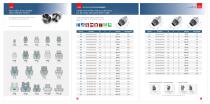
Part codes for available HSK CONNECTIONS* To configure your toolholder you need to choose one of the following connections first. Collet chucks RH without collet nut for ER collet DIN 6499/DIN 15488 Thanks to its setting versatility, the collet chuck is the most popular solution for milling operations at high speed. *See page 69 for the complete list of DIN manufacturing rules. AC03 collet chuck without mini nut RH ER 16 22 30 collet chuck without nut RH AC04 collet chuck without mini nut RH ER 16 22 40 collet chuck without nut RH AC05 collet chuck without mini nut RH ER...
Open the catalog to page 7
Part codes for available HSK CONNECTIONS* To configure your toolholder you need to choose one of the following connections first. Collet chucks LH without collet nut for ER collet DIN 6499/DIN 15488 Thanks to its setting versatility, the collet chuck is the most popular solution for milling operations at high speed. *See page 69 for the complete list of DIN manufacturing rules. AD03 collet chuck without mini nut LH ER 16 22 30 collet chuck without nut LH AD04 collet chuck without mini nut LH ER 16 22 40 collet chuck without nut LH AD05 collet chuck without mini nut LH ER...
Open the catalog to page 8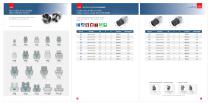
Part codes for available HSK CONNECTIONS* To configure your toolholder you need to choose one of the following connections first. HSK HSK TOOL HOLDERS DIN 69893 Collet chucks RH/LH with collet nut for collet EOC DIN 6388 Thanks to its setting versatility, the collet chuck is the most popular solution for milling operations at high speed. *See page 69 for the complete list of DIN manufacturing rules. AE00 collet chuckwith nut RH EOC 10 30 50 HSK 40 A-E 24.000 AE01 collet chuckwith nut RH EOC 12 35 50 HSK 50 A-E-F 24.000 AE02 collet chuckwith nut RH EOC...
Open the catalog to page 9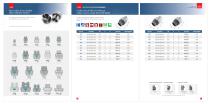
Part codes for available HSK CONNECTIONS* To configure your toolholder you need to choose one of the following connections first. Collet chucks RH/LH without collet nut for collet EOC DIN 6388 Thanks to its setting versatility, the collet chuck is the most popular solution for milling operations at high speed. *See page 69 for the complete list of DIN manufacturing rules. AG00 collet chuck without nut RH EOC 10 30 41 Part code collet chuck without nut LH AG01 collet chuck without nut RH EOC 12 35 40,5 collet chuck without nut LH AG02 collet chuck without nut RH EOC 16 43 39...
Open the catalog to page 10
Part codes for available HSK CONNECTIONS* To configure your toolholder you need to choose one of the following connections first. End Mill Holders are affordable, quick to install, and easy to use. An optimal choice for quality and price for lower speed operations. *See page 69 for the complete list of DIN manufacturing rules. Part code Part code MANUFACTURING MATERIAL
Open the catalog to page 11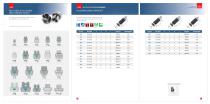
Part codes for available HSK CONNECTIONS* To configure your toolholder you need to choose one of the following connections first. *See page 69 for the complete list of DIN manufacturing rules. Traditional locking system for metalworking mills, the tool is held in place with spacer rings, closing washer and screw.
Open the catalog to page 12
Part codes for available HSK CONNECTIONS* To configure your toolholder you need to choose one of the following connections first. *See page 69 for the complete list of DIN manufacturing rules. The modular tool holders are used in assembly with sharpening mills and drills with a threaded connection. Htt page 163 page 223 Part code Description modular tool holder 8,5 M8 modular tool holder modular tool holder 8,5 M8 126 100 modular tool holder 10,5 M10 modular tool holder 10,5 M10 126 100 modular tool holder 10,5 M10 159 133 modular tool holder 12,5 M12...
Open the catalog to page 13All IMS catalogs and technical brochures
 TOOL HOLDERS CATALOGUE MARBLE-GLASS
100 Pages
