- Catalogs
- Imagine Optic
- Temporal stabilization module inside MicAO 3DSR - Adaptive optics for microscopy Application Notes

Temporal stabilization module inside MicAO 3DSR - Adaptive optics for microscopy Application Notes
Temporal stabilization module inside MicAO 3DSR - Adaptive optics for microscopy Application Notes
The document discusses the impact of ambient temperature variations on the shape and wavefront generated by thin reflective membrane deformable mirrors, particularly in open-loop mode. It highlights the importance of maintaining a constant mirror shape for high-precision applications like single molecule localization microscopy (SMLM).
MicAO 3DSR Device
The MicAO 3DSR is an adaptive optics device designed to optimize the point spread function (PSF) by correcting aberrations in optical systems, primarily used in 3D SMLM techniques such as PALM/STORM. It operates in an open-loop mode, which is suitable for fixed samples where continuous wavefront monitoring is unnecessary.
Challenges with Temperature Variations
Temperature changes can affect the deformable mirror's shape, leading to aberrations like astigmatism. The document provides examples of how temperature variations impact the PSF and wavefront, emphasizing the need for stability over long imaging periods.
Stabilization Module
The stabilization module within the MicAO 3DSR provides athermalization, significantly enhancing temporal stability. This module reduces wavefront variation by more than ten times, maintaining PSF consistency despite ambient temperature changes.
Experimental Results
Figures in the document illustrate the effects of temperature on wavefront and PSF, showing that the stabilization module effectively minimizes these effects. Over 12 hours, the wavefront change was less than 5 nm RMS, demonstrating the module's efficacy.
Conclusions
The stabilization module allows the deformable mirror to maintain its shape and optimize the PSF for extended periods, enhancing the MicAO 3DSR's usability for long-term imaging. It simplifies device operation by reducing the need for strict temperature control in the laboratory.
References
The document cites several studies and guides related to adaptive optics and microscopy techniques, providing a foundation for the discussed improvements.
Catalog excerpts

Temporal stabilization module inside MicAO 3DSR Audrius JASAITIS, Cynthia VEILLY and Fabrice HARMS Imagine Optic, 18 rue Charles de Gaulle, 91400 Orsay, France [email protected] Summary It is well known that the shape of thin reflective membrane deformable mirrors, and, eventually, their generated wavefront depends on the variation of the ambient temperature in the laboratory. This is not problematic when the deformable mirror is operated in a closed-loop mode because its shape is constantly adjusted using the information from the wavefront measurement. But the variation of surrounding temperature becomes much more important when the deformable mirror is operated in an open-loop mode, especially when the shape has to be kept constant to a very high precision for over 1 hour, as it is sometimes the case in single molecule localization microscopy techniques. Here we present the characterization of a modified Mirao 52e deformable mirror including athermalization for optimal temporal stability regarding temperature variations. Even when the ambient temperature in the room changed by more than four degrees, the shape generated by the modified Mirao 52e deformable mirror did not cause any visible changes of astigmatism in the PSF (less than 10nm RMS total wavefront change). The stabilization module greatly improved the temporal stability of Mirao 52e deformable mirror, thus greatly simplifying super-resolution imaging routine performed with a MicAO 3DSR adaptive optics device. MicAO 3DSR stabilization module Technical note www.imagine-optic.com 24 January 2019 – Property of Imagine Optic
Open the catalog to page 1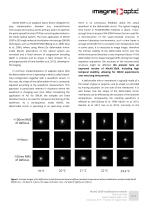
MicAO 3DSR is an adaptive optics device designed for easy there is no continuous feedback about the actual wavefront to the deformable mirror. The typical imaging microscope and camera and its primary task is to optimize time frame in PALM/STORM methods is about 1 hour, the point spread function (PSF) by correcting aberrations in enough time to acquire 50k-300k frames that are used for the whole optical system. The main application of MicAO a reconstruction of the super-resolved structure. In 3DSR is 3D single molecule localization microscopy (SMLM) common laboratory environments, such a time...
Open the catalog to page 2
market there is a variety of available deformable mirrors, which are using very different architectures and therefore they may be affected differently by the ambient temperature variation. Temperature variation can cause changes in focus, appearance of astigmatism, spherical aberration or coma. In the case of Mirao 52e deformable mirror, the main aberration which appears with temperature change is astigmatism. Depending on the way the membrane is assembled, the orientation of astigmatism is different and it is a generally a superposition of both astigmatism at 0° and astigmatism at 45°. In Figure...
Open the catalog to page 3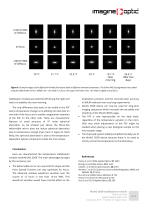
Figure 4. Example images of the diffraction-limited fluorescent bead at different ambient temperature. The 60nm RMS of astigmatism was added using the deformable mirror. Middle row – the bead is in focus, the upper and lower rows - the bead is slightly out of focus. stabilization module was switched off during the night and localization precision and the reconstruction accuracy had to re-stabilize the next morning. The only difference that starts to be visible in the PSF in SMLM methods over very long experiments. • imaging sequences which increases the versatility and due to temperature change...
Open the catalog to page 4All Imagine Optic catalogs and technical brochures
 WAVE Suite
3 Pages







Archived catalogs
 HASO™3 Wavefront Sensors
3 Pages
 SL-Sys neo
2 Pages
 SL-Sys LIQUID
2 Pages
 HASO R-Flex
3 Pages
 HASO?3 WSR Wavefront Sensors
2 Pages
 bendAO?
3 Pages
 HASO3
HASO32 Pages
 HASO R.FLEX
4 Pages
 absolute measurement
4 Pages
 Telescope characterization
3 Pages
 NIR optics characterization
6 Pages
 Large deformable mirror ILAO
6 Pages
 AO in femtosecond laser
5 Pages
 AO inside laser chain
5 Pages
 Microtraps
4 Pages